
Accueil>>Natural Products>>Pectolinarigenin

Pectolinarigenin

Catalog No.GN10183

Pectolinarigenin, un composé flavonoïde, peut être isolée des parties aériennes de C.

Products are for research use only. Not for human use. We do not sell to patients.
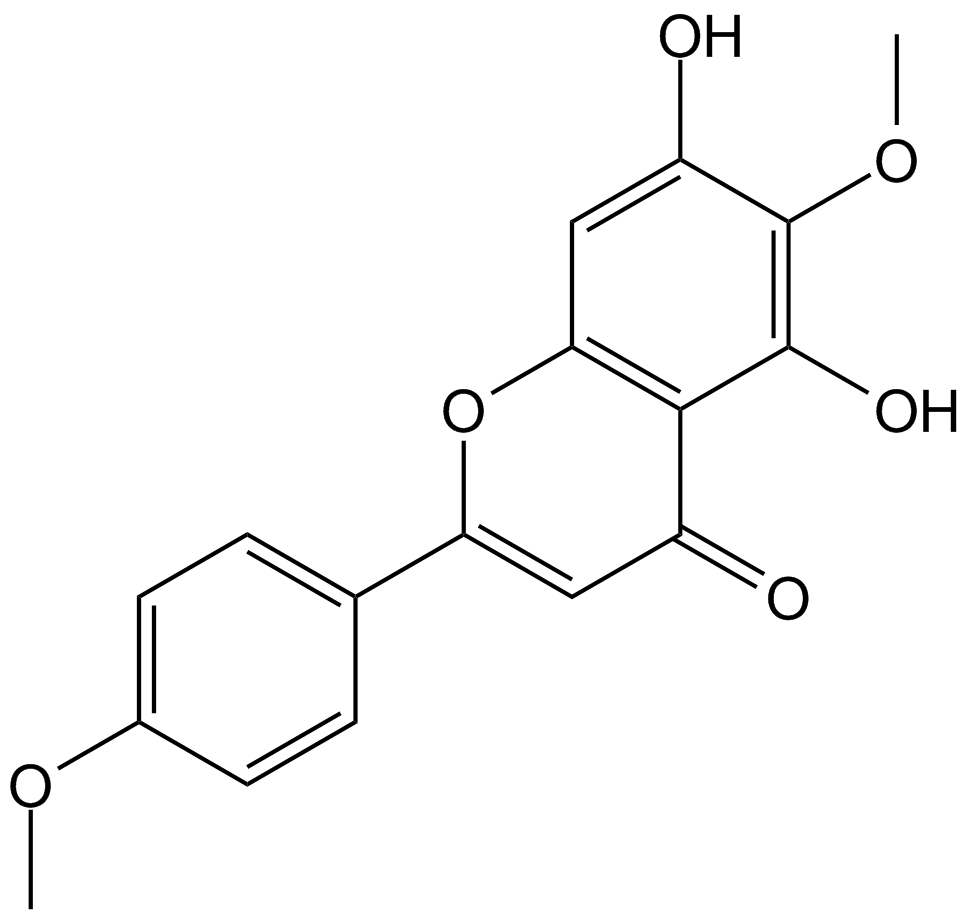
Pectolinarigenin Chemical Structure

Cas No.: 520-12-7

Taille Prix Stock Qté
5mg
90,00 $US
En stock
10mg
150,00 $US
En stock
20mg
279,00 $US
En stock

Tel:(909) 407-4943 Email: sales@glpbio.com


Avis des clients

Based on customer reviews.

Sample solution is provided at 25 µL, 10mM.

Description of Pectolinarigenin

Pectolinarigenin, un composé flavonoïde, peut être isolée des parties aériennes de C. chanroenicum, présente des activités biologiques telles que des effets anti-inflammatoires et anti-allergiques [1]. Elle a également démontré une inhibition de la croissance tumorale in vitro, notamment contre le cancer du poumon, le cancer du sein et l'adénocarcinome colorectal [2].

In vitro, la pectolinarigénine a significativement inhibé la croissance des cellules cancéreuses du foie SK-HEP-1, avec une IC50 de 10 µM, tandis que ses effets cytotoxiques sur les cellules normales étaient beaucoup moins prononcés [3]. Une expérience in vitro a montré qu'à une concentration de 10 µM, la pectolinarigénine inhibait de manière évidente l'accumulation de ROS après 24 heures de traitement dans les cellules HepG2 et augmentait également l'expression des protéines NQO-1 et AKR1B10 [4]. À une concentration de 30 µM, la pectolinarigénine a supprimé la biosynthèse de la mélanine sans provoquer de cytotoxicité dans les cellules melan-a [5]. Elle a également réduit la teneur en lipides in vitro [6]. Un traitement de 40 µM de pectolinarigénine dans les cellules A375 et B16 a entraîné une augmentation respective de plus de 6 fois et 10 fois du taux d'apoptose par rapport aux groupes témoins non traités [7].

In vivo, un traitement de 10 mg/kg de pectolinarigénine chez la souris a activé la voie Nrf2/ARE et induit l'expression d'enzymes antioxydantes de manière similaire aux résultats obtenus dans les cellules HepG2 [4]. Un test d'efficacité in vivo a démontré qu'une administration intrapéritonéale de pectolinarigénine (20 mg/kg tous les 2 jours et 50 mg/kg tous les 2 jours) bloquait l'activation de STAT3 et perturbait la croissance tumorale et la métastase avec de bonnes propriétés pharmacodynamiques [8]. Un autre test in vivo a révélé qu'une administration orale de 25 mg/kg/jour pendant 7 ou 14 jours permettait d'améliorer efficacement les lésions rénales et la fibrose tubulo-interstitielle après une intervention chirurgicale d'obstruction unilatérale de l'uretère (UUO) [9].

References:
[1] H. Lim, et al. Anti-inflammatory activity of pectolinarigenin and pectolinarin isolated from Cirsium chanroenicum Biol. Pharm. Bull., 31 (2008), pp. 2063-2067.
[2] M. Bonesi, et al. In vitro biological evaluation of novel 7-O dialkylaminoalkyl cytotoxic pectolinarigenin derivatives against a panel of human cancer cell lines Bioorg. Med. Chem. Lett., 18 (2008), pp. 5431-5434.
[3] Liu S, et al. Pectolinarigenin flavonoid exhibits selective anti-proliferative activity in cisplatin-resistant hepatocellular carcinoma, autophagy activation, inhibiting cell migration and invasion, G2/M phase cell cycle arrest and targeting ERK1/2 MAP kinases. J BUON. 2020 Jan-Feb;25(1):415-420.
[4] Shiraiwa M, et al. Pectolinarigenin Induces Antioxidant Enzymes through Nrf2/ARE Pathway in HepG2 Cells. Antioxidants (Basel). 2022 Mar 30;11(4):675.
[5] Lee S, et al. Pectolinarigenin, an aglycone of pectolinarin, has more potent inhibitory activities on melanogenesis than pectolinarin. Biochem Biophys Res Commun. 2017;493:765-772.
[6] Zhang Y, Wan C, Song Z, Meng W, Wang S, Lan Z. Pectolinarigenin reduces the expression of sterol regulatory element-binding proteins and cellular lipid levels. Biosci Biotechnol Biochem. 2022 Aug 24;86(9):1220-1230.
[7] Deng Y, et al. Pectolinarigenin inhibits cell viability, migration and invasion and induces apoptosis via a ROS-mitochondrial apoptotic pathway in melanoma cells. Oncol Lett. 2020 Oct;20(4):116.
[8] Zhang T, et al. Pectolinarigenin acts as a potential anti-osteosarcoma agent via mediating SHP-1/JAK2/STAT3 signaling. Biomed Pharmacother. 2022 Sep;153:113323.
[9] Li Y, et al. Natural flavonoid pectolinarigenin alleviated kidney fibrosis via inhibiting the activation of TGFβ/SMAD3 and JAK2/STAT3 signaling. Int Immunopharmacol. 2021 Feb;91:107279.

Protocol of Pectolinarigenin

Expériences cellulaires [1]:

Lignées cellulaires

Cellules d'ostéosarcome.

Méthode de préparation

Les cellules d'ostéosarcome ont été ensemencées dans des plaques de 6 puits et traitées avec ou sans 10 µM de pectolinarigénine pendant une semaine. Les colonies ont ensuite été fixées et colorées avec du violet de cristal à 0,1 %. Les images ont été prises à l'aide d'un microscope inversé. Le nombre de colonies a été compté manuellement.

Conditions de réaction

10 µM ; pendant une semaine.

Domaines d'application

Le traitement à la pectolinarigénine a entraîné une diminution marquée du nombre de colonies de cellules tumorales. De plus, la pectolinarigénine a également montré une propension pro-apoptotique.
Expériences animales [2]:

Modèles animaux

Souris mâles C57BL/6J (âgées de 8 à 10 semaines ; 20-25 g).

Méthode de préparation

Quarante souris ont été réparties aléatoirement en cinq groupes : Contrôle (n = 8), HN (n = 8), Allopurinol (n = 8), PEC (Pectolinarigénine) 25 mg/kg (n = 8), PEC 50 mg/kg (n = 8). Le modèle HN a été établi en nourrissant les souris avec un mélange d'adénine (0,16 g/kg) et d'oxonate de potassium (2,4 g/kg) tous les deux jours pendant 4 semaines, comme décrit précédemment (Ren et al., 2021). L'allopurinol (10 mg/kg) et la PEC (25 et 50 mg/kg) ont été administrés par voie orale quotidiennement pendant toute la durée de l'expérience, parallèlement à l'établissement du modèle HN (pendant 4 semaines).

Forme de dosage

25 et 50 mg/kg ; p.o. (par voie orale).

Domaines d'application

Après traitement avec l'allopurinol et la PEC, les niveaux sériques d'acide urique (UA), d'azote uréique et de créatinine ont significativement diminué. La PEC à une dose de 25 mg/kg semble plus efficace pour réduire les indices ci-dessus que la PEC à une dose plus élevée (50 mg/kg).

Références :

[1] Zhang T, et al. Pectolinarigenin acts as a potential anti-osteosarcoma agent via mediating SHP-1/JAK2/STAT3 signaling. Biomed Pharmacother. 2022 Sep;153:113323.

[2] Ren Q, et al. Natural Flavonoid Pectolinarigenin Alleviated Hyperuricemic Nephropathy via Suppressing TGFβ/SMAD3 and JAK2/STAT3 Signaling Pathways. Front Pharmacol. 2022 Jan 27;12:792139.

Chemical Properties of Pectolinarigenin

Cas No. 520-12-7 SDF
Chemical Name 5,7-dihydroxy-6-methoxy-2-(4-methoxyphenyl)chromen-4-one
Canonical SMILES COC1=CC=C(C=C1)C2=CC(=O)C3=C(C(=C(C=C3O2)O)OC)O
Formula C17H14O6 M.Wt 314.29
Solubility ≥ 31.4mg/mL in DMSO Storage 4°C, protect from light
General tips Please select the appropriate solvent to prepare the stock solution according to the solubility of the product in different solvents; once the solution is prepared, please store it in separate packages to avoid product failure caused by repeated freezing and thawing.Storage method and period of the stock solution: When stored at -80°C, please use it within 6 months; when stored at -20°C, please use it within 1 month.
To increase solubility, heat the tube to 37°C and then oscillate in an ultrasonic bath for some time.
Shipping Condition Evaluation sample solution: shipped with blue ice. All other sizes available: with RT, or with Blue Ice upon request.

Complete Stock Solution Preparation Table of Pectolinarigenin

Prepare stock solution
1 mg 5 mg 10 mg
1 mM 3.1818 mL 15.9089 mL 31.8177 mL
5 mM 636.4 μL 3.1818 mL 6.3635 mL
10 mM 318.2 μL 1.5909 mL 3.1818 mL
  • Molarity Calculator

  • Dilution Calculator

  • Molecular Weight Calculator

Mass
=
Concentration
x
Volume
x
MW*


**When preparing stock solutions always use the batch-specific molecular weight of the product found on the vial label and MSDS / CoA (available online).

Calculate

In vivo Formulation Calculator (Clear solution) of Pectolinarigenin

Step 1: Enter information below (Recommended: An additional animal making an allowance for loss during the experiment)

mg/kg g μL

Step 2: Enter the in vivo formulation (This is only the calculator, not formulation. Please contact us first if there is no in vivo formulation at the solubility Section.)

% DMSO % % Tween 80 % ddH2O
%DMSO %

Calculation results:

Working concentration: mg/ml;

Method for preparing DMSO master liquid: mg drug pre-dissolved in μL DMSO ( Master liquid concentration mg/mL, Please contact us first if the concentration exceeds the DMSO solubility of the batch of drug. )

Method for preparing in vivo formulation: Take μL DMSO master liquid, next addμL PEG300, mix and clarify, next addμL Tween 80, mix and clarify, next add μL ddH2O, mix and clarify.

Method for preparing in vivo formulation: Take μL DMSO master liquid, next add μL Corn oil, mix and clarify.

Note: 1. Please make sure the liquid is clear before adding the next solvent.
2. Be sure to add the solvent(s) in order. You must ensure that the solution obtained, in the previous addition, is a clear solution before proceeding to add the next solvent. Physical methods such as vortex, ultrasound or hot water bath can be used to aid dissolving.
3. All of the above co-solvents are available for purchase on the GlpBio website.

Product Documents

Quality Control & SDS

View current batch:

Avis

Review for Pectolinarigenin

Average Rating: 5 ★★★★★ (Based on Reviews and 30 reference(s) in Google Scholar.)

5 Star
100%
4 Star
0%
3 Star
0%
2 Star
0%
1 Star
0%
Review for Pectolinarigenin

GLPBIO products are for RESEARCH USE ONLY. Please make sure your review or question is research based.

Required fields are marked with *

You may receive emails regarding this submission. Any emails will include the ability to opt-out of future communications.