

PNU-120596 (Synonyms: NSC 216666) |
Catalog No.GC11643
 One-Click Copy Product Info
|

PNU-120596 est un modulateur allostérique positif du récepteur neuronal nicotinique de l'acétylcholine de type α7 (α7nAChR), sa valeur d'EC50 est 216nM.
Products are for research use only. Not for human use. We do not sell to patients.
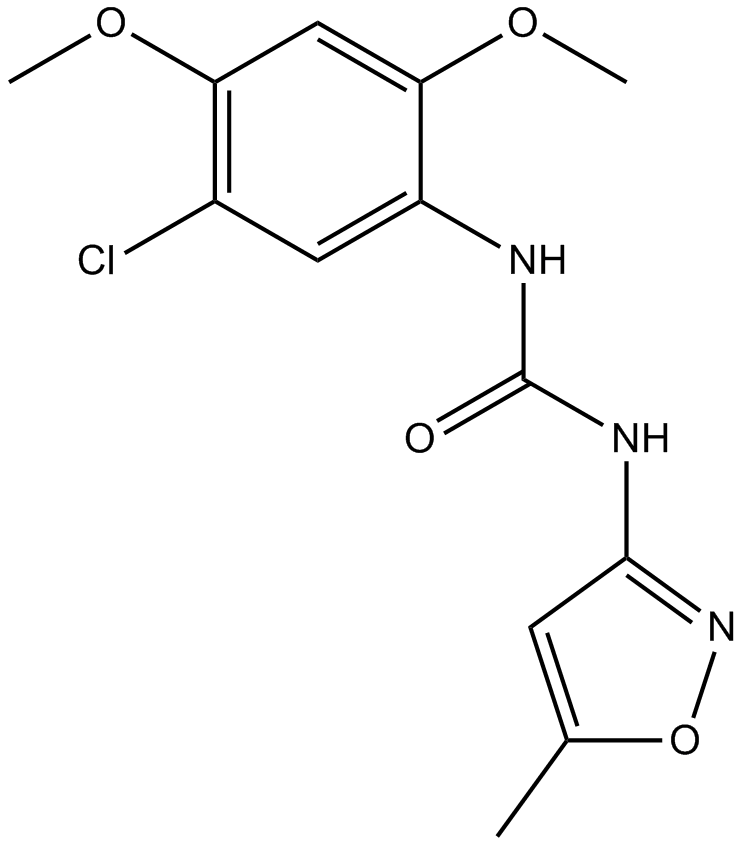
Cas No.: 501925-31-1
Sample solution is provided at 25 µL, 10mM.
_1-3.$$$39978408@51.jpg');)
_1-9.$$$38538795@65.jpg');)
_1-9.$$$39112701@51.jpg');)
_1-7.$$$37316672@70.jpg');)
_366-372.$$$36198801@70.jpg');)
.$$$38565142@65.jpg');)
_1867-1883.$$$33248023@67.jpg');)
_eads6055.$$$39977546@45.jpg');)
_eadm9805.$$$40080571@45.jpg');)
_eadj3020.$$$39666821@45.jpg');)
_1-20.$$$39757301@28.jpg');)
_1-24.$$$38898113@28.jpg');)
_273-287.$$$36806353@46.jpg');)
_1-16.$$$37156877@44.jpg');)
_1-19.$$$37460805@44.jpg');)
_1291-1307.$$$34518654@46.jpg');)
PNU-120596 est un modulateur allostérique positif du récepteur neuronal nicotinique de l'acétylcholine de type α7 (α7nAChR), sa valeur d'EC50 est 216nM[1]. α7nAChR est un canal ionique ligand-fermé. L'activation de α7nAChR peut affecter une série de processus physiologique cellulaires, comme l'influx de calcium, la libération de neurotransmetteurs, la plasticité synaptique et la transmission excitatrice, et peut également induire l'inflammation, l'autophagie, la nécrose, la transcription et l'apoptose[2]. PNU-120596 peut être utilisé pour rechercher les maladies neurologiques[3]. En présence de PNU-120596 et éventuellement d'autres modulateurs allostériques positifs, la choline endogène peut activer de manière continue les neurones pyramidaux CA1 via α7nAChR et améliorer l'excitabilité de ces neurones[4].
In vivo, PNU-120596 (3mg/kg) qui a été injecté par voie intra-péritonéale dans les rats atteints de la maladie de Parkinson (PD) 6-OHDA-induite pendant 14 jours a amélioré la dysfonction motrice, inhibé la neuro-inflammation, réduit l'expression de JAK2/NF-κB/GSk3β, et promu la régénération des neurones dopaminergiques dans la substance noire et le striatum[5]. PNU-120596 (1mg/kg) a été injecté par voie intraveineuse chez les rats atteints de lésion d'ischémie-reperfusion myocardique (MIRI), ce qui a significativement réduit la zone d'infarctus myocardique, les lésions ultrastructuraux, la production sérique de créatine kinase et de déshydrogénase lactique, la production dde cytokines pro-inflammatoires sériques, l'activation endothéliale myocardique et l'infiltration des neurophiles[6]. PNU-120596 (4mg/kg) a été injecté par voie intra-péritonéale dans les rats déprimés LPS-induits, ce qui a réduit l'expression de l'acide 3-hydroxyanthranilique dioxygénase (HAAO) dans l'hippocampe et le cortex préfrontal et la formation d'acide quinolinique microglial (QUIN)[7].
References:
[1] Uwada J, Nakazawa H, Mikami D, et al. PNU-120596, a positive allosteric modulator of α7 nicotinic acetylcholine receptor, directly inhibits p38 MAPK[J]. Biochemical pharmacology, 2020, 182: 114297.
[2] Xu Z Q, Zhang W J, Su D F, et al. Cellular responses and functions of α7 nicotinic acetylcholine receptor activation in the brain: A narrative review[J]. Annals of translational medicine, 2021, 9(6).
[3] Sun F, Jin K, Uteshev V V. A type-II positive allosteric modulator of α7 nAChRs reduces brain injury and improves neurological function after focal cerebral ischemia in rats[J]. PloS one, 2013, 8(8): e73581.
[4] Kalappa B I, Gusev A G, Uteshev V V. Activation of functional α7-containing nAChRs in hippocampal CA1 pyramidal neurons by physiological levels of choline in the presence of PNU-120596[J]. PloS one, 2010, 5(11): e13964.
[5] Gowayed M A, El-Sayed N S, Matar N A, et al. The α7 nAChR allosteric modulator PNU-120596 amends neuroinflammatory and motor consequences of parkinsonism in rats: role of JAK2/NF-κB/GSk3β/TNF-α pathway[J]. Biomedicine & Pharmacotherapy, 2022, 148: 112776.
[6] Li H, Zhang Z Z, Zhan J, et al. Protective Effect of PNU-120596, a Selective Alpha7 Nicotinic Acetylcholine Receptor–positive Allosteric Modulator, on Myocardial Ischemia–reperfusion Injury in Rats[J]. Journal of Cardiovascular Pharmacology, 2012, 59(6): 507-513.
[7] Alzarea S, Abbas M, Ronan P J, et al. The effect of an α-7 nicotinic allosteric modulator PNU120596 and NMDA receptor antagonist memantine on depressive-like behavior induced by LPS in mice: the involvement of brain microglia[J]. Brain Sciences, 2022, 12(11): 1493.
| Expériences animales [1]: | |
Modèles animaux | Rats atteints de la maladie de Parkinson (PD) |
Méthode de préparation | Les rats ont été aléatoirement divisés en six groupes : SH : rats qui sont administrés simulément par la saline. Les rats qui sont administrés par 6-OHDA ont été subdivisés en 5 groupes supplémentaires : (1) OH: administré par véhicule, (2) LD: administré par une sonde orale de lévodopa/carbidopa (10/1mg/kg), (3) PNU: administré par voie intra-péritonéale avec PNU-120596 (3mg/kg), (4) MLA: administré par la méthyllycaconitine citrate (3mg/kg), (5) PNU-120596+MLA: administré par la méthyllycaconitine citrate et PNU-120596, par voie intra-péritonéale. MLA a été administré 30 minutes avant PNU-120596. Levodopa/carbidopa et PNU-120596 ont été dissous dans une solution de 5%DMSO/5% Kolliphor HS 15/90% saline. Les médicaments ont été administrés quotidiennement pendant 14 jours; ensuite, les rats ont été décapités, les cerveaux ont été excisés, les striata gauches ont été disséqués, conservés à -80°C et utilisés pour les analyses neurochimiques. |
Forme de dosage | 3mg/kg; 14 days; i.p. |
Domaines d'application | PNU-120596 a amélioré les dysfonctions motrices chez les rats atteints de PD induite par 6-OHDA. PNU-120596 a enrayé la neuro-inflammation, manifestés par une diminution de l'expression de JAK2/NF-κB/GSk3β. Les neurones dopaminergiques nigrostriataux ont été restaurés suite au traitement avec PNU-120596. |
References: | |
| Cas No. | 501925-31-1 | SDF | |
| Synonymes | NSC 216666 | ||
| Chemical Name | 1-(5-chloro-2,4-dimethoxyphenyl)-3-(5-methyl-1,2-oxazol-3-yl)urea | ||
| Canonical SMILES | CC1=CC(=NO1)NC(=O)NC2=CC(=C(C=C2OC)OC)Cl | ||
| Formula | C13H14ClN3O4 | M.Wt | 311.73 |
| Solubility | ≥ 31.2mg/mL in DMSO | Storage | Store at -20°C |
| General tips | Please select the appropriate solvent to prepare the stock solution according to the
solubility of the product in different solvents; once the solution is prepared, please store it in
separate packages to avoid product failure caused by repeated freezing and thawing.Storage method
and period of the stock solution: When stored at -80°C, please use it within 6 months; when stored
at -20°C, please use it within 1 month. To increase solubility, heat the tube to 37°C and then oscillate in an ultrasonic bath for some time. |
||
| Shipping Condition | Evaluation sample solution: shipped with blue ice. All other sizes available: with RT, or with Blue Ice upon request. | ||
| Prepare stock solution | |||

|
1 mg | 5 mg | 10 mg |
| 1 mM | 3.2079 mL | 16.0395 mL | 32.079 mL |
| 5 mM | 641.6 μL | 3.2079 mL | 6.4158 mL |
| 10 mM | 320.8 μL | 1.604 mL | 3.2079 mL |
Step 1: Enter information below (Recommended: An additional animal making an allowance for loss during the experiment)
 g
μL
g
μL
Step 2: Enter the in vivo formulation (This is only the calculator, not formulation. Please contact us first if there is no in vivo formulation at the solubility Section.)
Calculation results:
Working concentration: mg/ml;
Method for preparing DMSO master liquid: mg drug pre-dissolved in μL DMSO ( Master liquid concentration mg/mL, Please contact us first if the concentration exceeds the DMSO solubility of the batch of drug. )
Method for preparing in vivo formulation: Take μL DMSO master liquid, next addμL PEG300, mix and clarify, next addμL Tween 80, mix and clarify, next add μL saline, mix and clarify.
Method for preparing in vivo formulation: Take μL DMSO master liquid, next add μL Corn oil, mix and clarify.
Note: 1. Please make sure the liquid is clear before adding the next solvent.
2. Be sure to add the solvent(s) in order. You must ensure that the solution obtained, in the previous addition, is a clear solution before proceeding to add the next solvent. Physical methods such as vortex, ultrasound or hot water bath can be used to aid dissolving.
3. All of the above co-solvents are available for purchase on the GlpBio website.
Quality Control & SDS
- View current batch:
- Purity: >98.00% Appearance: A solid
- COA (Certificate of Analysis)
- SDS (Safety Data Sheet)
- Datasheet
Average Rating: 5 (Based on Reviews and 8 reference(s) in Google Scholar.)