

R243 |
Catalog No.GC62724
 One-Click Copy Product Info
|

R243 est un inhibiteur du récepteur CCR8 qui supprime les voie de signalisation déclenchées par CCL1, le ligand endogène du CCR8.
Products are for research use only. Not for human use. We do not sell to patients.
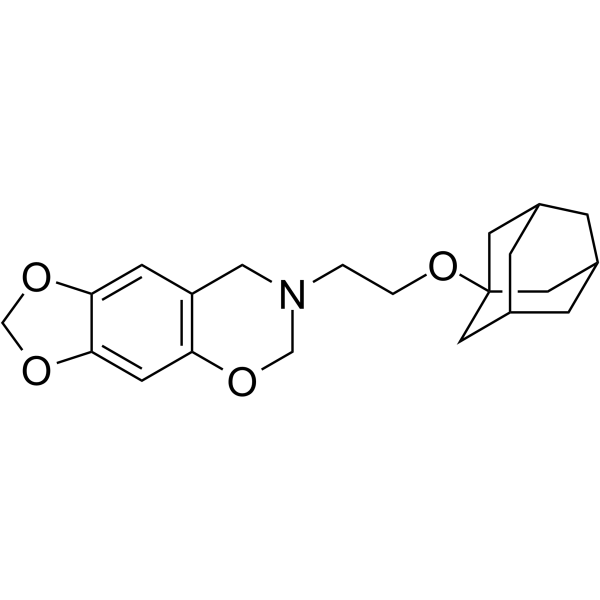
Cas No.: 688352-84-3
Sample solution is provided at 25 µL, 10mM.
_1-3.$$$39978408@51.jpg');)
_1-9.$$$38538795@65.jpg');)
_1-9.$$$39112701@51.jpg');)
_1-7.$$$37316672@70.jpg');)
_366-372.$$$36198801@70.jpg');)
.$$$38565142@65.jpg');)
_1867-1883.$$$33248023@67.jpg');)
_eads6055.$$$39977546@45.jpg');)
_eadm9805.$$$40080571@45.jpg');)
_eadj3020.$$$39666821@45.jpg');)
_1-20.$$$39757301@28.jpg');)
_1-24.$$$38898113@28.jpg');)
_273-287.$$$36806353@46.jpg');)
_1-16.$$$37156877@44.jpg');)
_1-19.$$$37460805@44.jpg');)
_1291-1307.$$$34518654@46.jpg');)
R243 est un inhibiteur du récepteur CCR8 qui supprime les voie de signalisation déclenchées par CCL1, le ligand endogène du CCR8[1-2]. R243 est principalement utilisé dans la recherche liée aux maladies immunitaires et inflammatoires[3].
In vitro, le traitement de macrophages murin RAW264.7 et de macrophages dérivés de la moelle osseuse (BMDM) avec R243 (10µM) pendant 24 heures a significativement inhibé la migration chimiotactique induite par CCL1 dans un test de migration en chambre de Boyden (Transwell) sous induction de CCL1(10ng/mL), bien que l'effet inhibiteur sur la migration de monocytes hymains THP-1 n'ait pas été significatif [4]. Lorsque des macrophages péritonéaux murin (PMφ) stimulé par LPS (100ng/mL) ont été traités avec R243 (0–10µM) pendant 24 heures, R243 a significativement supprimé la sécrétion de TNF-α, d'IL-6 et d' IL-10, et a réduit les niveaux de phosphorylation des voies de signalisation JNK et NF-κB [5].
In vivo, dans un modèle murin de fibrose péritonéale, R243 (1.0mg/kg; administré par injection intrapéritonéale trois fois par semaine pendant 28 jours) a significativement atténué l'inflammation et la fibrose péritonéale induite par le gluconate de chlorhexidine en inhibant fonctionnellement le récepteur CCR8. Cela s'est traduit par une réduction de l'épaisseur péritonéale, une diminution du dépôt de collagène et une infiltration macrophage réduite[6]. Dans un modèle de test d'hyperalgésie thermique, R243 (0.3–1mg/kg; administré par injection intrapéritonéale 30 minutes avant CCL1) a inhibé de manière dose-dépendante l'analgésie thermique systémique induite par CCL1 (10µg/kg)[7].
References:
[1] Berenguer J, Lagerweij T, Zhao XW, et al. Glycosylated extracellular vesicles released by glioblastoma cells are decorated by CCL18 allowing for cellular uptake via chemokine receptor CCR8. J Extracell Vesicles. 2018 Mar 13;7(1):1446660.
[2] García-Domínguez M, González-Rodríguez S, Hidalgo A, et al. Kappa-opioid receptor-mediated thermal analgesia evoked by the intrathecal administration of the chemokine CCL1 in mice. Fundam Clin Pharmacol. 2021 Dec;35(6):1109-1118.
[3] Ding H, Xu X, Zhu Y, et al. Inhibition of Alkbh5 Attenuates Lipopolysaccharide-Induced Lung Injury by Promoting Ccl1 m6A and Treg Recruitment. Cell Prolif. 2025 Sep;58(9):e70032.
[4] Geervliet E, Arora S, Donohue D, et al. Design, molecular characterization and therapeutic investigation of a novel CCR8 peptide antagonist that attenuates acute liver injury by inhibiting infiltration and activation of macrophages. Acta Pharm Sin B. 2025 Apr;15(4):2114-2133.
[5] Oshio T, Kawashima R, Kawamura YI, et al. Chemokine receptor CCR8 is required for lipopolysaccharide-triggered cytokine production in mouse peritoneal macrophages. PLoS One. 2014 Apr 8;9(4):e94445.
[6] Lee Y, Lee J, Park M, et al. Inflammatory chemokine (C-C motif) ligand 8 inhibition ameliorates peritoneal fibrosis. FASEB J. 2023 Jan;37(1):e22632.
[7] García-Domínguez M, Aguirre A, Lastra A, et al. The Systemic Administration of the Chemokine CCL1 Evokes Thermal Analgesia in Mice Through the Activation of the Endocannabinoid System. Cell Mol Neurobiol. 2019 Nov;39(8):1115-1124.
| Expériences cellulaires [1]: | |
Lignées cellulaires | Macrophages RAW264.7 (lignée cellulaire leucémique monocytaire/macrophagique de souris), monocytes THP-1 (lignée cellulaire monocytaire humaine) et macrophages dérivés de la moelle osseuse (BMDM) provenant de souris C57BL/6. |
Méthode de préparation | Les cellules ont été maintenues dans du milieu RPMI 1640 supplémenté avec 10% de sérum foetal bovin (FBS), 2mM de L-glutamine et 1% de pénicilline/streptomycin à 37°C sous 5% de CO₂. Pour les tests de migration en chambre de Boyden (Transwell), les cellules ont été activées avec R243 (10μM), LPS (100ng/mL) et IFN-γ (10ng/mL), puis ensemencées dans les inserts Transwell . CCL1(10ng/mL) a été ajoutée dans les puits inférieus (chambres extérieures) des Transwell. Pour l'analyse de l'expression génique, les macrophages RAW264.7 ont été activés avec R243 (10μM), CCL1(10ng/mL), LPS (100ng/mL) et IFN-γ (10ng/mL). |
Conditions de réaction | 10μM; 24h |
Domaines d'application | R243 a significativement inhibé la chimiotaxie induite par CCL1 des macrophages murins RAW264.7 et BMDMs, mais pas celle des monocytes humains THP-1, dans les tests de migration en chambre de Boyden (Transwell). R243 a également significativement supprimé l'expression des gènes de marqueurs pro-inflammatoires (iNOS et IL-6) et CCR8 dans les macrophages RAW264.7 activés par LPS/IFN-γ. |
| Expériences animales [2]: | |
Modèles animaux | Souris C57BL/6 |
Méthode de préparation | La fibrose péritonéale (FP) a été induite chez la souris par injection intrapéritonéale quotidienne de 0.2mL d'une solution de gluconate de chlorhexidine (GC) (composée de 0.1% de CG et de 15% d'éthanol) pendant 4 semaines. Les souris ont été traitées avec R243 (1.0mg/kg) par injection intrapéritonéale trois fois par semaine, à partir du jour 0 et jusqu'au jour 28. Au jour 28, les souris ont été sacrifiées et les tissus péritonéaux ont été prélevés pour analyse. |
Forme de dosage | 1.0mg/kg; i.p. ; trois fois par semaine pendant 4 semaines |
Domaines d'application | Le traitement à R243 a significativement amélioré la fibrose péritonéale induite par le GC, comme en témoignent la réduction de l'épaissement péritonéale, la diminution du dépôt de collagène et l'atténuation de l'inflammation péritonéale. |
References: | |
| Cas No. | 688352-84-3 | SDF | |
| Formula | C21H27NO4 | M.Wt | 357.44 |
| Solubility | DMSO : 125 mg/mL (349.71 mM; Need ultrasonic) | Storage | Store at -20°C |
| General tips | Please select the appropriate solvent to prepare the stock solution according to the
solubility of the product in different solvents; once the solution is prepared, please store it in
separate packages to avoid product failure caused by repeated freezing and thawing.Storage method
and period of the stock solution: When stored at -80°C, please use it within 6 months; when stored
at -20°C, please use it within 1 month. To increase solubility, heat the tube to 37°C and then oscillate in an ultrasonic bath for some time. |
||
| Shipping Condition | Evaluation sample solution: shipped with blue ice. All other sizes available: with RT, or with Blue Ice upon request. | ||
| Prepare stock solution | |||

|
1 mg | 5 mg | 10 mg |
| 1 mM | 2.7977 mL | 13.9884 mL | 27.9767 mL |
| 5 mM | 559.5 μL | 2.7977 mL | 5.5953 mL |
| 10 mM | 279.8 μL | 1.3988 mL | 2.7977 mL |
Step 1: Enter information below (Recommended: An additional animal making an allowance for loss during the experiment)
 g
μL
g
μL
Step 2: Enter the in vivo formulation (This is only the calculator, not formulation. Please contact us first if there is no in vivo formulation at the solubility Section.)
Calculation results:
Working concentration: mg/ml;
Method for preparing DMSO master liquid: mg drug pre-dissolved in μL DMSO ( Master liquid concentration mg/mL, Please contact us first if the concentration exceeds the DMSO solubility of the batch of drug. )
Method for preparing in vivo formulation: Take μL DMSO master liquid, next addμL PEG300, mix and clarify, next addμL Tween 80, mix and clarify, next add μL saline, mix and clarify.
Method for preparing in vivo formulation: Take μL DMSO master liquid, next add μL Corn oil, mix and clarify.
Note: 1. Please make sure the liquid is clear before adding the next solvent.
2. Be sure to add the solvent(s) in order. You must ensure that the solution obtained, in the previous addition, is a clear solution before proceeding to add the next solvent. Physical methods such as vortex, ultrasound or hot water bath can be used to aid dissolving.
3. All of the above co-solvents are available for purchase on the GlpBio website.
Quality Control & SDS
- View current batch:
- Purity: >98.00% Appearance: A solid
- COA (Certificate of Analysis)
- SDS (Safety Data Sheet)
- Datasheet
Average Rating: 5 (Based on Reviews and 26 reference(s) in Google Scholar.)