

R428 (Synonyms: R-428;R 428;BGB324) |
Catalog No.GC17618
 One-Click Copy Product Info
|

R428, en tant qu'inhibiteur Axl, bloque l'autophosphorylation d'Axl sur son site de fixation C-terminal, R428, aux concentrations nanomolaires.
Products are for research use only. Not for human use. We do not sell to patients.
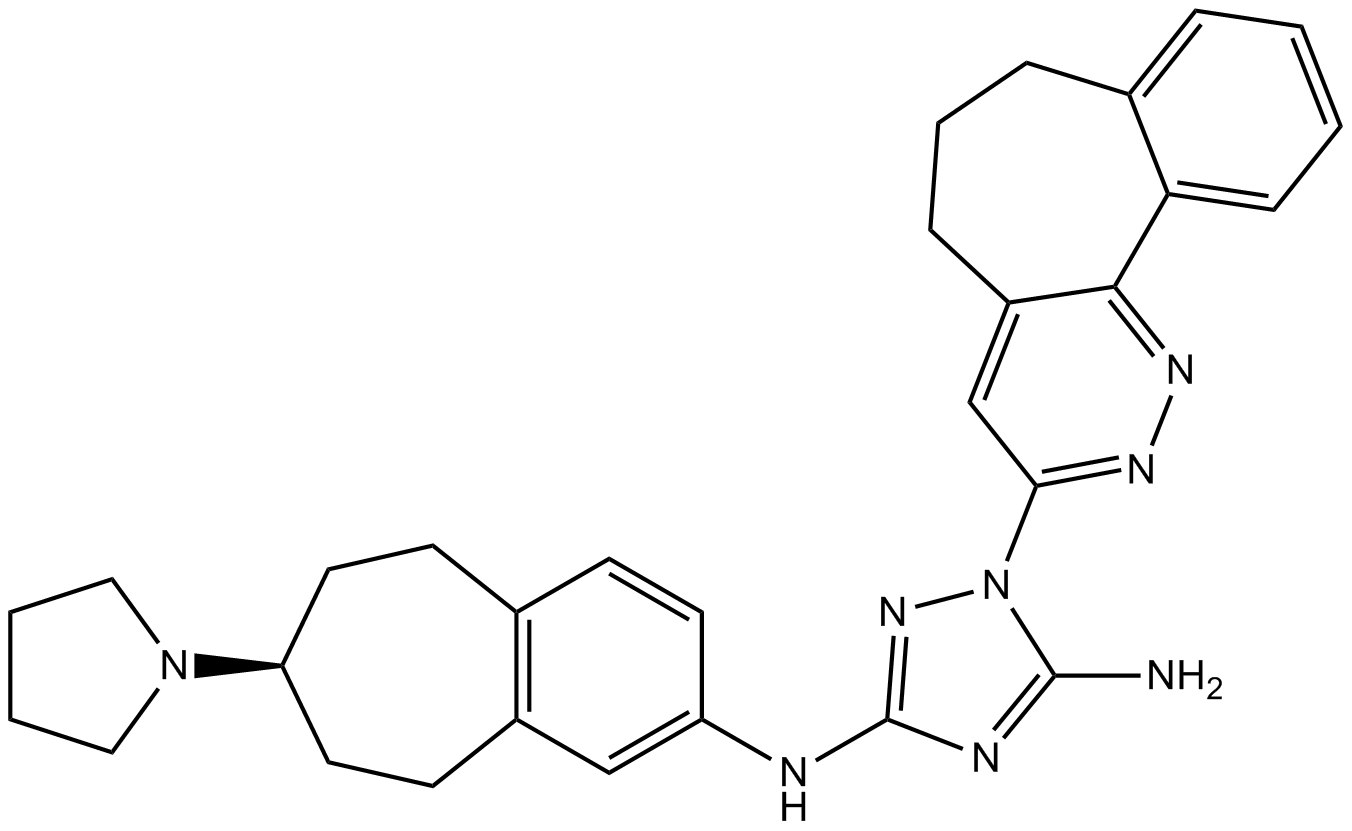
Cas No.: 1037624-75-1
Sample solution is provided at 25 µL, 10mM.
R428, en tant qu'inhibiteur Axl, bloque l'autophosphorylation d'Axl sur son site de fixation C-terminal, R428, aux concentrations nanomolaires[1].
In vivo, R428 a inhibé la croissance de H1299, une lignée cellulaire de carcinome pulmonaire qui n'est pas à petite cellule humain, avec une activation constitutive d'Axl, de manière dose-dépendante, sa valeur d'IC50 est approximativement 4 µM[1]. Dans les cellules CE81T, la valeur d'IC50 de R428 était 1,98µM après le traitement de 72h[2]. In vitro, les cellules ont été traitées par 0.5, 1 ou 2 µM R428 pendant 30 minutes, , 1-, 2- et 4-h ont pertubé la localisation polarisée de l'appareil de Golgi vers le bord avant les cellules migratoires[3].
In vivo, les rats qui ont été administrés par 100 mg/kg de poids corporel (p.o.) R428 ont présenté une hpertrophie RV plus sévère, une augmentation de la pression systolique ventriculaire droite (RVSP), une altération de la sortie cardiaque et une aggravation de l'excursion systolique du plan annulaire tricuspide, et une augmentation significative de l'indice de résistance vasculaire pulmonaire totale[4]. L'essai d'efficacité in vivo a montré que R428 possède une longue demi - vie plasmatique (13 heures à 75 mg/kg), et se distribue efficacement dans les tissus[5].
Le traitement in vivo par 125 mg/kg R428 par voie orale aux rats (âgés de 8 semaines) a considérablement réduit le nombre des cellules CD4+ T dans le rein par rapport au nombre de cellules T dans le rein de rats B6 néphritiques[6].
References:
[1] Chen F, et al. Axl inhibitor R428 induces apoptosis of cancer cells by blocking lysosomal acidification and recycling independent of Axl inhibition. Am J Cancer Res. 2018 Aug 1;8(8):1466-1482.
[2] Yang PW, et al. Cabozantinib (XL184) and R428 (BGB324) Inhibit the Growth of Esophageal Squamous Cell Carcinoma (ESCC). Front Oncol. 2019 Nov 6;9:1138.
[3] Zajac O, et al. AXL Controls Directed Migration of Mesenchymal Triple-Negative Breast Cancer Cells. Cells. 2020 Jan 19;9(1):247.
[4] Novoyatleva T, et al. Deficiency of Axl aggravates pulmonary arterial hypertension via BMPR2. Commun Biol. 2021 Aug 24;4(1):1002. doi: 10.1038/s42003-021-02531-1. Erratum in: Commun Biol. 2022 Jan 20;5(1):97.
[5] Zhen Y, et al. Targeted inhibition of Axl receptor tyrosine kinase ameliorates anti-GBM-induced lupus-like nephritis. J Autoimmun. 2018 Sep;93:37-44.
[6] Zhen Y, et al. Axl regulated survival/proliferation network and its therapeutic intervention in mouse models of glomerulonephritis. Arthritis Res Ther. 2022 Dec 28;24(1):284.
| Expériences cellulaires [1]: | |
Lignées cellulaires | Lignée cellulaire B-CPAP (dérivée de tissu cancéreux de PTC humain) |
Méthode de préparation | La lignée cellulaire B-CPAP a été cultivée et traitée par l'inhibiteur d'AXL R428 ) différentes concentrations (0.5 µmol/L, 1 µmol/L, 2 µmol/L, 4 µmol/L), et la lignée cellulaire B-CPAP pas-traitées a été utilisée en tant que groupe de témoin. Un essai CCK-8 a été effectué pour évaluer le ratio de prolifération cellulaire. |
Conditions de réaction | 0.5 µmol/L, 1 µmol/L, 2 µmol/L, 4 µmol/L; pendant 24 h |
Domaines d'application | Dans le groupe expérimental B-CPAP, les taux de survie cellulaire après le traitement de 0.5, 1.0, 2.0, et 4.0 µmol/L R428 étaient respectivement 85.28% ± 9.21%, 66.74% ± 3.88%, 41.51% ± 6.33%, et 3.71% ± 2.10%. |
| Expériences animales [2]: | |
Modèles animaux | Rats mâles NOD-SCID |
Méthode de préparation | Dans le modèle animal, les modèles xénogreffés de ESCC (carcinome épidermoïde de l'oesophage) ont été établis par injecter les cellules KYSE-70 avec Matrigel dans la région du haut du dos de rats mâles NOD-SCID, suivis d'un traitement de véhicule de témoin, R428 (50 mg/kg/jour), cisplatine (1.0 mg/kg), ou cabozantinib (30 mg/kg/jour) pendant les jours au nombre indiqué. |
Forme de dosage | 50 mg/kg/jour; i.p. |
Domaines d'application | R428 seul a significativement inhibé la croissance des tumeurs ESCC par rapport au véhicule; cependant, aucun effet synergique avec la cisplatine n'a été observé. |
References: | |
| Cas No. | 1037624-75-1 | SDF | |
| Synonymes | R-428;R 428;BGB324 | ||
| Chemical Name | 1-(6,7-dihydro-5H-benzo[2,3]cyclohepta[2,4-d]pyridazin-3-yl)-3-N-[(7S)-7-pyrrolidin-1-yl-6,7,8,9-tetrahydro-5H-benzo[7]annulen-3-yl]-1,2,4-triazole-3,5-diamine | ||
| Canonical SMILES | C1CCN(C1)C2CCC3=C(CC2)C=C(C=C3)NC4=NN(C(=N4)N)C5=NN=C6C(=C5)CCCC7=CC=CC=C76 | ||
| Formula | C30H34N8 | M.Wt | 506.64 |
| Solubility | ≥ 25mg/mL in DMSO with gentle warming | Storage | Store at -20°C |
| General tips | Please select the appropriate solvent to prepare the stock solution according to the
solubility of the product in different solvents; once the solution is prepared, please store it in
separate packages to avoid product failure caused by repeated freezing and thawing.Storage method
and period of the stock solution: When stored at -80°C, please use it within 6 months; when stored
at -20°C, please use it within 1 month. To increase solubility, heat the tube to 37°C and then oscillate in an ultrasonic bath for some time. |
||
| Shipping Condition | Evaluation sample solution: shipped with blue ice. All other sizes available: with RT, or with Blue Ice upon request. | ||
| Prepare stock solution | |||

|
1 mg | 5 mg | 10 mg |
| 1 mM | 1.9738 mL | 9.8689 mL | 19.7379 mL |
| 5 mM | 394.8 μL | 1.9738 mL | 3.9476 mL |
| 10 mM | 197.4 μL | 986.9 μL | 1.9738 mL |
Step 1: Enter information below (Recommended: An additional animal making an allowance for loss during the experiment)
 g
μL
g
μL
Step 2: Enter the in vivo formulation (This is only the calculator, not formulation. Please contact us first if there is no in vivo formulation at the solubility Section.)
Calculation results:
Working concentration: mg/ml;
Method for preparing DMSO master liquid: mg drug pre-dissolved in μL DMSO ( Master liquid concentration mg/mL, Please contact us first if the concentration exceeds the DMSO solubility of the batch of drug. )
Method for preparing in vivo formulation: Take μL DMSO master liquid, next addμL PEG300, mix and clarify, next addμL Tween 80, mix and clarify, next add μL saline, mix and clarify.
Method for preparing in vivo formulation: Take μL DMSO master liquid, next add μL Corn oil, mix and clarify.
Note: 1. Please make sure the liquid is clear before adding the next solvent.
2. Be sure to add the solvent(s) in order. You must ensure that the solution obtained, in the previous addition, is a clear solution before proceeding to add the next solvent. Physical methods such as vortex, ultrasound or hot water bath can be used to aid dissolving.
3. All of the above co-solvents are available for purchase on the GlpBio website.
Quality Control & SDS
- View current batch:
- Purity: >99.00% Appearance: A solid
- COA (Certificate of Analysis)
- SDS (Safety Data Sheet)
- Datasheet
Average Rating: 5 (Based on Reviews and 6 reference(s) in Google Scholar.)