

R428 (Synonyms: R-428;R 428;BGB324) |
Katalog-Nr.GC17618
 One-Click Copy Product Info
|

R428 blockiert als Axl-Inhibitor die Axl-Autophosphorylierung an der C-terminalen Andockstelle Tyr821 in nanomolaren Konzentrationen.
Products are for research use only. Not for human use. We do not sell to patients.
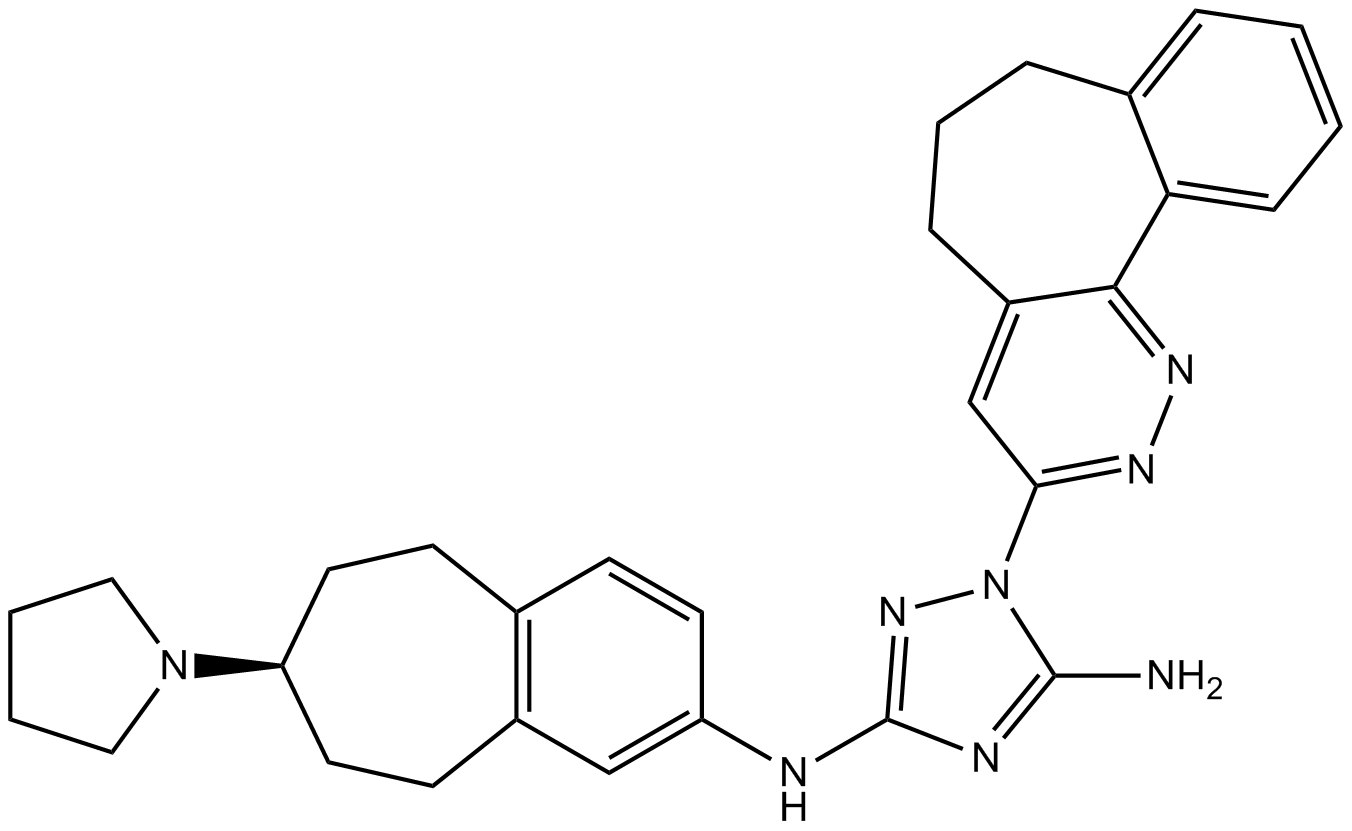
Cas No.: 1037624-75-1
Sample solution is provided at 25 µL, 10mM.
R428 blockiert als Axl-Inhibitor die Axl-Autophosphorylierung an der C-terminalen Andockstelle Tyr821 in nanomolaren Konzentrationen[1].
In vitro hemmte R428 das Wachstum von H1299, einer humanen nicht-kleinzelligen Lungenkarzinomzelllinie mit konstitutiv aktiviertem Axl, dosisabhängig mit einem IC50-Wert von etwa 4 µM[1]. In CE81T-Zellen war der IC50-Wert von R428 nach 72-stündiger Behandlung 1.98 µM[2]. In vitro wurden TNBC-Zellen 30 Minuten lang mit 0.5, 1 oder 2 µM R428 behandelt. 1-, 2- und 4-stündige Behandlung unterbrach die polarisierte Lokalisierung des Golgi-Apparats in Richtung der Vorderkante in migratorischen Zellen[3].
In vivo wurde Ratten 100 mg/kg Körpergewicht(p.o.) R428 verabreicht. Die Ratten zeigten eine stärkere RV-Hypertrophie, erhöhten rechtsventrikulären systolischen Druck(RVSP), ein verringertes Herzzeitvolumen, eine verschlechterte systolische Exkursion der Trikuspidalringebene sowie einen erheblich erhöhten totalen pulmonalvaskulären Widerstandsindex(TVA)[4]. In-vivo-Wirksamkeitstests zeigten, dass R428 eine lange Plasmahalbwertszeit(13 Stunden bei 75 mg/kg) aufweist und sich effektiv im Gewebe verteilt[5].
In vivo wurden Mäusen(8 Wochen alt) oral mit 125 mg/kg R428 behandelt. Die Anzahl der CD4+-T-Zellen in der Niere reduzierte sich erheblich im Vergleich zur T-Zellzahl in der Niere von nephritischen B6-Mäusen[6].
References:
[1] Chen F, et al. Axl inhibitor R428 induces apoptosis of cancer cells by blocking lysosomal acidification and recycling independent of Axl inhibition. Am J Cancer Res. 2018 Aug 1;8(8):1466-1482.
[2] Yang PW, et al. Cabozantinib (XL184) and R428 (BGB324) Inhibit the Growth of Esophageal Squamous Cell Carcinoma (ESCC). Front Oncol. 2019 Nov 6;9:1138.
[3] Zajac O, et al. AXL Controls Directed Migration of Mesenchymal Triple-Negative Breast Cancer Cells. Cells. 2020 Jan 19;9(1):247.
[4] Novoyatleva T, et al. Deficiency of Axl aggravates pulmonary arterial hypertension via BMPR2. Commun Biol. 2021 Aug 24;4(1):1002. doi: 10.1038/s42003-021-02531-1. Erratum in: Commun Biol. 2022 Jan 20;5(1):97.
[5] Zhen Y, et al. Targeted inhibition of Axl receptor tyrosine kinase ameliorates anti-GBM-induced lupus-like nephritis. J Autoimmun. 2018 Sep;93:37-44.
[6] Zhen Y, et al. Axl regulated survival/proliferation network and its therapeutic intervention in mouse models of glomerulonephritis. Arthritis Res Ther. 2022 Dec 28;24(1):284.
| Zellexperiment [1]: | |
Zelllinien | B-CPAP-Zelllinie(abgeleitet aus menschlichem PTC-Krebsgewebe) |
Vorbereitungsmethode | Die B-CPAP-Zelllinie wurde kultiviert und mit dem AXL-Inhibitor R428 in verschiedenen Konzentrationen(0.5 µmol/L, 1 µmol/L, 2 µmol/L, 4 µmol/L) behandelt. Die unbehandelte B-CPAP-Zelllinie diente als Kontrollgruppe. Zur Bestimmung der Zellproliferationsrate wurde ein CCK-8-Test durchgeführt. |
Reaktionsbedingungen | 0.5 µmol/L, 1 µmol/L, 2 µmol/L, 4 µmol/L; für 24 Stunden |
Anwendungen | In der B-CPAP-Experimentalgruppe war die Zellüberlebensrate nach Behandlung mit 0.5, 1.0, 2.0 bzw. 4.0 µmol/L R428 85.28% ± 9.21%, 66.74% ± 3.88%, 41.51% ± 6.33% bzw. 3.71% ± 2.10%. |
| Tierversuch [2]: | |
Tiermodelle | NOD-SCID männliche Mäuse |
Vorbereitungsmethode | Im Tiermodell wurden ESCC(Plattenepithelkarzinom der Speiseröhre)erstellt, dadurch dass männlichen NOD-SCID-Mäusen KYSE-70-Zellen mit Matrigel in die obere Rückenregion injiziert wurden, gefolgt von einer Behandlung mit Vehikelkontrolle, R428(50 mg/kg/Tag), Cisplatin(1.0 mg/kg) oder Cabozantinib(30 mg/kg/Tag) für die angegebene Anzahl von Tagen. |
Dosierungsform | 50 mg/kg/Tag; i.p. |
Anwendungen | R428 allein hemmte das ESCC-Tumorwachstum im Vergleich zum Vehikel erheblich; es wurde aber kein synergistischer Effekt mit Cisplatin beobachtet. |
References: | |
| Cas No. | 1037624-75-1 | SDF | |
| Überlieferungen | R-428;R 428;BGB324 | ||
| Chemical Name | 1-(6,7-dihydro-5H-benzo[2,3]cyclohepta[2,4-d]pyridazin-3-yl)-3-N-[(7S)-7-pyrrolidin-1-yl-6,7,8,9-tetrahydro-5H-benzo[7]annulen-3-yl]-1,2,4-triazole-3,5-diamine | ||
| Canonical SMILES | C1CCN(C1)C2CCC3=C(CC2)C=C(C=C3)NC4=NN(C(=N4)N)C5=NN=C6C(=C5)CCCC7=CC=CC=C76 | ||
| Formula | C30H34N8 | M.Wt | 506.64 |
| Löslichkeit | ≥ 25mg/mL in DMSO with gentle warming | Storage | Store at -20°C |
| General tips | Please select the appropriate solvent to prepare the stock solution according to the
solubility of the product in different solvents; once the solution is prepared, please store it in
separate packages to avoid product failure caused by repeated freezing and thawing.Storage method
and period of the stock solution: When stored at -80°C, please use it within 6 months; when stored
at -20°C, please use it within 1 month. To increase solubility, heat the tube to 37°C and then oscillate in an ultrasonic bath for some time. |
||
| Shipping Condition | Evaluation sample solution: shipped with blue ice. All other sizes available: with RT, or with Blue Ice upon request. | ||
| Prepare stock solution | |||

|
1 mg | 5 mg | 10 mg |
| 1 mM | 1.9738 mL | 9.8689 mL | 19.7379 mL |
| 5 mM | 394.8 μL | 1.9738 mL | 3.9476 mL |
| 10 mM | 197.4 μL | 986.9 μL | 1.9738 mL |
Step 1: Enter information below (Recommended: An additional animal making an allowance for loss during the experiment)
 g
μL
g
μL
Step 2: Enter the in vivo formulation (This is only the calculator, not formulation. Please contact us first if there is no in vivo formulation at the solubility Section.)
Calculation results:
Working concentration: mg/ml;
Method for preparing DMSO master liquid: mg drug pre-dissolved in μL DMSO ( Master liquid concentration mg/mL, Please contact us first if the concentration exceeds the DMSO solubility of the batch of drug. )
Method for preparing in vivo formulation: Take μL DMSO master liquid, next addμL PEG300, mix and clarify, next addμL Tween 80, mix and clarify, next add μL saline, mix and clarify.
Method for preparing in vivo formulation: Take μL DMSO master liquid, next add μL Corn oil, mix and clarify.
Note: 1. Please make sure the liquid is clear before adding the next solvent.
2. Be sure to add the solvent(s) in order. You must ensure that the solution obtained, in the previous addition, is a clear solution before proceeding to add the next solvent. Physical methods such as vortex, ultrasound or hot water bath can be used to aid dissolving.
3. All of the above co-solvents are available for purchase on the GlpBio website.
Quality Control & SDS
- View current batch:
- Purity: >99.00% Appearance: A solid
- COA (Certificate of Analysis)
- SDS (Safety Data Sheet)
- Datasheet
Average Rating: 5 (Based on Reviews and 6 reference(s) in Google Scholar.)