
Rapastinel Trifluoroacetate (GLYX-13 Trifluoroacetate) (Synonyms: GLYX-13 Trifluoroacetate) |
| Catalog No.GC33492 |
Rapastinel Trifluoroacetate (GLYX-13 Trifluoroacetate) (GLYX-13 Trifluoroacetate) est un modulateur des récepteurs NMDA avec des propriétés agonistes partielles du site glycine.
Products are for research use only. Not for human use. We do not sell to patients.
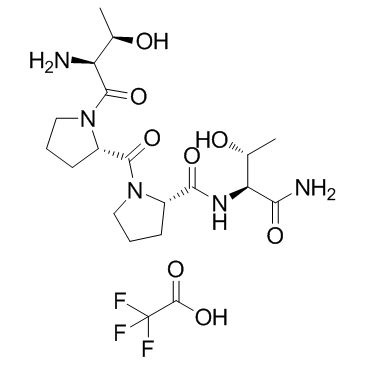
Cas No.: 1435786-04-1
Sample solution is provided at 25 µL, 10mM.
Rapastinel Trifluoroacetate is an NMDA receptor modulator with glycine-site partial agonist properties and currently in a phase II clinical development program as an adjunctive therapy for major depressive disorder.
Rapastinel Trifluoroacetate is an NMDA receptor modulator with glycine-site partial agonist properties and currently in a phase II clinical development program as an adjunctive therapy for major depressive disorder. Mice given Rapastinel Trifluoroacetate (1.0 mg/kg) prior to acute ketamine (30 mg/kg) show clear preference for novel compare to familiar objects (P0.05][2].
[1]. Rajagopal L, et al. GLYX-13 (rapastinel) ameliorates subchronic phencyclidine- and ketamine-induced declarative memory deficits in mice. Behav Brain Res. 2016 Feb 15;299:105-10. [2]. Burgdorf J, et al. The long-lasting antidepressant effects of rapastinel (GLYX-13) are associated with a metaplasticity process in the medial prefrontal cortex and hippocampus. Neuroscience. 2015 Nov 12;308:202-11.

Animal experiment: | Male C57BL/6J mice are used in this study. Mice are group housed (five/cage) in a controlled environment held at 21±2°C with a 14:10 h light-dark period (lights on:±05:00 am). All experiments are conducted during the light phase. Food and water are available ad libitum. For acute drug treatments, Rapastinel Trifluoroacetate (1.0 mg/kg, iv) is administered 30 min prior to the acquisition trial of the novel object recognition (NOR) task to the subchronic ketamine or subchronic phencyclidine (PCP)-treated animals[1]. |
References: [1]. Rajagopal L, et al. GLYX-13 (rapastinel) ameliorates subchronic phencyclidine- and ketamine-induced declarative memory deficits in mice. Behav Brain Res. 2016 Feb 15;299:105-10. | |
| Cas No. | 1435786-04-1 | SDF | |
| Synonymes | GLYX-13 Trifluoroacetate | ||
| Canonical SMILES | O=C([C@H]1N(C([C@H]2N(C([C@@H](N)[C@H](O)C)=O)CCC2)=O)CCC1)N[C@@H]([C@H](O)C)C(N)=O.O=C(O)C(F)(F)F | ||
| Formula | C20H32F3N5O8 | M.Wt | 527.49 |
| Solubility | DMSO : 125 mg/mL (236.97 mM) | Storage | Store at -20°C |
| General tips | Please select the appropriate solvent to prepare the stock solution according to the
solubility of the product in different solvents; once the solution is prepared, please store it in
separate packages to avoid product failure caused by repeated freezing and thawing.Storage method
and period of the stock solution: When stored at -80°C, please use it within 6 months; when stored
at -20°C, please use it within 1 month. To increase solubility, heat the tube to 37°C and then oscillate in an ultrasonic bath for some time. |
||
| Shipping Condition | Evaluation sample solution: shipped with blue ice. All other sizes available: with RT, or with Blue Ice upon request. | ||
| Prepare stock solution | |||
|
1 mg | 5 mg | 10 mg |
| 1 mM | 1.8958 mL | 9.4789 mL | 18.9577 mL |
| 5 mM | 379.2 μL | 1.8958 mL | 3.7915 mL |
| 10 mM | 189.6 μL | 947.9 μL | 1.8958 mL |
Step 1: Enter information below (Recommended: An additional animal making an allowance for loss during the experiment)
Step 2: Enter the in vivo formulation (This is only the calculator, not formulation. Please contact us first if there is no in vivo formulation at the solubility Section.)
Calculation results:
Working concentration: mg/ml;
Method for preparing DMSO master liquid: mg drug pre-dissolved in μL DMSO ( Master liquid concentration mg/mL, Please contact us first if the concentration exceeds the DMSO solubility of the batch of drug. )
Method for preparing in vivo formulation: Take μL DMSO master liquid, next addμL PEG300, mix and clarify, next addμL Tween 80, mix and clarify, next add μL ddH2O, mix and clarify.
Method for preparing in vivo formulation: Take μL DMSO master liquid, next add μL Corn oil, mix and clarify.
Note: 1. Please make sure the liquid is clear before adding the next solvent.
2. Be sure to add the solvent(s) in order. You must ensure that the solution obtained, in the previous addition, is a clear solution before proceeding to add the next solvent. Physical methods such as vortex, ultrasound or hot water bath can be used to aid dissolving.
3. All of the above co-solvents are available for purchase on the GlpBio website.
Quality Control & SDS
- View current batch:
- Purity: >98.00%
- COA (Certificate Of Analysis)
- SDS (Safety Data Sheet)
- Datasheet
Average Rating: 5 (Based on Reviews and 22 reference(s) in Google Scholar.)
GLPBIO products are for RESEARCH USE ONLY. Please make sure your review or question is research based.
Required fields are marked with *


