

Sodium Tauroursodeoxycholate (TUDC) |
Catalog No.GC17425
 One-Click Copy Product Info
|

Le tauroursodésoxycholate (acide tauroursodésoxycholique; TUDCA) de sodium est un inhibiteur du stress du réticulum endoplasmique (RE). Le tauroursodésoxycholate réduit significativement l'expression des molécules d'apoptose, telles que la caspase-3 et la caspase-12. Le tauroursodésoxycholate inhibe également l'ERK.
Products are for research use only. Not for human use. We do not sell to patients.
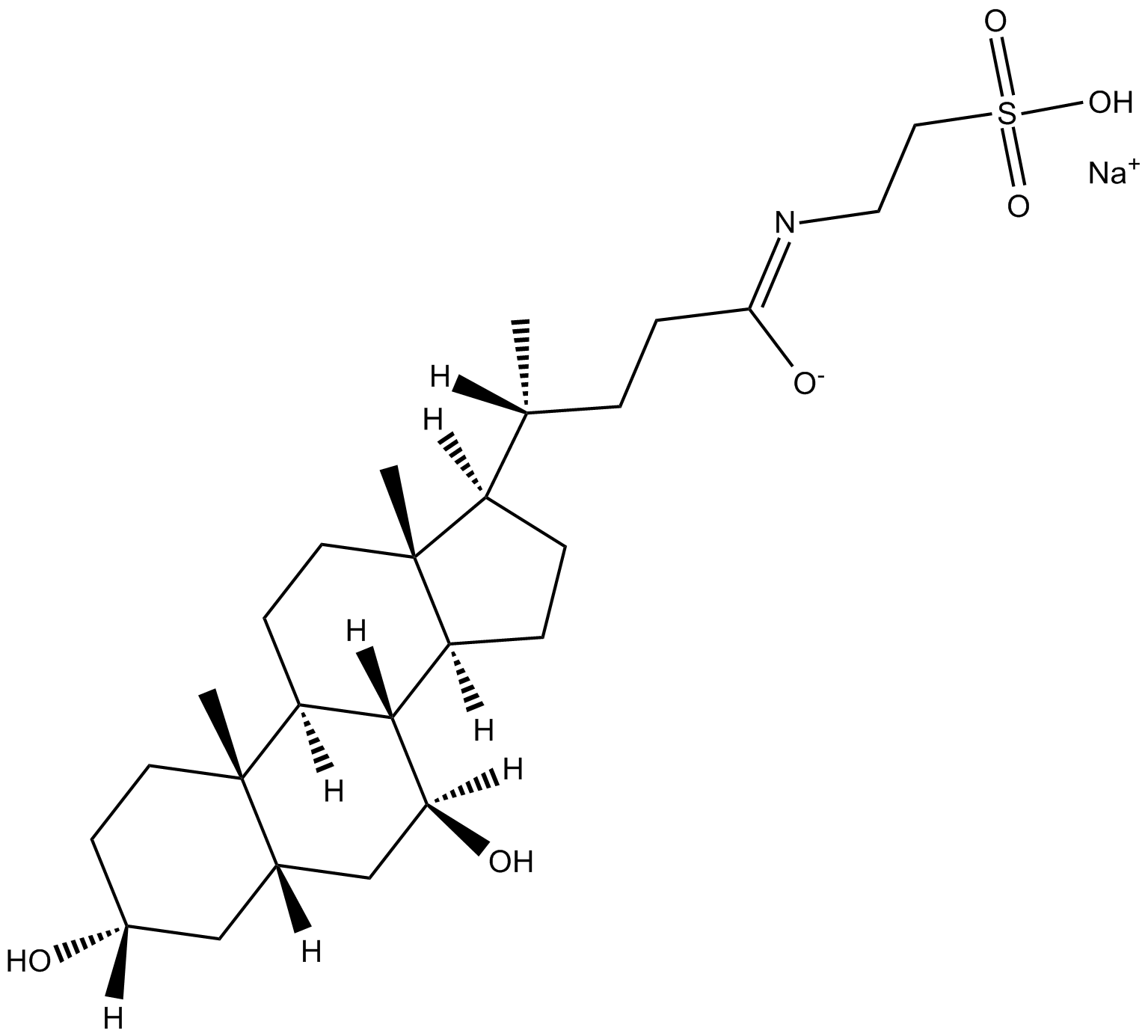
Cas No.: 35807-85-3
Sample solution is provided at 25 µL, 10mM.
_1-3.$$$39978408@51.jpg');)
_1-9.$$$38538795@65.jpg');)
_1-9.$$$39112701@51.jpg');)
_1-7.$$$37316672@70.jpg');)
_366-372.$$$36198801@70.jpg');)
.$$$38565142@65.jpg');)
_1867-1883.$$$33248023@67.jpg');)
_eads6055.$$$39977546@45.jpg');)
_eadm9805.$$$40080571@45.jpg');)
_eadj3020.$$$39666821@45.jpg');)
_1-20.$$$39757301@28.jpg');)
_1-24.$$$38898113@28.jpg');)
_273-287.$$$36806353@46.jpg');)
_1-16.$$$37156877@44.jpg');)
_1-19.$$$37460805@44.jpg');)
_1291-1307.$$$34518654@46.jpg');)
Sodium tauroursodeoxycholate (TUDC) shows therapeutic effect on cholestasis [1, 2]. In human erythrocytes, it inhibited 2’,7’-bis-(carboxypropyl)-5(6)-carboxyfluorescein (BCPCF) efflux induced by bile salts with an IC50 value of 560 µM [3].
Cholestasis is the syndrome resulted from the impairment of the formation of bile, a vital function [4].
cVA-of-CLF means the canalicular vacuolar accumulation of cholyllysylfluorescein [1]. cVA of CLF is a parameter to indicate overall biliary secretion [5]. Incubation with 17βEG dose-dependently decreased the cVA-of-CLF in cells. 17βEG at a concentration of 50 µM decreased cVA-of-CLF by 40%. The simultaneous incubation with TUDC and 17βEG improved the decreased cVA by 24%. The simultaneous incubation with SAMe and 17βEG improved the decreased cVA by 18%. The simultaneous incubation with TUDC, SAMe and 17βEG improved the decreased cVA by 28%. But the effect of TUDC + SAMe was not significantly greater than the effect of either protectant alone [1].
In rats, intrahepatic cholestasis was induced by the administration of phalloidin at an i.p. dose of 500 µg/kg for 7 days. In these treated rats, bile flow was decreased, and activities of glutamic pyruvic transaminase, leucine aminopeptidase, serum alkaline phosphatase, and concentrations of bile acid, phospholipid and cholesterol were increased. But these effects were significantly suppressed by tauroursodeoxycholate. In these rats, excretion rates of biliary cholesterol and phospholipid were significantly improved by tauroursodeoxycholate [2].
References:
[1]. Milkiewicz P, Roma MG, Cardenas R, et al. Effect of tauroursodeoxycholate and S-adenosyl-l-methionine on 17β-estradiol glucuronide-induced cholestasis. Journal of hepatology, 2001, 34(2): 184-191.
[2]. Ishizaki K, Kinbara S, Hirabayashi N, et al. Effect of sodium tauroursodeoxycholate on phalloidin-induced cholestasis in rats. European journal of pharmacology, 2001, 421(1): 55-60.
[3]. Mrowczynska L, Bobrowska-Hgerstrand M, Wrobel A, et al. Inhibition of MRP1-mediated efflux in human erythrocytes by mono-anionic bile salts. Anticancer research, 2005, 25(5): 3173-3178.
[4]. Trauner M, Meier PJ, Boyer JL. Molecular pathogenesis of cholestasis. New England Journal of Medicine, 1998, 339(17): 1217-1227.
[5]. Milkiewicz P, Roma MG, Elias E, et al. Hepatoprotection with tauroursodeoxycholate and β muricholate against taurolithocholate induced cholestasis: involvement of signal transduction pathways. Gut, 2002, 51(1): 113-119.
|
Cell experiment: |
Cell viability and proliferation are measured using Ez-Cytox. VSMCs (5×10³ cells) are seeded onto 96-well plates in Smooth Muscle Cell Growth Medium 2 (SMCGM2) and cultured. After serum starvation, Tauroursodeoxycholate (0, 50, 100, and 200 μM) is added to the hVSMCs, with or without 1,2-bis(o-aminophenoxy) ethane-N,N,N′,N′-tetraacetic acid tetra(acetoxymethyl) ester (BAPTA, 10 μM) and 7-hydroxystaurosporine (H7, 10 μM) and cultured for 24 h. To assess the effect of Tauroursodeoxycholate on the PDGF-stimulated hVSMC proliferation, hVSMCs are seeded onto 96-well plates and cultured. After serum starvation, Tauroursodeoxycholate (0, 50, 100, and 200 μM) is added to the hVSMCs, with or without PDGF-BB (50 ng/mL) and cultured. After addition of 10 μL of Ez-Cytox into each well, cell viability is evaluated by measuring the optical density at 450 nm[1]. |
|
Animal experiment: |
Rats[1]Sprague-Dawley rats are anaesthetized with a combined anaesthetic (Ketamine, 70 mg/kg; Xylazine, 7 mg/kg ip). Tauroursodeoxycholate is administered orally once a day, in different concentrations (i.e. vehicle, 10, 50, and 100 mg/kg) for 2 weeks. The carotid arteries are fixed by perfusion with 4% formaldehyde, then the tissues are embedded in paraffin, and sections (8 μm) are stained with H&E[1]. Mice[2]Thirty ApoE-/- C57BL/6 male mice aged 8 weeks are randomly divided into three groups (n=10 in each group): (i) sham operated and injected with physiologic (0.9%) saline as vehicle (normal: group); (ii) mini-osmotic pumps are implanted subcutaneously into the right flank of ApoE-/- mice to release Ang II (1000 ng/kg/min) over the course of 28 days (AAA model group); (iii) AAA model mice treated with Tauroursodeoxycholate daily for 4 weeks at a dosage of 0.5 g/kg/day in drinking water (Tauroursodeoxycholate group). Mice are sacrificed after 28 days of Ang II infusion[2]. |
|
References: [1]. Kim SY, et al. Tauroursodeoxycholate (TUDCA) inhibits neointimal hyperplasia by suppression of ERK via PKCα-mediated MKP-1 induction. Cardiovasc Res. 2011 Nov 1;92(2):307-16. |
|
| Cas No. | 35807-85-3 | SDF | |
| Chemical Name | sodium (R,Z)-4-((3R,5S,7S,8R,9S,10S,13R,14S,17R)-3,7-dihydroxy-10,13-dimethylhexadecahydro-1H-cyclopenta[a]phenanthren-17-yl)-N-(2-sulfoethyl)pentanimidate | ||
| Canonical SMILES | C[C@]([C@@]1([H])CC[C@@]2([H])[C@@]([C@](O)([H])C[C@]3([H])C[C@@](O)([H])CC[C@@]34C)([H])[C@]4([H])CC[C@]12C)([H])CC/C([O-])=N/CCS(O)(=O)=O.[Na+] | ||
| Formula | C26H44NNaO6S | M.Wt | 521.69 |
| Solubility | ≥ 26.1mg/mL in DMSO | Storage | Store at -20°C |
| General tips | Please select the appropriate solvent to prepare the stock solution according to the
solubility of the product in different solvents; once the solution is prepared, please store it in
separate packages to avoid product failure caused by repeated freezing and thawing.Storage method
and period of the stock solution: When stored at -80°C, please use it within 6 months; when stored
at -20°C, please use it within 1 month. To increase solubility, heat the tube to 37°C and then oscillate in an ultrasonic bath for some time. |
||
| Shipping Condition | Evaluation sample solution: shipped with blue ice. All other sizes available: with RT, or with Blue Ice upon request. | ||
| Prepare stock solution | |||

|
1 mg | 5 mg | 10 mg |
| 1 mM | 1.9168 mL | 9.5842 mL | 19.1685 mL |
| 5 mM | 383.4 μL | 1.9168 mL | 3.8337 mL |
| 10 mM | 191.7 μL | 958.4 μL | 1.9168 mL |
Step 1: Enter information below (Recommended: An additional animal making an allowance for loss during the experiment)
 g
μL
g
μL
Step 2: Enter the in vivo formulation (This is only the calculator, not formulation. Please contact us first if there is no in vivo formulation at the solubility Section.)
Calculation results:
Working concentration: mg/ml;
Method for preparing DMSO master liquid: mg drug pre-dissolved in μL DMSO ( Master liquid concentration mg/mL, Please contact us first if the concentration exceeds the DMSO solubility of the batch of drug. )
Method for preparing in vivo formulation: Take μL DMSO master liquid, next addμL PEG300, mix and clarify, next addμL Tween 80, mix and clarify, next add μL saline, mix and clarify.
Method for preparing in vivo formulation: Take μL DMSO master liquid, next add μL Corn oil, mix and clarify.
Note: 1. Please make sure the liquid is clear before adding the next solvent.
2. Be sure to add the solvent(s) in order. You must ensure that the solution obtained, in the previous addition, is a clear solution before proceeding to add the next solvent. Physical methods such as vortex, ultrasound or hot water bath can be used to aid dissolving.
3. All of the above co-solvents are available for purchase on the GlpBio website.
Quality Control & SDS
- View current batch:
- Purity: >98.00% Appearance: A solid
- COA (Certificate of Analysis)
- SDS (Safety Data Sheet)
- Datasheet
Average Rating: 5 (Based on Reviews and 37 reference(s) in Google Scholar.)