

α-Cyano-4-hydroxycinnamic acid (CHC) (Synonyms: CHC, α-CHCA, NSC 173138) |
カタログ番号GC10877
 One-Click Copy Product Info
|

CHC (α-Cyano-4-hydroxycinnamate) は、モノカルボン酸トランスポーター (MCT) の強力な非競合的阻害剤です。
Products are for research use only. Not for human use. We do not sell to patients.
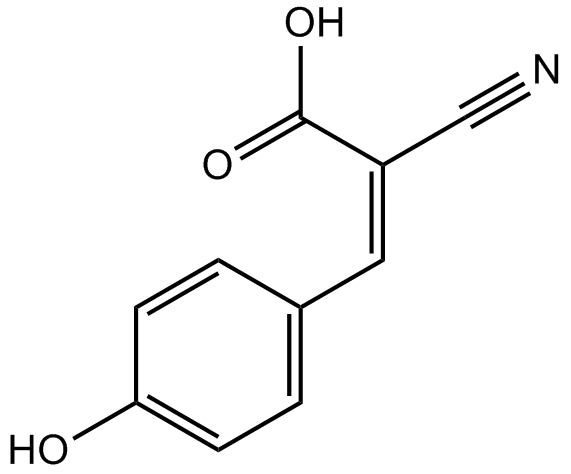
Cas No.: 28166-41-8
Sample solution is provided at 25 µL, 10mM.
_1-3.$$$39978408@51.jpg');)
_1-9.$$$38538795@65.jpg');)
_1-9.$$$39112701@51.jpg');)
_1-7.$$$37316672@70.jpg');)
_366-372.$$$36198801@70.jpg');)
.$$$38565142@65.jpg');)
_1867-1883.$$$33248023@67.jpg');)
_eads6055.$$$39977546@45.jpg');)
_eadm9805.$$$40080571@45.jpg');)
_eadj3020.$$$39666821@45.jpg');)
_1-20.$$$39757301@28.jpg');)
_1-24.$$$38898113@28.jpg');)
_273-287.$$$36806353@46.jpg');)
_1-16.$$$37156877@44.jpg');)
_1-19.$$$37460805@44.jpg');)
_1291-1307.$$$34518654@46.jpg');)
α-Cyano-4-hydroxycinnamic acid (CHC) is a non-competitive inhibitor of the mitochondrial pyruvate transporter with a Ki of 6.3μM[1]. α-Cyano-4-hydroxycinnamic acid inhibits both the monophenolase activity and diphenolase activity of mushroom tyrosinase, with IC50 values of 48µM and 2.17mM, respectively[2]. α-Cyano-4-hydroxycinnamic acid regulates isolated mouse muscle fatigue and recovery by blocking the transport of lactate and hydrogen ions[3]. α-Cyano-4-hydroxycinnamic acid has been extensively used for protein and peptide analysis as a matrix for ultraviolet matrix-assisted laser desorption/ionization mass spectrometry (MALDI-MS)[4].
In vitro, α-Cyano-4-hydroxycinnamic acid treatment for 72 hours significantly inhibited the viability of HeLa and HCT116 cells, with IC50 values of 2.41mM and 1.65mM, respectively[5]. Treatment with 400µM α-Cyano-4-hydroxycinnamic acid for 24 hours altered the activities of protein kinase C (PKC)-δ and PKC-ζ, and reduced the occurrence of malformations in rat embryos cultured in high-glucose conditions[6].
In vivo, a single intraperitoneal injection of α-Cyano-4-hydroxycinnamic acid (200mg/kg) stimulated food intake in rats within 4 hours, without affecting blood glucose levels[7].
References:
[1] Halestrap A P. The mitochondrial pyruvate carrier. Kinetics and specificity for substrates and inhibitors[J]. Biochemical Journal, 1975, 148(1): 85-96.
[2] Qiu L, Chen Q H, Zhuang J X, et al. Inhibitory effects of α-cyano-4-hydroxycinnamic acid on the activity of mushroom tyrosinase[J]. Food Chemistry, 2009, 112(3): 609-613.
[3] Clarke P D, Clift D L, Dooldeniya M, et al. Effects of α-cyano-4-hydroxycinnamic acid on fatigue and recovery of isolated mouse muscle[J]. Journal of Muscle Research & Cell Motility, 1995, 16(6): 611-617.
[4] Mojica E R E, Vedad J, Desamero R Z B. Vibrational analysis of α-cyanohydroxycinnamic acid[J]. Journal of molecular structure, 2015, 1094: 203-209.
[5] Ji H, Tan Y, Gan N, et al. Synthesis and anticancer activity of new coumarin-3-carboxylic acid derivatives as potential lactate transport inhibitors[J]. Bioorganic & Medicinal Chemistry, 2021, 29: 115870.
[6] Gäreskog M, Wentzel P. N-Acetylcysteine and α-cyano-4-hydroxycinnamic acid alter protein kinase C (PKC)-δ and PKC-ζ and diminish dysmorphogenesis in rat embryos cultured with high glucose in vitro[J]. Journal of endocrinology, 2007, 192(1): 207-214.
[7] Del Prete E, Lutz T A, Scharrer E. Inhibition of glucose oxidation by α-cyano-4-hydroxycinnamic acid stimulates feeding in rats[J]. Physiology & behavior, 2004, 80(4): 489-498.
| Cell experiment [1]: | |
|
Cell lines |
HCT116 cells |
|
Preparation Method |
HCT116 cells were cultured in DMEM medium supplemented with 100U/ml penicillin, 100ug/ml streptomycin, and 10% fetal bovine serum, at 37°C in an incubator with 5% CO2. HCT116 (3000 cells/well) cells were seeded in 96-well microtiter plates overnight. α-Cyano-4-hydroxycinnamic acid was then diluted in DMEM and added 10µl into per well with varying final concentrations (0, 0.001, 0.001, 0.1, 1, and 10mM) for 72h exposure, and cell viability was measured. |
|
Reaction Conditions |
0, 0.001, 0.001, 0.1, 1, and 10mM; 72h |
|
Applications |
α-Cyano-4-hydroxycinnamic acid reduced cell viability of HCT116 cells in a dose-dependent manner. |
| Animal experiment [2]: | |
|
Animal models |
Male Sprague-Dawley rat |
|
Preparation Method |
Male Sprague-Dawley rats (6-week-old) were housed individually in a temperature-controlled (21±1°C) colony room and kept on a 12-h light/dark cycle. Rats were adapted to the diet (16.5kJ/g) for at least 2 weeks. Rats were injected with 200mg/kg α-Cyano-4-hydroxycinnamic acid or saline in the middle of the light phase. Cumulative food intake was measured by weighing the food cups (±0.1g) just before injection and 1, 2, and 4h afterward. |
|
Dosage form |
200mg/kg; once; i.p. |
|
Applications |
α-Cyano-4-hydroxycinnamic acid treatment enhanced cumulative food intake in rats in 4h. |
References: [1] Ji H, Tan Y, Gan N, et al. Synthesis and anticancer activity of new coumarin-3-carboxylic acid derivatives as potential lactate transport inhibitors[J]. Bioorganic & Medicinal Chemistry, 2021, 29: 115870. [2] Del Prete E, Lutz T A, Scharrer E. Inhibition of glucose oxidation by α-cyano-4-hydroxycinnamic acid stimulates feeding in rats[J]. Physiology & behavior, 2004, 80(4): 489-498. | |
| Cas No. | 28166-41-8 | SDF | |
| 同義語 | CHC, α-CHCA, NSC 173138 | ||
| Chemical Name | (Z)-2-cyano-3-(4-hydroxyphenyl)acrylic acid | ||
| Canonical SMILES | OC1=CC=C(/C=C(C#N)\C(O)=O)C=C1 | ||
| Formula | C10H7NO3 | M.Wt | 189.17 |
| 溶解度 | ≥ 37.8 mg/mL in DMSO, ≥ 20.9 mg/mL in EtOH with ultrasonic, ≥ 1.03 mg/mL in Water with ultrasonic and warming | Storage | Store at -20°C |
| General tips | Please select the appropriate solvent to prepare the stock solution according to the
solubility of the product in different solvents; once the solution is prepared, please store it in
separate packages to avoid product failure caused by repeated freezing and thawing.Storage method
and period of the stock solution: When stored at -80°C, please use it within 6 months; when stored
at -20°C, please use it within 1 month. To increase solubility, heat the tube to 37°C and then oscillate in an ultrasonic bath for some time. |
||
| Shipping Condition | Evaluation sample solution: shipped with blue ice. All other sizes available: with RT, or with Blue Ice upon request. | ||
| Prepare stock solution | |||

|
1 mg | 5 mg | 10 mg |
| 1 mM | 5.2863 mL | 26.4313 mL | 52.8625 mL |
| 5 mM | 1.0573 mL | 5.2863 mL | 10.5725 mL |
| 10 mM | 528.6 μL | 2.6431 mL | 5.2863 mL |
Step 1: Enter information below (Recommended: An additional animal making an allowance for loss during the experiment)
 g
μL
g
μL
Step 2: Enter the in vivo formulation (This is only the calculator, not formulation. Please contact us first if there is no in vivo formulation at the solubility Section.)
Calculation results:
Working concentration: mg/ml;
Method for preparing DMSO master liquid: mg drug pre-dissolved in μL DMSO ( Master liquid concentration mg/mL, Please contact us first if the concentration exceeds the DMSO solubility of the batch of drug. )
Method for preparing in vivo formulation: Take μL DMSO master liquid, next addμL PEG300, mix and clarify, next addμL Tween 80, mix and clarify, next add μL saline, mix and clarify.
Method for preparing in vivo formulation: Take μL DMSO master liquid, next add μL Corn oil, mix and clarify.
Note: 1. Please make sure the liquid is clear before adding the next solvent.
2. Be sure to add the solvent(s) in order. You must ensure that the solution obtained, in the previous addition, is a clear solution before proceeding to add the next solvent. Physical methods such as vortex, ultrasound or hot water bath can be used to aid dissolving.
3. All of the above co-solvents are available for purchase on the GlpBio website.
Quality Control & SDS
- View current batch:
- Purity: >98.00% Appearance: A solid
- COA (Certificate of Analysis)
- SDS (Safety Data Sheet)
- Datasheet
Average Rating: 5 (Based on Reviews and 12 reference(s) in Google Scholar.)