

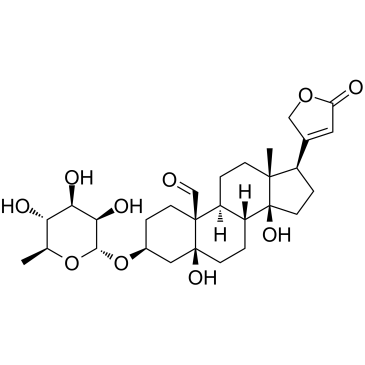
Convallatoxin |
カタログ番号GC39701
 One-Click Copy Product Info
|

Convallatoxin は、Adonis amurensis Regel et Radde から分離された強心配糖体です。
Products are for research use only. Not for human use. We do not sell to patients.
Cas No.: 508-75-8
Sample solution is provided at 25 µL, 10mM.
_1-3.$$$39978408@51.jpg');)
_1-9.$$$38538795@65.jpg');)
_1-9.$$$39112701@51.jpg');)
_1-7.$$$37316672@70.jpg');)
_366-372.$$$36198801@70.jpg');)
.$$$38565142@65.jpg');)
_1867-1883.$$$33248023@67.jpg');)
_eads6055.$$$39977546@45.jpg');)
_eadm9805.$$$40080571@45.jpg');)
_eadj3020.$$$39666821@45.jpg');)
_1-20.$$$39757301@28.jpg');)
_1-24.$$$38898113@28.jpg');)
_273-287.$$$36806353@46.jpg');)
_1-16.$$$37156877@44.jpg');)
_1-19.$$$37460805@44.jpg');)
_1291-1307.$$$34518654@46.jpg');)
Convallatoxin is a cardiac glycoside isolated from Adonis amurensis Regel et Radde. Convallatoxin enhances myocardial contractility by inhibiting Na⁺/K⁺-ATPase to increase intracellular calcium concentration. Convallatoxin can be used in research related to cancers (such as lung cancer, breast cancer, colon cancer, etc.) and viral infections (such as human cytomegalovirus)[1-4].
In vitro, U251MG and A172 human glioma cells were treated with Convallatoxin (12.5–50nM) for 24–72 hours. Convallatoxin significantly inhibited cell proliferation, migration, invasion, and angiogenesis, and reduced the phosphorylation levels of JAK2 and STAT3[5]. MG63 and U2OS human osteosarcoma cells were treated with Convallatoxin (12.5–100nM) for 24 hours. Convallatoxin significantly inhibited cell proliferation, migration, and invasion, and promoted osteogenic differentiation. Convallatoxin downregulated PTHR1 expression and inhibited the Wnt/β-catenin pathway[6].
In vivo, C57BL/6 mice were subcutaneously injected with Convallatoxin (0.5mg/kg) combined with morphine (10mg/kg; twice daily) for 8 days. The combination of Convallatoxin and morphine significantly enhanced analgesic effects and reduced naloxone-induced withdrawal jumping[7]. Convallatoxin (0.01μg/site) was topically applied daily to skin lesions of BALB/c mice for 12 days. Convallatoxin significantly improved skin lesions and inflammation[8].
References:
[1] Li MY, Zhang ZH, Wang Z, et al. Convallatoxin protects against dextran sulfate sodium-induced experimental colitis in mice by inhibiting NF-κB signaling through activation of PPARγ. Pharmacol Res. 2019 Sep;147:104355.
[2] Gozalpour E, Greupink R, Bilos A, et al. Convallatoxin: a new P-glycoprotein substrate. Eur J Pharmacol. 2014 Dec 5;744:18-27.
[3] Fink SL, Robey TE, Tarabar AF, et al. Rapid detection of convallatoxin using five digoxin immunoassays. Clin Toxicol (Phila). 2014 Aug;52(7):659-63.
[4] Lee J, Kang JS, Nam LB, et al. Suppression of NRF2/ARE by convallatoxin sensitises A549 cells to 5-FU-mediated apoptosis. Free Radic Res. 2018 Dec;52(11-12):1416-1423.
[5] Hao Z, Han Y, Bo Y, et al. Convallatoxin inhibits proliferation and angiogenesis of glioma cells via regulating JAK/STAT3 pathway. Open Life Sci. 2025 Apr 28;20(1):20221056.
[6] Liu X, Geng Z, Ding X, et al. Convallatoxin suppresses osteosarcoma cell proliferation, migration, invasion, and enhances osteogenic differentiation by downregulating parathyroid hormone receptor 1 (PTHR1) expression and inactivating Wnt/β-catenin pathway. Bioengineered. 2022 May;13(5):13280-13292.
[7] Chao PK, Chang HF, Ou LC, et al. Convallatoxin enhance the ligand-induced mu-opioid receptor endocytosis and attenuate morphine antinociceptive tolerance in mice. Sci Rep. 2019 Feb 20;9(1):2405.
[8] Jiang BW, Zhang WJ, Wang Y, et al. Convallatoxin induces HaCaT cell necroptosis and ameliorates skin lesions in psoriasis-like mouse models. Biomed Pharmacother. 2020 Jan;121:109615.
| Cell experiment [1]: | |
Cell lines | MG63 and U2OS human osteosarcoma cells |
Preparation Method | MG63 and U2OS cells were cultured in high-glucose Dulbecco's modified Eagle's medium (HG-DMEM) supplemented with 10% fetal bovine serum (FBS) at 37°C with 5% CO₂. Cells were treated with Convallatoxin for 24 hours. |
Reaction Conditions | 12.5–100nM; 24h |
Applications | Convallatoxin significantly inhibited cell proliferation, migration, and invasion of MG63 and U2OS cells in a dose-dependent manner. Convallatoxin promoted osteogenic differentiation of osteosarcoma cells, as evidenced by increased protein expressions of collagen 1, osteopontin, Runx2, and osteocalcin, and decreased RANKL protein expression. The mechanism involves downregulating parathyroid hormone receptor 1 (PTHR1) expression and inactivating the Wnt/β-catenin pathway. |
| Animal experiment [2]: | |
Animal models | C57BL/6 (B6) mice |
Preparation Method | Mice were chronically injected subcutaneously (s.c.) with vehicle, morphine (10 mg/kg), Convallatoxin (0.5mg/kg), or morphine (10mg/kg) + Convallatoxin (0.5mg/kg), twice daily for 8 days. Morphine dependence was evaluated on day 9 by precipitating withdrawal with naloxone (1mg/kg; s.c.). |
Dosage form | 0.5mg/kg; s.c.; Twice daily injection for 8 days |
Applications | Chronic co-treatment with Convallatoxin and morphine resulted in greater antinociception relative to chronic morphine alone in the tail-flick test. Chronic co-administration of morphine plus Convallatoxin also reduced naloxone-precipitated withdrawal jumping compared to chronic morphine alone. In a CFA-induced chronic inflammatory pain model, co-treatment with Convallatoxin and morphine attenuated mechanical allodynia. |
References: | |
| Cas No. | 508-75-8 | SDF | |
| Canonical SMILES | O=C1OCC([C@H]2CC[C@]3(O)[C@]4([H])CC[C@]5(O)C[C@@H](O[C@H]6[C@@H]([C@@H]([C@H]([C@H](C)O6)O)O)O)CC[C@]5(C=O)[C@@]4([H])CC[C@]23C)=C1 | ||
| Formula | C29H42O10 | M.Wt | 550.64 |
| 溶解度 | DMSO : 50 mg/mL (90.80 mM; Need ultrasonic) | Storage | Store at -20°C |
| General tips | Please select the appropriate solvent to prepare the stock solution according to the
solubility of the product in different solvents; once the solution is prepared, please store it in
separate packages to avoid product failure caused by repeated freezing and thawing.Storage method
and period of the stock solution: When stored at -80°C, please use it within 6 months; when stored
at -20°C, please use it within 1 month. To increase solubility, heat the tube to 37°C and then oscillate in an ultrasonic bath for some time. |
||
| Shipping Condition | Evaluation sample solution: shipped with blue ice. All other sizes available: with RT, or with Blue Ice upon request. | ||
| Prepare stock solution | |||

|
1 mg | 5 mg | 10 mg |
| 1 mM | 1.8161 mL | 9.0803 mL | 18.1607 mL |
| 5 mM | 363.2 μL | 1.8161 mL | 3.6321 mL |
| 10 mM | 181.6 μL | 908 μL | 1.8161 mL |
Step 1: Enter information below (Recommended: An additional animal making an allowance for loss during the experiment)
 g
μL
g
μL
Step 2: Enter the in vivo formulation (This is only the calculator, not formulation. Please contact us first if there is no in vivo formulation at the solubility Section.)
Calculation results:
Working concentration: mg/ml;
Method for preparing DMSO master liquid: mg drug pre-dissolved in μL DMSO ( Master liquid concentration mg/mL, Please contact us first if the concentration exceeds the DMSO solubility of the batch of drug. )
Method for preparing in vivo formulation: Take μL DMSO master liquid, next addμL PEG300, mix and clarify, next addμL Tween 80, mix and clarify, next add μL saline, mix and clarify.
Method for preparing in vivo formulation: Take μL DMSO master liquid, next add μL Corn oil, mix and clarify.
Note: 1. Please make sure the liquid is clear before adding the next solvent.
2. Be sure to add the solvent(s) in order. You must ensure that the solution obtained, in the previous addition, is a clear solution before proceeding to add the next solvent. Physical methods such as vortex, ultrasound or hot water bath can be used to aid dissolving.
3. All of the above co-solvents are available for purchase on the GlpBio website.
Quality Control & SDS
- View current batch:
- Purity: >98.00% Appearance: A solid
- COA (Certificate of Analysis)
- SDS (Safety Data Sheet)
- Datasheet
Average Rating: 5 (Based on Reviews and 39 reference(s) in Google Scholar.)