

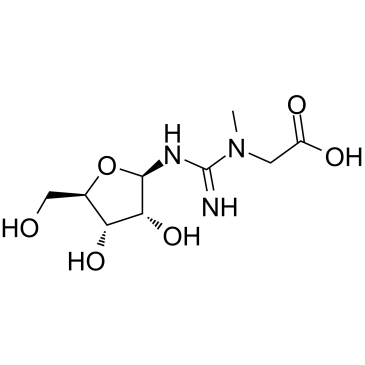
Creatine riboside |
カタログ番号GC60727
 One-Click Copy Product Info
|

Creatine ribosideはヒト代謝物であり、クレアチンとリボースの自然で、非酵素的な結合により生成されたものであり、癌の診断と予後のための潜在的なバイオマーカーとして頭角を表している。
Products are for research use only. Not for human use. We do not sell to patients.
Cas No.: 1616693-92-5
Sample solution is provided at 25 µL, 10mM.
_1-3.$$$39978408@51.jpg');)
_1-9.$$$38538795@65.jpg');)
_1-9.$$$39112701@51.jpg');)
_1-7.$$$37316672@70.jpg');)
_366-372.$$$36198801@70.jpg');)
.$$$38565142@65.jpg');)
_1867-1883.$$$33248023@67.jpg');)
_eads6055.$$$39977546@45.jpg');)
_eadm9805.$$$40080571@45.jpg');)
_eadj3020.$$$39666821@45.jpg');)
_1-20.$$$39757301@28.jpg');)
_1-24.$$$38898113@28.jpg');)
_273-287.$$$36806353@46.jpg');)
_1-16.$$$37156877@44.jpg');)
_1-19.$$$37460805@44.jpg');)
_1291-1307.$$$34518654@46.jpg');)
Creatine ribosideはヒト代謝物であり、クレアチンとリボースの自然で、非酵素的な結合により生成されたものであり、癌の診断と予後のための潜在的なバイオマーカーとして頭角を表している[1, 2]。高レベルのCreatine ribosideは通常、癌の予後不良(腫瘍の悪性増殖や免疫細胞浸潤の減少など)に関連している。Creatine ribosideが、癌細胞におけるミトコンドリア尿素回路機能不全と代謝異常を反映している可能性がある[3]。Creatine ribosideは、非標的メタボロミクス解析の対象に当たる非小細胞肺癌(NSCLC)の患者と対照群の尿サンプルで初めて発見された[4]。
References:
[1] Araújo H P F C. Purines, creatine, defective methylation and their biochemical and clinical relationship[M]. Universidade da Madeira (Portugal), 2003.
[2] Patel D P, Pauly G T, Tada T, et al. Improved detection and precise relative quantification of the urinary cancer metabolite biomarkers–Creatine riboside, creatinine riboside, creatine and creatinine by UPLC-ESI-MS/MS: Application to the NCI-Maryland cohort population controls and lung cancer cases[J]. Journal of pharmaceutical and biomedical analysis, 2020, 191: 113596.
[3] Parker A L, Toulabi L, Oike T, et al. Creatine riboside is a cancer cell–derived metabolite associated with arginine auxotrophy[J]. The Journal of Clinical Investigation, 2022, 132(14).
[4] Oike T, Kanke Y, Parker A, et al. Abstract PR02: Diagnostic and prognostic utility of urinary creatine riboside for early stage non-small cell lung cancer[J]. Clinical Cancer Research, 2018, 24(17_Supplement): PR02-PR02.
| Cas No. | 1616693-92-5 | SDF | |
| Canonical SMILES | O=C(O)CN(C(N[C@H]1[C@@H]([C@@H]([C@@H](CO)O1)O)O)=N)C | ||
| Formula | C9H17N3O6 | M.Wt | 263.25 |
| 溶解度 | Storage | Store at -20°C | |
| General tips | Please select the appropriate solvent to prepare the stock solution according to the
solubility of the product in different solvents; once the solution is prepared, please store it in
separate packages to avoid product failure caused by repeated freezing and thawing.Storage method
and period of the stock solution: When stored at -80°C, please use it within 6 months; when stored
at -20°C, please use it within 1 month. To increase solubility, heat the tube to 37°C and then oscillate in an ultrasonic bath for some time. |
||
| Shipping Condition | Evaluation sample solution: shipped with blue ice. All other sizes available: with RT, or with Blue Ice upon request. | ||
| Prepare stock solution | |||

|
1 mg | 5 mg | 10 mg |
| 1 mM | 3.7987 mL | 18.9934 mL | 37.9867 mL |
| 5 mM | 759.7 μL | 3.7987 mL | 7.5973 mL |
| 10 mM | 379.9 μL | 1.8993 mL | 3.7987 mL |
Step 1: Enter information below (Recommended: An additional animal making an allowance for loss during the experiment)
 g
μL
g
μL
Step 2: Enter the in vivo formulation (This is only the calculator, not formulation. Please contact us first if there is no in vivo formulation at the solubility Section.)
Calculation results:
Working concentration: mg/ml;
Method for preparing DMSO master liquid: mg drug pre-dissolved in μL DMSO ( Master liquid concentration mg/mL, Please contact us first if the concentration exceeds the DMSO solubility of the batch of drug. )
Method for preparing in vivo formulation: Take μL DMSO master liquid, next addμL PEG300, mix and clarify, next addμL Tween 80, mix and clarify, next add μL saline, mix and clarify.
Method for preparing in vivo formulation: Take μL DMSO master liquid, next add μL Corn oil, mix and clarify.
Note: 1. Please make sure the liquid is clear before adding the next solvent.
2. Be sure to add the solvent(s) in order. You must ensure that the solution obtained, in the previous addition, is a clear solution before proceeding to add the next solvent. Physical methods such as vortex, ultrasound or hot water bath can be used to aid dissolving.
3. All of the above co-solvents are available for purchase on the GlpBio website.
Quality Control & SDS
- View current batch:
- Purity: >98.00% Appearance: A solid
- COA (Certificate of Analysis)
- SDS (Safety Data Sheet)
- Datasheet
Average Rating: 5 (Based on Reviews and 39 reference(s) in Google Scholar.)