

Geraniin (Synonyms: NSC 359346) |
カタログ番号GN10151
 One-Click Copy Product Info
|

GeraniinはTNF-α放出阻害剤であり、 IC50値は43μMであり、抗癌、抗炎症や抗高血糖の作用など、様々な活性を示す。
Products are for research use only. Not for human use. We do not sell to patients.
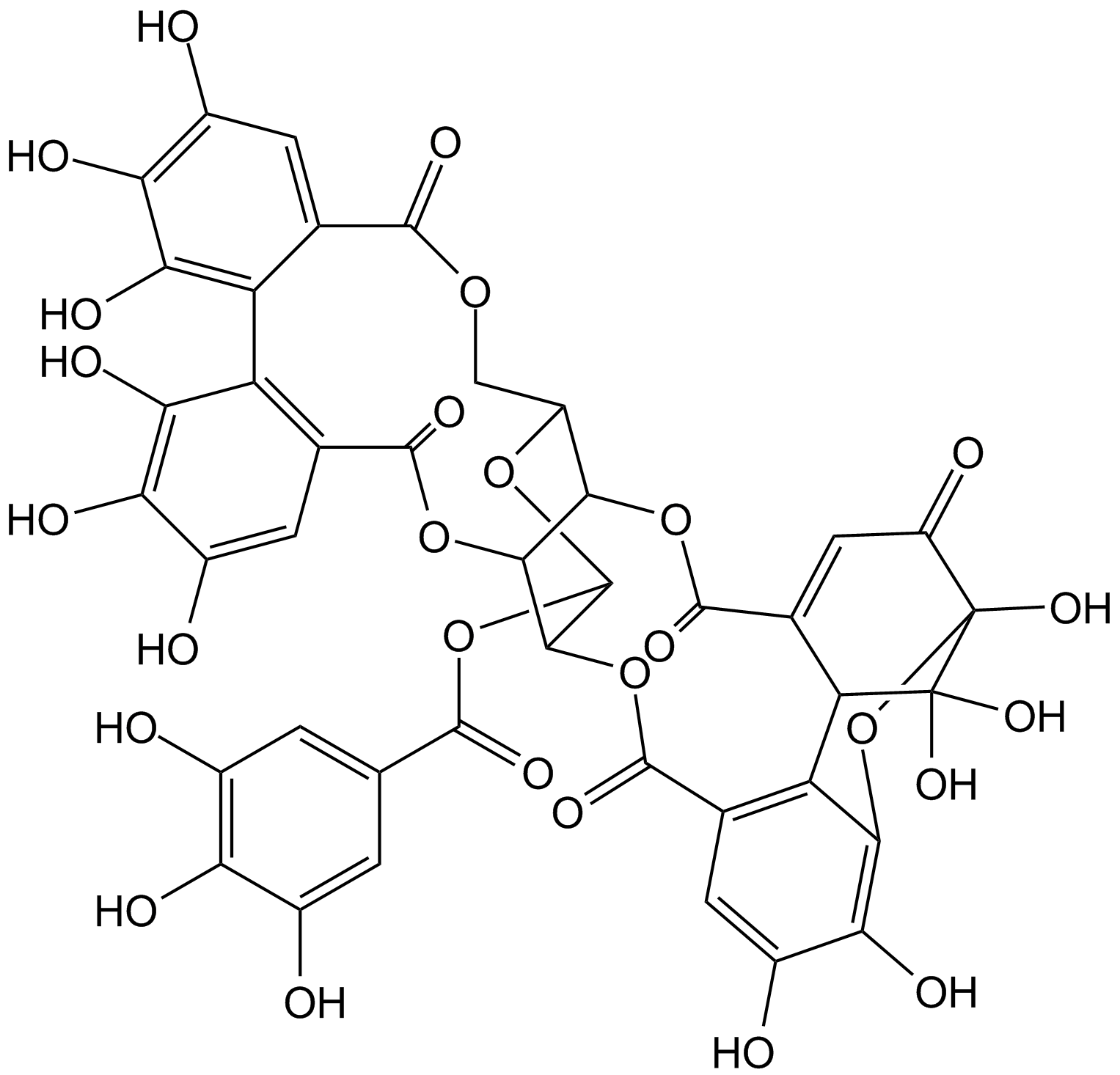
Cas No.: 60976-49-0
Sample solution is provided at 25 µL, 10mM.
_1-3.$$$39978408@51.jpg');)
_1-9.$$$38538795@65.jpg');)
_1-9.$$$39112701@51.jpg');)
_1-7.$$$37316672@70.jpg');)
_366-372.$$$36198801@70.jpg');)
.$$$38565142@65.jpg');)
_1867-1883.$$$33248023@67.jpg');)
_eads6055.$$$39977546@45.jpg');)
_eadm9805.$$$40080571@45.jpg');)
_eadj3020.$$$39666821@45.jpg');)
_1-20.$$$39757301@28.jpg');)
_1-24.$$$38898113@28.jpg');)
_273-287.$$$36806353@46.jpg');)
_1-16.$$$37156877@44.jpg');)
_1-19.$$$37460805@44.jpg');)
_1291-1307.$$$34518654@46.jpg');)
GeraniinはTNF-α放出阻害剤であり、 IC50値は43μMであり、抗癌、抗炎症や抗高血糖の作用など、様々な活性を示す[1]。Geraniinは、核因子Nrf2の核移行を誘発でき、グルタチオン(GSH)のレベルを向上させ、細胞内ROSのレベルを低下させられる[2]。Geraniinは、腫瘍成長の阻害とミトコンドリア機能の干渉のために、細胞と動物モデルに広く使われている[3]。
In vitro(体外)実験で、Geraniinで48時間処理したところ、OVCAR3とSKOV3細胞の生存率を著しく阻害し、IC50値はそれぞれ34.5μMと23.6μMであった[4]。36µMのGeraniinで24時間処理したところ、HT-29細胞の成長を抑制し、核の形態変化とDNAの断片化を誘発した[5]。T24細胞を20µMのGeraniinで24時間処理したところ、細胞周期停止を誘発し、S期におけるT24細胞の割合を減らし、細胞のアポトーシスを促進し、PI3K/AKTシグナル伝達経路を調節した[6]。
In vivo(体内)実験で、Geraniin(20mg/kg/日)を14日間、毎日胃内投与したところ、マウスで、リポ多糖類(LPS)誘発の認知障害を軽減し、LPS誘発の神経/シナプス損傷を改善し、Aβの産生を減らした[7]。Geraniin(8mg/kg/日)を10週間連続で、毎日胃内投与すれば、高脂肪食を与えているApoE−/−マウスの体重を減らし、血清トリグリセリド(TG)のレベル、低密度のリポタンパク質コレステロール(LDL-C)のレベルを下げることができる[8]。
References:
[1] Okabe S, Suganuma M, Imayoshi Y, et al. New TNF-α releasing inhibitors, geraniin and corilagin, in leaves of Acer nikoense, Megusurino-ki[J]. Biological and Pharmaceutical Bulletin, 2001, 24(10): 1145-1148.
[2] Cheng H S, Ton S H, Abdul Kadir K. Ellagitannin geraniin: a review of the natural sources, biosynthesis, pharmacokinetics and biological effects[J]. Phytochemistry reviews, 2017, 16(1): 159-193.
[3] Li J, Wang S, Yin J, et al. Geraniin induces apoptotic cell death in human lung adenocarcinoma A549 cells in vitro and in vivo[J]. Canadian Journal of Physiology and Pharmacology, 2013, 91(12): 1016-1024.
[4] Wang X, Chen Z, Li X, et al. Geraniin suppresses ovarian cancer growth through inhibition of NF‐κB activation and downregulation of Mcl‐1 expression[J]. Journal of Biochemical and Molecular Toxicology, 2017, 31(9): e21929.
[5] Chan C K, Tang L Y, Goh B H, et al. Targeting apoptosis via inactivation of PI3K/Akt/mTOR signaling pathway involving NF-κB by geraniin in HT-29 human colorectal adenocarcinoma cells[J]. Progress in Drug Discovery & Biomedical Science, 2019, 2(1).
[6] Xu J, Qin N, Yao Y, et al. Geraniin inhibits bladder cancer cell growth via regulation of PI3K/AKT signaling pathways[J]. Tropical Journal of Pharmaceutical Research, 2020, 19(2): 253-257.
[7] Wang D, Dong X, Wang B, et al. Geraniin attenuates lipopolysaccharide-induced cognitive impairment in mice by inhibiting toll-like receptor 4 activation[J]. Journal of Agricultural and Food Chemistry, 2019, 67(36): 10079-10088.
[8] Xie Y, Liu S, Wei Z, et al. Geraniin Alleviates High‐Fat Diet‐Induced Atherosclerosis in ApoE−/− Mice[J]. Food Science & Nutrition, 2025, 13(7): e70693.
| 細胞実験[1]: | |
細胞株 | OVCAR3細胞 |
準備方法 | 37℃、5% CO2の存在下で、10%のウシ胎児血清を含有するDulbecco's改変Eagle's培地でOVCAR3細胞を培養した。5×10³個の細胞/ウェルの密度で、OVCAR3細胞を96ウェルの平底プレートに播種し、24時間培養した。細胞を様々な濃度のGeraniin(0、5、10、20、40と80µM)で処理し、細胞の生存率を48時間後に検出した。 |
反応条件 | 0、5、10、20、40と80µM;48時間 |
アプリケーション | Geraniinの処理は、OVCAR3細胞の生存率を濃度依存的に減らした。 |
| 動物実験 [2]: | |
動物モデル | 雄のApoE−/−マウス |
準備方法 | 24°C±1°Cに設定された室温、40%から50%の間にコントロールされた相対湿度、12時間の明暗周期の無特定病原体(SPF)の実験環境で雄のApoE−/−マウス(6週齢)を飼育した。全てのマウスには順応食を1週間投与した。ApoE−/−マウスをランダムに2つのグループのどちらかに割り当てた(n=6/グループ):(1)ApoE−/−マウスモデルグループ;(2)Geraniin 8mg/kg/日(経口投与)。全てのApoE−/−マウスに、0.5%のコレステロールを含有する高脂肪食(40% kcalの脂肪)を10週間投与した。分析のために、マウスを毎週体重を測り、血液を採取した。 |
投与形態 | 8mg/kg/日、10週間;経口投与 |
アプリケーション | Geraniinの処理は、高脂肪食を投与したApoE−/−マウスの体重を減らし、TGとLDL-Cのレベルを減らした。 |
References: | |
| Cas No. | 60976-49-0 | SDF | |
| 同義語 | NSC 359346 | ||
| Canonical SMILES | OC1=C(O)C(O)=C(C(C(O)=C(O)C(O)=C2)=C2C(O[C@H]3[C@@H]4OC(C(C=C(O)C(O)=C5OC6(O)C(O)7O)=C5C7C8=CC6=O)=O)=O)C(C(OC[C@H](O[C@@H]4OC(C9=CC(O)=C(O)C(O)=C9)=O)[C@@H]3OC8=O)=O)=C1 | ||
| Formula | C41H28O27 | M.Wt | 952.08 |
| 溶解度 | DMF: 30 mg/ml,DMSO: 30 mg/ml,Ethanol: 30 mg/ml,Ethanol:PBS (pH 7.2) (1:3): 0.25 mg/ml | Storage | 4°C, away from moisture and light |
| General tips | Please select the appropriate solvent to prepare the stock solution according to the
solubility of the product in different solvents; once the solution is prepared, please store it in
separate packages to avoid product failure caused by repeated freezing and thawing.Storage method
and period of the stock solution: When stored at -80°C, please use it within 6 months; when stored
at -20°C, please use it within 1 month. To increase solubility, heat the tube to 37°C and then oscillate in an ultrasonic bath for some time. |
||
| Shipping Condition | Evaluation sample solution: shipped with blue ice. All other sizes available: with RT, or with Blue Ice upon request. | ||
| Prepare stock solution | |||

|
1 mg | 5 mg | 10 mg |
| 1 mM | 1.0503 mL | 5.2517 mL | 10.5033 mL |
| 5 mM | 210.1 μL | 1.0503 mL | 2.1007 mL |
| 10 mM | 105 μL | 525.2 μL | 1.0503 mL |
Step 1: Enter information below (Recommended: An additional animal making an allowance for loss during the experiment)
 g
μL
g
μL
Step 2: Enter the in vivo formulation (This is only the calculator, not formulation. Please contact us first if there is no in vivo formulation at the solubility Section.)
Calculation results:
Working concentration: mg/ml;
Method for preparing DMSO master liquid: mg drug pre-dissolved in μL DMSO ( Master liquid concentration mg/mL, Please contact us first if the concentration exceeds the DMSO solubility of the batch of drug. )
Method for preparing in vivo formulation: Take μL DMSO master liquid, next addμL PEG300, mix and clarify, next addμL Tween 80, mix and clarify, next add μL saline, mix and clarify.
Method for preparing in vivo formulation: Take μL DMSO master liquid, next add μL Corn oil, mix and clarify.
Note: 1. Please make sure the liquid is clear before adding the next solvent.
2. Be sure to add the solvent(s) in order. You must ensure that the solution obtained, in the previous addition, is a clear solution before proceeding to add the next solvent. Physical methods such as vortex, ultrasound or hot water bath can be used to aid dissolving.
3. All of the above co-solvents are available for purchase on the GlpBio website.
Quality Control & SDS
- View current batch:
- Purity: >98.00% Appearance: A solid
- COA (Certificate of Analysis)
- SDS (Safety Data Sheet)
- Datasheet
Average Rating: 5 (Based on Reviews and 30 reference(s) in Google Scholar.)