
NCI172112 (NSC172112) |
| カタログ番号GC34194 |
NCI172112 (NSC172112) は、CNS 腫瘍に対して有効な抗腫瘍剤を開発するために合成された、古典的な二官能性アルキル化剤です。
Products are for research use only. Not for human use. We do not sell to patients.
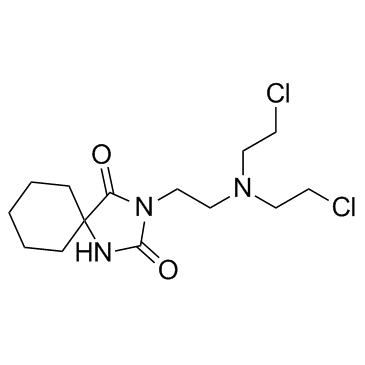
Cas No.: 56605-16-4
Sample solution is provided at 25 µL, 10mM.
NCI172112 is a classical bifunctional alkylating agent synthesized in an effort to develop antitumor agents effective against CNS tumors.
NCI172112 (Spirohydantoin mustard, SHM) might serve as a carrier to cross the blood brain barrier[1]. The cumulative excretion of radioactivity in the urine and faeces of rats after administration of [2-chloroethyl-U-14C]NCI172112 or [hydantoin-4-14C]NCI172112 ( 3.13 mg/kg. i.v.) is measured. Four hours after dosing, a significantly (P<0.005) greater amount of radioactivity has been excreted in the urine of rats treated with [hydantoin-14C]NCI172112 than with [ethyl-14C]NCI172112. However, by 24 h, approx.50% of dose is recovered in the urine with both labelled materials. Clearance of radioactivity in the faeces is slow, but, as for the renal excretion, is significantly greater for the hydantoin-14C moiety. No radioactivity is found in the expired air of a rat receiving a single dosing of [hydantoin-14C]NCI172112 and less than 1% is measured after administration of [ethyl-14C]NCI172112. Renal clearance of radioactivity is similar 4 h after administration of [14C]NCI172112 to rats with biliary cannulas, with 14.1±2.9 and 17.5±2.1% of the ethyl-14C and 34.5±2.5 and 33.1±6.3%, of the hydantoin-14C dose appearing in the urine after dosing with 3.13 and 6.25 mg/kg,respectively. A difference in the 4 h urinary excretion of the two labels also is observed in dogs given [14C]NCI172112 (1 mg/kg, i.v.). The percentages of hydantoin-14C and ethyl-14C eliminated are 29.4±2.7% and 17.2±3.5%, respectively (P<0.05)[2].
[1]. Brown TD, et al. A phase I trial of spirohydantoin mustard (NSC 172112) in patients with advanced cancer. J Clin Oncol. 1986 Aug;4(8):1270-6. [2]. Plowman J, et al. The disposition of spirohydantoin mustard (NSC 172112) in rats and dogs. Xenobiotica. 1979 Jun;9(6):379-91.

Animal experiment: | Rats[2]Male Sprague-Dawley rats (190-240 g) are lightly anaesthetized with pentobarbital (30 mg/kg i.p.) and [14C]NCI172112 (2 μCi/rat, 3.13 mg/kg) dissolved in DMSO injected into the femoral vein. The animals are individually housed in glass metabolic cages, with access to food and water for 96 h, and urine and faeces are collected separately. At 96 h, the rats are killed with an overdose of pentobarbital and each carcass is homogenized in 4 vol. water with a Waring blender. Radioactivity in aliquots of drug soln. and urine are measured by liquid scintillation counting with 15 mL phosphor.Dogs[2]Female foxhounds, weighing 15-20 kg, are anaesthetized with pentobarbital (30 mg/kg) and are maintained in this state throughout the experiment with aditional pentobarbital. [14C] NCI172112 (50-60 μCi, 1 mg/kg) in 1 mL DMSO is administered to the dogs via a catheter inserted into the femoral vein. Blood samples are withdrawn from the femoral artery by means of an indwelling catheter at timed intervals from 1 min to 4 h and transferred to heparinized tubes chilled on crushed ice. Immediately, a 0.5 mL aliquot is removed and extracted with three 2 mL vol. of cold toluene. The remaining blood is centrifuged, and 0.5 mL aliquots of plasma digested with NCS, extracted with 2 mL vol. of toluene or diluted with 2 mL 10% trichloroacetic acid. From the initial sampling of the dog blood to the start of the extraction or pptn. procedures for plasma, 8-14 min elapsed. |
References: [1]. Brown TD, et al. A phase I trial of spirohydantoin mustard (NSC 172112) in patients with advanced cancer. J Clin Oncol. 1986 Aug;4(8):1270-6. | |
| Cas No. | 56605-16-4 | SDF | |
| Canonical SMILES | O=C(N1CCN(CCCl)CCCl)NC2(CCCCC2)C1=O | ||
| Formula | C14H23Cl2N3O2 | M.Wt | 336.26 |
| 溶解度 | Soluble in DMSO | Storage | Store at -20°C |
| General tips | Please select the appropriate solvent to prepare the stock solution according to the
solubility of the product in different solvents; once the solution is prepared, please store it in
separate packages to avoid product failure caused by repeated freezing and thawing.Storage method
and period of the stock solution: When stored at -80°C, please use it within 6 months; when stored
at -20°C, please use it within 1 month. To increase solubility, heat the tube to 37°C and then oscillate in an ultrasonic bath for some time. |
||
| Shipping Condition | Evaluation sample solution: shipped with blue ice. All other sizes available: with RT, or with Blue Ice upon request. | ||
| Prepare stock solution | |||
|
1 mg | 5 mg | 10 mg |
| 1 mM | 2.9739 mL | 14.8694 mL | 29.7389 mL |
| 5 mM | 594.8 μL | 2.9739 mL | 5.9478 mL |
| 10 mM | 297.4 μL | 1.4869 mL | 2.9739 mL |
Step 1: Enter information below (Recommended: An additional animal making an allowance for loss during the experiment)
Step 2: Enter the in vivo formulation (This is only the calculator, not formulation. Please contact us first if there is no in vivo formulation at the solubility Section.)
Calculation results:
Working concentration: mg/ml;
Method for preparing DMSO master liquid: mg drug pre-dissolved in μL DMSO ( Master liquid concentration mg/mL, Please contact us first if the concentration exceeds the DMSO solubility of the batch of drug. )
Method for preparing in vivo formulation: Take μL DMSO master liquid, next addμL PEG300, mix and clarify, next addμL Tween 80, mix and clarify, next add μL ddH2O, mix and clarify.
Method for preparing in vivo formulation: Take μL DMSO master liquid, next add μL Corn oil, mix and clarify.
Note: 1. Please make sure the liquid is clear before adding the next solvent.
2. Be sure to add the solvent(s) in order. You must ensure that the solution obtained, in the previous addition, is a clear solution before proceeding to add the next solvent. Physical methods such as vortex, ultrasound or hot water bath can be used to aid dissolving.
3. All of the above co-solvents are available for purchase on the GlpBio website.
Quality Control & SDS
- View current batch:
- Purity: >99.00%
- COA (Certificate Of Analysis)
- SDS (Safety Data Sheet)
- Datasheet
Average Rating: 5 (Based on Reviews and 31 reference(s) in Google Scholar.)
GLPBIO products are for RESEARCH USE ONLY. Please make sure your review or question is research based.
Required fields are marked with *


