

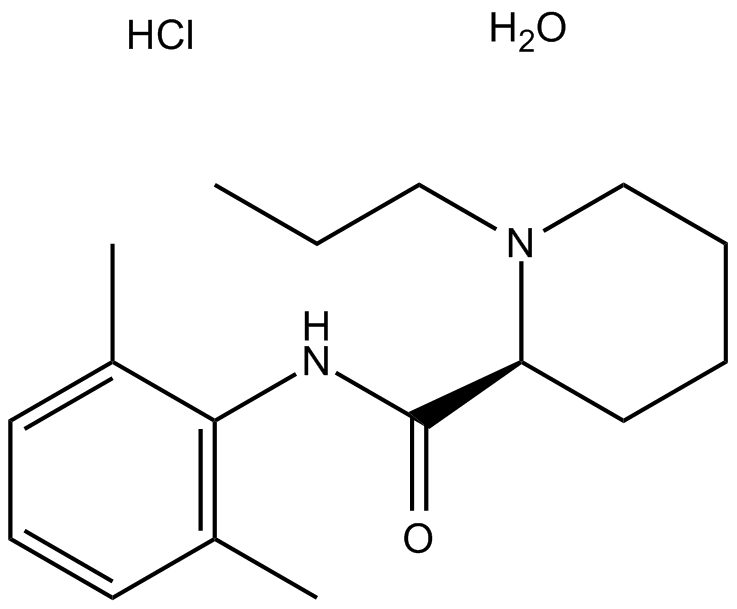
Ropivacaine hydrochloride monohydrate (Synonyms: LEA 103, (S)-Ropivacaine) |
カタログ番号GC16390
 One-Click Copy Product Info
|

ロピバカイン塩酸塩一水和物は、強力なナトリウムチャネルブロッカーであり、神経線維におけるナトリウムイオン流入の可逆的阻害を介してインパルス伝導をブロックします。
Products are for research use only. Not for human use. We do not sell to patients.
Cas No.: 132112-35-7
Sample solution is provided at 25 µL, 10mM.
_1-3.$$$39978408@51.jpg');)
_1-9.$$$38538795@65.jpg');)
_1-9.$$$39112701@51.jpg');)
_1-7.$$$37316672@70.jpg');)
_366-372.$$$36198801@70.jpg');)
.$$$38565142@65.jpg');)
_1867-1883.$$$33248023@67.jpg');)
_eads6055.$$$39977546@45.jpg');)
_eadm9805.$$$40080571@45.jpg');)
_eadj3020.$$$39666821@45.jpg');)
_1-20.$$$39757301@28.jpg');)
_1-24.$$$38898113@28.jpg');)
_273-287.$$$36806353@46.jpg');)
_1-16.$$$37156877@44.jpg');)
_1-19.$$$37460805@44.jpg');)
_1291-1307.$$$34518654@46.jpg');)
Ropivacaine hydrochloride monohydrate is an effective, long-acting and local anaesthetic [1].
In COS-7 cells, Ropivacaine hydrochloride monohydrate has been reported to inhibit the the SUR2A/Kir6.2 channel currents. The inhibitory effects of Ropivacaine have shown be concentration-dependent and reversible because the channel currents recovered after washout. Furthermore, the IC50 values of Ropivacaine hydrochloride monohydrate are 249±11, 2235±115, 2442±132 and 2375±179μM for SUR2A/Kir6.2, SUR2B/Kir6.1, SUR2B/Kir6.2 and Kir6.2△C36, respectively. Apart from these, Ropivacaine hydrochloride monohydrate has also demonstrated to inhibit sarcolemmal KATP channels in the cardiovascular system by a stereoselective and tissue-specific way[2].
References:
[1] Reiz S1, Häggmark S, Johansson G, Nath S. Cardiotoxicity of ropivacaine--a new amide local anaesthetic agent. Acta Anaesthesiol Scand. 1989 Feb;33(2):93-8.
[2] Kawano T1, Oshita S, Takahashi A, Tsutsumi Y, Tomiyama Y, Kitahata H, Kuroda Y, Nakaya Y. Molecular mechanisms of the inhibitory effects of bupivacaine, levobupivacaine, and ropivacaine on sarcolemmal adenosine triphosphate-sensitive potassium channels in the cardiovascular system. Anesthesiology. 2004 Aug;101(2):390-8.
| Cas No. | 132112-35-7 | SDF | |
| 同義語 | LEA 103, (S)-Ropivacaine | ||
| Chemical Name | (2S)-N-(2,6-dimethylphenyl)-1-propylpiperidine-2-carboxamide;hydrate;hydrochloride | ||
| Canonical SMILES | CCCN1CCCCC1C(=O)NC2=C(C=CC=C2C)C.O.Cl | ||
| Formula | C17H29ClN2O2 | M.Wt | 328.88 |
| 溶解度 | 25mg/mL in Water; 50mg/mL in DMSO | Storage | Store at -20°C |
| General tips | Please select the appropriate solvent to prepare the stock solution according to the
solubility of the product in different solvents; once the solution is prepared, please store it in
separate packages to avoid product failure caused by repeated freezing and thawing.Storage method
and period of the stock solution: When stored at -80°C, please use it within 6 months; when stored
at -20°C, please use it within 1 month. To increase solubility, heat the tube to 37°C and then oscillate in an ultrasonic bath for some time. |
||
| Shipping Condition | Evaluation sample solution: shipped with blue ice. All other sizes available: with RT, or with Blue Ice upon request. | ||
| Prepare stock solution | |||

|
1 mg | 5 mg | 10 mg |
| 1 mM | 3.0406 mL | 15.2031 mL | 30.4062 mL |
| 5 mM | 608.1 μL | 3.0406 mL | 6.0812 mL |
| 10 mM | 304.1 μL | 1.5203 mL | 3.0406 mL |
Step 1: Enter information below (Recommended: An additional animal making an allowance for loss during the experiment)
 g
μL
g
μL
Step 2: Enter the in vivo formulation (This is only the calculator, not formulation. Please contact us first if there is no in vivo formulation at the solubility Section.)
Calculation results:
Working concentration: mg/ml;
Method for preparing DMSO master liquid: mg drug pre-dissolved in μL DMSO ( Master liquid concentration mg/mL, Please contact us first if the concentration exceeds the DMSO solubility of the batch of drug. )
Method for preparing in vivo formulation: Take μL DMSO master liquid, next addμL PEG300, mix and clarify, next addμL Tween 80, mix and clarify, next add μL saline, mix and clarify.
Method for preparing in vivo formulation: Take μL DMSO master liquid, next add μL Corn oil, mix and clarify.
Note: 1. Please make sure the liquid is clear before adding the next solvent.
2. Be sure to add the solvent(s) in order. You must ensure that the solution obtained, in the previous addition, is a clear solution before proceeding to add the next solvent. Physical methods such as vortex, ultrasound or hot water bath can be used to aid dissolving.
3. All of the above co-solvents are available for purchase on the GlpBio website.
Quality Control & SDS
- View current batch:
- Purity: >99.50% Appearance: A solid
- COA (Certificate of Analysis)
- SDS (Safety Data Sheet)
- Datasheet
Average Rating: 5 (Based on Reviews and 39 reference(s) in Google Scholar.)