

SRT1720 HCl (Synonyms: SRT-1720,SRT 1720,SRT 1720 Hydrochloride) |
カタログ番号GC17101
 One-Click Copy Product Info
|

SRT1720 HClは、NAD+依存性のタンパク質とヒストン脱アセチル化酵素であるSIRT1(EC1.5 = 0.16 µM、最大の活性化= 781%)の活性剤であり、数多くの生理学的なプロセスでは重要な役割を果たしている。
Products are for research use only. Not for human use. We do not sell to patients.
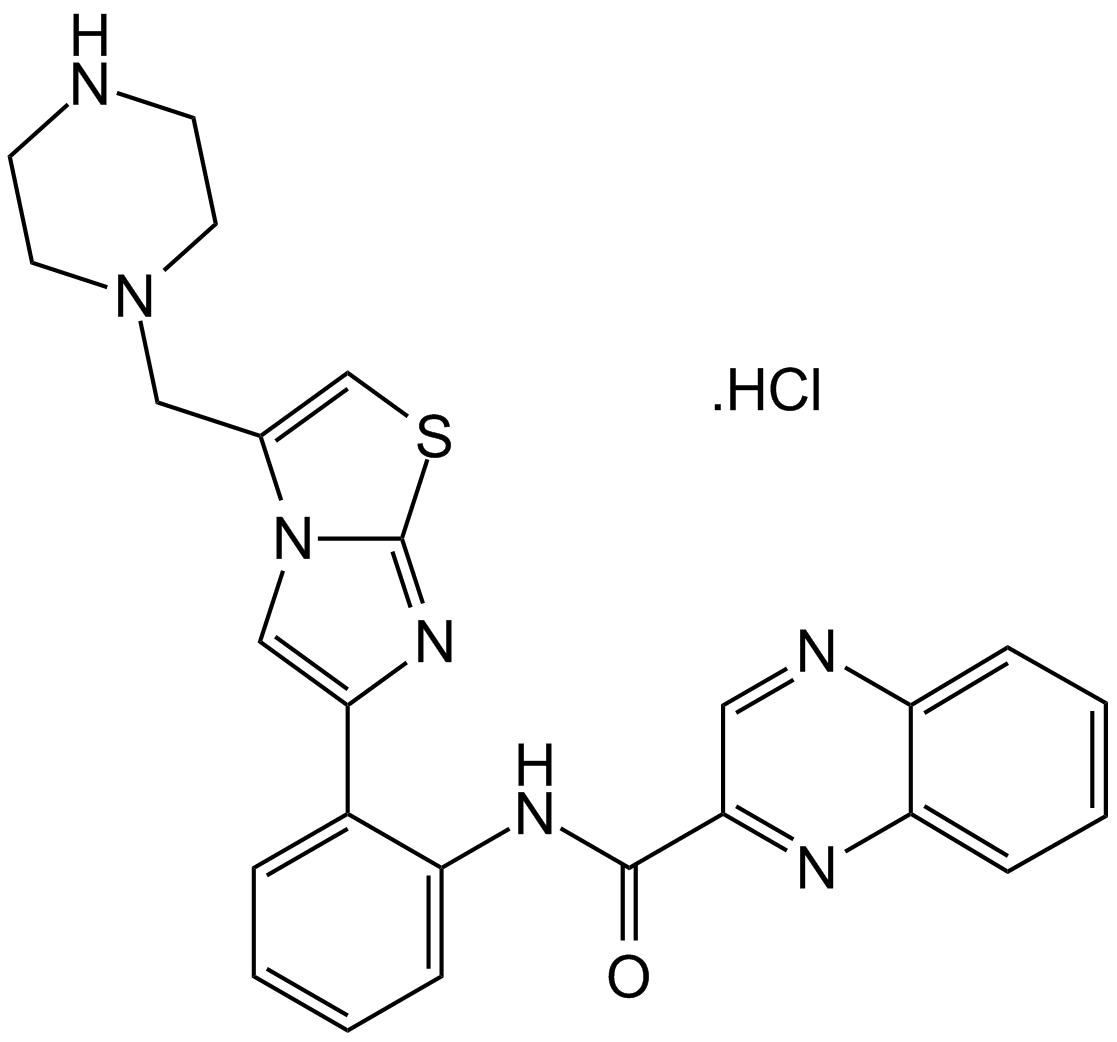
Cas No.: 1001645-58-4
Sample solution is provided at 25 µL, 10mM.
SRT1720 HClは、NAD+依存性のタンパク質とヒストン脱アセチル化酵素であるSIRT1(EC1.5 = 0.16 µM、最大の活性化= 781%)の活性剤であり[1]、数多くの生理学的なプロセスでは重要な役割を果たしている[2]。SRT1720 HClはp300活性をも阻害し、IC50は9μMである[3]。
SRT1720 HCl処理は、HepG2細胞における脂質生成遺伝子の発見を減らした[4]。MDA-MB-231とBT20基礎型乳癌細胞の生存率は、5 µMのSRT1720 HClで80%以上減り、20 µMの処理ではMCF-7管腔型細胞の生存率は20%しか減らなかった。SRT1720 HCl (5 µM、8時間)の処理の後、1%のMDA-MB-231細胞は早期のアポトーシスに陽性で、12%の細胞は後期のアポトーシス/壊死に陽性である[2]。
SRT1720 HCl (200 mg/kg、10週間)はMSGマウスで、肝臓の脂肪蓄積を減らし、肝不全を改善した。MSGマウスにSRT1720 HClを10週間投与した結果、脂肪の蓄積を21%減らした。アミノトランスフェラーゼの血清レベルはMSGマウスでも上昇された。SRT1720 HClの投与はMSGマウスの脂質異常を改善した[4]。SRT1720 HCl (100 mg/kg)の投与は、1週間の処理後、飼料誘発肥満(DIO)マウスでグルコースのレベルを減らし、10週間の投与でこのような状態が続いた[5]。
References:
[1]. Milne J C, Lambert P D, Schenk S, et al. Small molecule activators of SIRT1 as therapeutics for the treatment of type 2 diabetes[J]. Nature, 2007, 450(7170): 712-716.
[2]. Lahusen T J, Deng C X. SRT1720 Induces Lysosomal-Dependent Cell Death of Breast Cancer CellsSRT1720 Induces Lysosomal-Dependent Cell Death[J]. Molecular cancer therapeutics, 2015, 14(1): 183-192. SRT1720 treatment decreased the expression of lipogenic genes in HepG2 cells.
[3]. Huber J L, McBurney M W, DiStefano P S, et al. SIRT1-independent mechanisms of the putative sirtuin enzyme activators SRT1720 and SRT2183[J]. Future medicinal chemistry, 2010, 2(12): 1751-1759.
[4]. Yamazaki Y, Usui I, Kanatani Y, et al. Treatment with SRT1720, a SIRT1 activator, ameliorates fatty liver with reduced expression of lipogenic enzymes in MSG mice[J]. American Journal of Physiology-Endocrinology and Metabolism, 2009, 297(5): E1179-E1186.
| 細胞実験[1]: | |
細胞株 | MDA-MB-231乳癌細胞、BT20基礎型乳癌細胞、MCF-7管腔型細胞 |
準備方法 | MDA-MB-231細胞を1ウェルあたり15000細胞の密度で24ウェルのプレートで播種した。その次の日に、指定された時間と濃度でSRT1720 HClを細胞に添加した。細胞の生存率はメチルチアゾリジフェニルテトラゾリウム臭化物(MTT)アッセイで測定した。 |
反応条件 | 0-20µM、24時間 |
アプリケーション | MDA-MB-231とBT20基礎型乳癌細胞の生存率は、5 µMのSRT1720 HClで80%以上減り、20 µMの処理ではMCF-7管腔型細胞の生存率は20%しか減らなかった。 |
| 動物実験 [2]: | |
動物モデル | 雄のMSGマウスと対照の雄のICRマウス |
準備方法 | SRT1720 HCl処理を始める前に、6週齢の20匹のICRマウスと12匹のMSGマウスを事前処理グループとして分析した。SRT1720 HClは標準飼料(200 mg/kg体重/日)で混合させ、6週齢のMSGマウスに10週間経口投与した。SRT1720 HCl の処理を受けた16週齢の15匹のICRマウス、15匹のMSGマウスを、10週間の処理期の後に、ポスト処理グループとして分析した。 |
投与形態 | 200 mg/kg体重/日、経口 |
アプリケーション | SRT1720 HClの投与は、PGC-1αのアセチル化レベルをほぼ対照レベルと同様の程度に減らしたが、肝臓におけるmRNAまたはタンパク質のレベルのどちらでもSIRT1の発見を変えなかった。16週齢のMSGマウスの体重と精巣上体の脂肪の重量は、対照群のマウスよりもそれぞれ約20%と60%高かった。SRT1720 HClの処理は、MSGマウスの体重または食物の摂取には明な影響を与えなかった。 |
References: | |
| Cas No. | 1001645-58-4 | SDF | |
| 同義語 | SRT-1720,SRT 1720,SRT 1720 Hydrochloride | ||
| Chemical Name | N-[2-[3-(piperazin-1-ylmethyl)imidazo[2,1-b][1,3]thiazol-6-yl]phenyl]quinoxaline-2-carboxamide;hydrochloride | ||
| Canonical SMILES | C1CN(CCN1)CC2=CSC3=NC(=CN23)C4=CC=CC=C4NC(=O)C5=NC6=CC=CC=C6N=C5.Cl | ||
| Formula | C25H23N7OS.HCl | M.Wt | 506.02 |
| 溶解度 | 100 mg/mL in DMSO | Storage | Store at -20°C |
| General tips | Please select the appropriate solvent to prepare the stock solution according to the
solubility of the product in different solvents; once the solution is prepared, please store it in
separate packages to avoid product failure caused by repeated freezing and thawing.Storage method
and period of the stock solution: When stored at -80°C, please use it within 6 months; when stored
at -20°C, please use it within 1 month. To increase solubility, heat the tube to 37°C and then oscillate in an ultrasonic bath for some time. |
||
| Shipping Condition | Evaluation sample solution: shipped with blue ice. All other sizes available: with RT, or with Blue Ice upon request. | ||
| Prepare stock solution | |||

|
1 mg | 5 mg | 10 mg |
| 1 mM | 1.9762 mL | 9.881 mL | 19.7621 mL |
| 5 mM | 395.2 μL | 1.9762 mL | 3.9524 mL |
| 10 mM | 197.6 μL | 988.1 μL | 1.9762 mL |
Step 1: Enter information below (Recommended: An additional animal making an allowance for loss during the experiment)
 g
μL
g
μL
Step 2: Enter the in vivo formulation (This is only the calculator, not formulation. Please contact us first if there is no in vivo formulation at the solubility Section.)
Calculation results:
Working concentration: mg/ml;
Method for preparing DMSO master liquid: mg drug pre-dissolved in μL DMSO ( Master liquid concentration mg/mL, Please contact us first if the concentration exceeds the DMSO solubility of the batch of drug. )
Method for preparing in vivo formulation: Take μL DMSO master liquid, next addμL PEG300, mix and clarify, next addμL Tween 80, mix and clarify, next add μL saline, mix and clarify.
Method for preparing in vivo formulation: Take μL DMSO master liquid, next add μL Corn oil, mix and clarify.
Note: 1. Please make sure the liquid is clear before adding the next solvent.
2. Be sure to add the solvent(s) in order. You must ensure that the solution obtained, in the previous addition, is a clear solution before proceeding to add the next solvent. Physical methods such as vortex, ultrasound or hot water bath can be used to aid dissolving.
3. All of the above co-solvents are available for purchase on the GlpBio website.
Quality Control & SDS
- View current batch:
- Purity: >98.00% Appearance: A solid
- COA (Certificate of Analysis)
- SDS (Safety Data Sheet)
- Datasheet
Average Rating: 5 (Based on Reviews and 30 reference(s) in Google Scholar.)