

Anacetrapib (MK-0859) (Synonyms: MK-0859) |
Catalog No.GC17520
 One-Click Copy Product Info
|

A CETP inhibitor
Products are for research use only. Not for human use. We do not sell to patients.
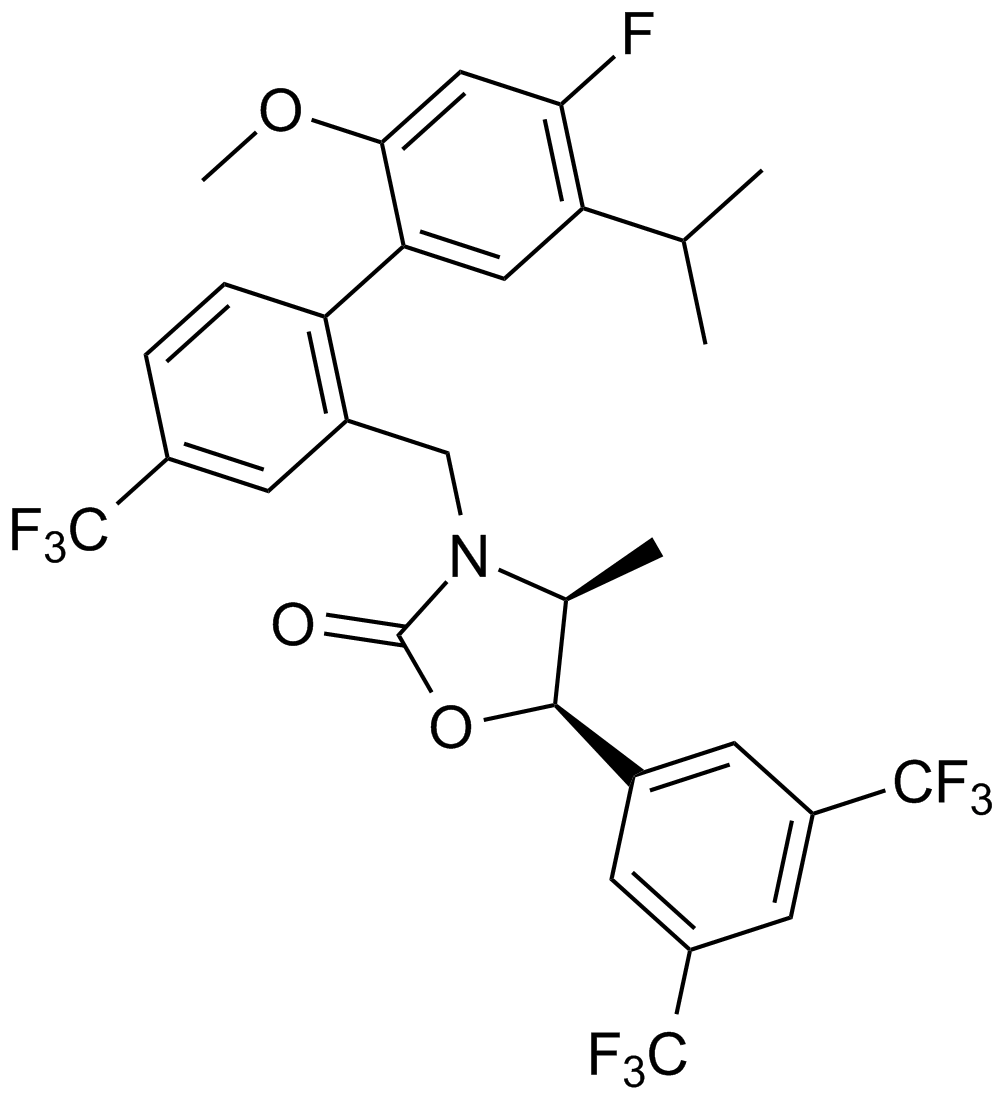
Cas No.: 875446-37-0
Sample solution is provided at 25 µL, 10mM.
_1-3.$$$39978408@51.jpg');)
_1-9.$$$38538795@65.jpg');)
_1-9.$$$39112701@51.jpg');)
_1-7.$$$37316672@70.jpg');)
_366-372.$$$36198801@70.jpg');)
.$$$38565142@65.jpg');)
_1867-1883.$$$33248023@67.jpg');)
_eads6055.$$$39977546@45.jpg');)
_eadm9805.$$$40080571@45.jpg');)
_eadj3020.$$$39666821@45.jpg');)
_1-20.$$$39757301@28.jpg');)
_1-24.$$$38898113@28.jpg');)
_273-287.$$$36806353@46.jpg');)
_1-16.$$$37156877@44.jpg');)
_1-19.$$$37460805@44.jpg');)
_1291-1307.$$$34518654@46.jpg');)
Anacetrapib, also known as MK-0859, is a potent and selective inhibitor of cholesteryl ester transfer protein (CETP) that exhibits strong inhibition against CETP-mediated transfer of cholesteryl esters and triglycerides with values of inhibition constant IC50 of 16 nM and 29 nM respectively. Anacetrapib is mainly metabolized by CYP3A4 through O-demethylation, hydroxylation on the biphenyl moiety and hydroxylation on the isopropyl side chain resulting in three oxidative metabolites M1, M2 and M3 respectively. Anacetrapib is being investigated for the treatment of primary hypercholesterolemia and mixed hyperlipidemia due to its impressive effects to lower low-density lipoprotein (LDL) cholesterol levels and increase high-density lipoprotein (HDL) cholesterol levels without any associated major adverse events.
Reference
[1].Tan EY, Hartmann G, Chen Q, Pereira A, Bradley S, Doss G, Zhang AS, Ho JZ, Braun MP, Dean DC, Tang W, Kumar S. Pharmacokinetics, metabolism, and excretion of anacetrapib, a novel inhibitor of the cholesteryl ester transfer protein, in rats and rhesus monkeys. Drug Metab Dispos. 2010;38(3):459-473.
[2].Kumar S, Tan EY, Hartmann G, Biddle Z, Bergman AJ, Dru J, Ho JZ, Jones AN, Staskiewicz SJ, Braun MP, Karanam B, Dean DC, Gendrano IN, Graves MW, Wagner JA, Krishna R. Metabolism and excretion of anacetrapib, a novel inhibitor of the cholesteryl ester transfer protein, in humans. Drug Metab Dispos. 2010;38(3):474-483
|
Kinase experiment: |
The inhibitory potency (IC50) of Dalcetrapib, Torcetrapib, and Anacetrapib to decrease CE transfer from HDL to LDL by rhCETP and C13S CETP is measured using a scintillation proximity assay kit. Briefly, [3H]CE-labeled HDL donor particles are incubated in the presence of purified CETP proteins (final concentration 0.5 µg/mL) and biotinylated LDL acceptor particles for 3 h at 37°C. Subsequently, streptavidin-coupled polyvinyltoluene beads containing liquid scintillation cocktail binding selectively to biotinylated LDL are added, and the amount of [3H]CE molecules transferred to LDL is measured by β counting[1]. |
|
Cell experiment: |
Cells are seeded in a 96 well plate overnight prior to the treatment by different concentrations of CETP inhibitors (e.g., Anacetrapib) for 24 h. Cell viability is measured using the CellTiter-Glo Luminescent Cell Viability Assay kit. Four wells are evaluated under each experimental condition[2]. |
|
Animal experiment: |
Mice[2] Eight-week old male C57BL/6J mice are housed (4 animals/cage) under controlled temperature (72°F) and lighting (12 h light/dark cycle). Animals have free access to autoclaved water and food. In the first in vivo study, after an acclimatization period of 7 days, mice are fed a high-fat high-cholesterol diet (HFHC) containing 35% calories from fat and 1.25% cholesterol for two weeks. Mice are then divided into two groups (n=8 per group) and are given a daily dose of Anacetrapib at 50 mg/kg by oral gavage. The control group receive vehicle (0.5% methyl cellulose). The drug treatment lasts 7 days. In the second in vivo study, mice fed a normal chow diet are treated with Anacetrapib (50 mg/kg, n=8) or vehicle (n=8) for 10 days. Serum samples are collected after a 4 h fasting before and after the drug treatment. After the last dosing, all animals are sacrificed for collection of serum and liver tissues. Livers are immediately removed, cut into small pieces, and stored at −80°C for RNA and protein isolations and cholesterol measurement. Rats[3] Adult male Sprague-Dawley rats, weighing 280 to 330 g, are fasted overnight before the study. The animals are allowed access to food 4 h after dosing, but water is provided ad libitum. For intravenous administration, four rats received a dose of Anacetrapib (dosing volume 2.5 mL/kg) via bolus injection through a catheter previously implanted into the femoral vein, followed by a 300 μL saline flush. The intravenous dose of Anacetrapib is formulated in polyethylene glycol 300-water (7:3, v/v) at a concentration of 0.2 mg/mL. For oral administration, four rats received a dose via oral gavage (dosing volume 2 mL/kg). These oral doses of 5, 50, 100, and 500 mg/kg are formulated in Imwitor 742-Tween 80 (1:1, w/w) at concentrations of 2.5, 25, 50, and 250 mg/mL, respectively. Blood samples (0.3 mL) are collected into EDTA-containing tubes at the following time points: predose and 0.083 (intravenous only), 0.25, 0.5, 1, 2, 4, 6, 8, 24, and 48 h postdose. Blood samples are stored on ice, and plasma is prepared by centrifugation. Plasma is transferred to a 96-well plate and stored at −70°C until analysis. |
|
References: [1]. Niesor EJ, et al. Modulating cholesteryl ester transfer protein activity maintains efficient pre-β-HDL formation and increases reverse cholesterol transport. J Lipid Res. 2010, 51(12), 3443-3454. |
|
| Cas No. | 875446-37-0 | SDF | |
| Synonyms | MK-0859 | ||
| Chemical Name | (4S,5R)-5-[3,5-bis(trifluoromethyl)phenyl]-3-[[2-(4-fluoro-2-methoxy-5-propan-2-ylphenyl)-5-(trifluoromethyl)phenyl]methyl]-4-methyl-1,3-oxazolidin-2-one | ||
| Canonical SMILES | CC1C(OC(=O)N1CC2=C(C=CC(=C2)C(F)(F)F)C3=CC(=C(C=C3OC)F)C(C)C)C4=CC(=CC(=C4)C(F)(F)F)C(F)(F)F | ||
| Formula | C30H25F10NO3 | M.Wt | 637.51 |
| Solubility | ≥ 31.9 mg/mL in DMSO, ≥ 86.6 mg/mL in EtOH | Storage | Store at -20°C |
| General tips | Please select the appropriate solvent to prepare the stock solution according to the
solubility of the product in different solvents; once the solution is prepared, please store it in
separate packages to avoid product failure caused by repeated freezing and thawing.Storage method
and period of the stock solution: When stored at -80°C, please use it within 6 months; when stored
at -20°C, please use it within 1 month. To increase solubility, heat the tube to 37°C and then oscillate in an ultrasonic bath for some time. |
||
| Shipping Condition | Evaluation sample solution: shipped with blue ice. All other sizes available: with RT, or with Blue Ice upon request. | ||
| Prepare stock solution | |||

|
1 mg | 5 mg | 10 mg |
| 1 mM | 1.5686 mL | 7.843 mL | 15.686 mL |
| 5 mM | 313.7 μL | 1.5686 mL | 3.1372 mL |
| 10 mM | 156.9 μL | 784.3 μL | 1.5686 mL |
Step 1: Enter information below (Recommended: An additional animal making an allowance for loss during the experiment)
 g
μL
g
μL
Step 2: Enter the in vivo formulation (This is only the calculator, not formulation. Please contact us first if there is no in vivo formulation at the solubility Section.)
Calculation results:
Working concentration: mg/ml;
Method for preparing DMSO master liquid: mg drug pre-dissolved in μL DMSO ( Master liquid concentration mg/mL, Please contact us first if the concentration exceeds the DMSO solubility of the batch of drug. )
Method for preparing in vivo formulation: Take μL DMSO master liquid, next addμL PEG300, mix and clarify, next addμL Tween 80, mix and clarify, next add μL saline, mix and clarify.
Method for preparing in vivo formulation: Take μL DMSO master liquid, next add μL Corn oil, mix and clarify.
Note: 1. Please make sure the liquid is clear before adding the next solvent.
2. Be sure to add the solvent(s) in order. You must ensure that the solution obtained, in the previous addition, is a clear solution before proceeding to add the next solvent. Physical methods such as vortex, ultrasound or hot water bath can be used to aid dissolving.
3. All of the above co-solvents are available for purchase on the GlpBio website.
Quality Control & SDS
- View current batch:
- Purity: >99.50% Appearance: A solid
- COA (Certificate of Analysis)
- SDS (Safety Data Sheet)
- Datasheet
Average Rating: 5 (Based on Reviews and 30 reference(s) in Google Scholar.)