

CAL-130 Hydrochloride |
Catalog No.GC11135
 One-Click Copy Product Info
|

Products are for research use only. Not for human use. We do not sell to patients.
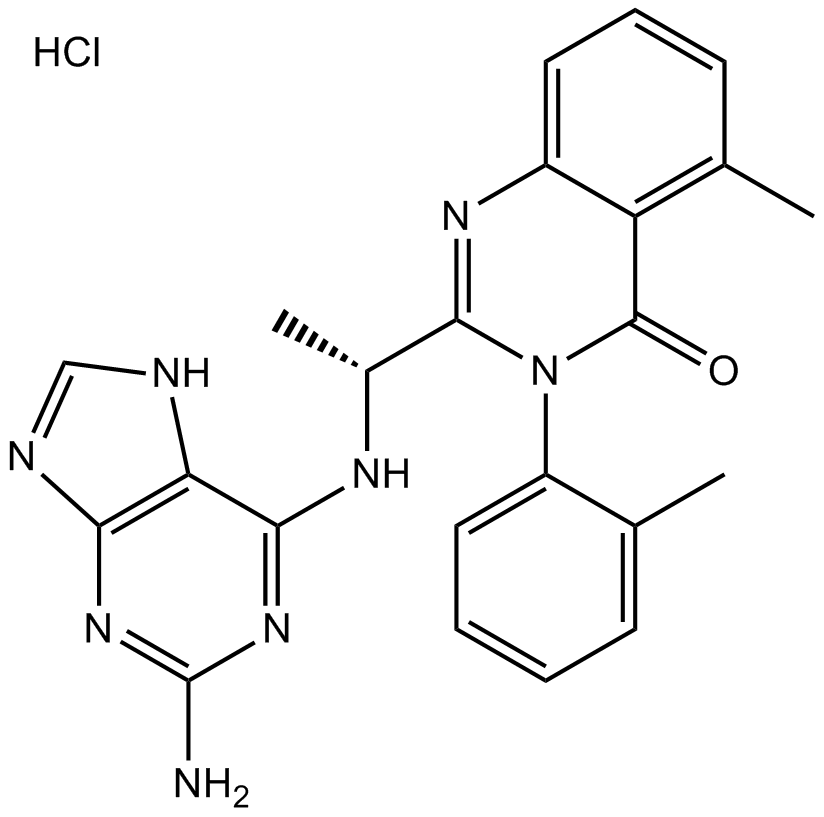
Cas No.: 1431697-78-7
Sample solution is provided at 25 µL, 10mM.
_1-3.$$$39978408@51.jpg');)
_1-9.$$$38538795@65.jpg');)
_1-9.$$$39112701@51.jpg');)
_1-7.$$$37316672@70.jpg');)
_366-372.$$$36198801@70.jpg');)
.$$$38565142@65.jpg');)
_1867-1883.$$$33248023@67.jpg');)
_eads6055.$$$39977546@45.jpg');)
_eadm9805.$$$40080571@45.jpg');)
_eadj3020.$$$39666821@45.jpg');)
_1-20.$$$39757301@28.jpg');)
_1-24.$$$38898113@28.jpg');)
_273-287.$$$36806353@46.jpg');)
_1-16.$$$37156877@44.jpg');)
_1-19.$$$37460805@44.jpg');)
_1291-1307.$$$34518654@46.jpg');)
Class I phosphoinositide 3-kinase (PI3K) activate fundamental pathways controlling cell survival, metabolism, proliferation and and therefore play crucial role in cancer development. It is reported that p110γ is mainly expressed in leukocytes, whose role in cancer development is recently starting to be studied. CAL-130 is a specific dual inhibitor of p110γ and p110δ.
In vitro: To demonstrate that CAL-130 can block the activities of both PI3Kγ and PI3Kδ in thymocytes, previous autors evaluated its ability of preventing phosphorylation of Akt (Ser473) and calcium flux in response to T cell receptor (TCR). Consistently, CAL-130 treated thymocytes from 6-week-old WT animals prevented TCR-induced Akt phosphorylation and attenuated calcium flux to levels observed for their Pik3cγ-/-; Pik3cδ-/- counterparts [1].
In vivo: To assess the in vivo efficacy, previous study determined its effects on 6-week-old WT mice thymi. Mice orally received 10 mg/kg of the inhibitor, which was sufficient to maintain plasma concentrations of 0.33 μM at the end of 8 hrs. Moreover, such dose did not affect either plasma glucose or insulin levels. In contrast, CAL-130 treatment (10 mg/kg every 8 hrs) for a period of 7 days greatly affected the size, cellularity, and overall architecture of the thymus. Notely there was a 18-fold reduction in total thymocyte number when comparred to controls, which was mainly due to the DP population loss [1].
Clinical trial: CAL-130 is currently in the preclinical developlent stage and no clinical data are available.
Reference:
[1] Subramaniam PS, Whye DW, Efimenko E, Chen J, Tosello V, De Keersmaecker K, Kashishian A, Thompson MA, Castillo M, Cordon-Cardo C, Davé UP, Ferrando A, Lannutti BJ, Diacovo TG. Targeting nonclassical oncogenes for therapy in T-ALL. Cancer Cell. 2012;21(4):459-72.
Kinase experiment: | IC50 values for CAL-130 inhibition of PI3K isoforms are determined in ex vivo PI3 kinase assays using recombinant PI3K. A ten-point kinase inhibitory profile is determined with ATP at a concentration consistent with the KM for each enzyme[1]. |
Cell experiment: | Cell proliferation of CCRF-CEM cells or shRNA-transfected CCRF-CEM cells, in presence or absence of CAL-130 (1, 2.5 and 5 μM), is followed by cell counting of samples in triplicate using a hemocytometer and trypan blue. For apoptosis determinations of untransfected or shRNA-transfected CCRF-CEMs, cells are stained with APC-conjugated Annexin-V in Annexin Binding Buffer and analyzed by flow cytometry. For primary T-ALL samples, cell viability is assessed using the BD Cell Viability kit coupled with the use of fluorescentcounting beads. For this, cells are plated with MS5-DL1 stroma cells, and after 72 hr following CAL-130 treatment, cells are harvested and stained with an APC-conjugated antihuman CD45 followed by a staining with the aforementioned kit[1]. |
Animal experiment: | Mice[1]For subcutaneous xenograft experiments, luminescent CCRF-CEM (CEMluc) cells are generated by lentiviral infection with FUW-luc and selection with Neomycin. Luciferase expression is verified with the Dual-Luciferase Reporter Assay kit. 2.5×10⁶ CEM-luc cells embedded in Matrigel are injected in the flank of NOD.Cg-Prkdcscid Il2rgtm1Wjl/Sz mice. After 1 week, mice are treated by oral gavage with vehicle (0.5% methyl cellulose, 0.1% Tween 80), or CAL-130 (10 mg/kg) every 8 hr daily for 4 days, and then tumors are imaged as follows: mice anesthetized by isoflurane inhalation are injected intraperitoneally with D-luciferin (50 mg/kg). Photonic emission is imaged with the in vivo imaging system. Tumor bioluminescence is quantified by integrating the photonic flux (photons per second) through a region encircling each tumor using the Living Image software package. Administration of D-luciferin and detection of tumor bioluminescence in Lck/Ptenfl/fl/Gt(ROSA)26Sortm1(Luc)Kael/J mice are performed in a similar manner. |
References: [1]. Subramaniam Prem S, et al. Targeting nonclassical oncogenes for therapy in T-ALL. Cancer cell (2012), 21(4), 459-72. | |
| Cas No. | 1431697-78-7 | SDF | |
| Chemical Name | (R)-2-(1-((2-amino-7H-purin-6-yl)amino)ethyl)-5-methyl-3-(o-tolyl)quinazolin-4(3H)-one hydrochloride | ||
| Canonical SMILES | O=C1N(C2=CC=CC=C2C)C([C@@H](C)NC3=NC(N)=NC4=C3NC=N4)=NC5=CC=CC(C)=C15.Cl | ||
| Formula | C23H23ClN8O | M.Wt | 462.93 |
| Solubility | Soluble in DMSO | Storage | Store at -20°C |
| General tips | Please select the appropriate solvent to prepare the stock solution according to the
solubility of the product in different solvents; once the solution is prepared, please store it in
separate packages to avoid product failure caused by repeated freezing and thawing.Storage method
and period of the stock solution: When stored at -80°C, please use it within 6 months; when stored
at -20°C, please use it within 1 month. To increase solubility, heat the tube to 37°C and then oscillate in an ultrasonic bath for some time. |
||
| Shipping Condition | Evaluation sample solution: shipped with blue ice. All other sizes available: with RT, or with Blue Ice upon request. | ||
| Prepare stock solution | |||

|
1 mg | 5 mg | 10 mg |
| 1 mM | 2.1602 mL | 10.8008 mL | 21.6015 mL |
| 5 mM | 432 μL | 2.1602 mL | 4.3203 mL |
| 10 mM | 216 μL | 1.0801 mL | 2.1602 mL |
Step 1: Enter information below (Recommended: An additional animal making an allowance for loss during the experiment)
 g
μL
g
μL
Step 2: Enter the in vivo formulation (This is only the calculator, not formulation. Please contact us first if there is no in vivo formulation at the solubility Section.)
Calculation results:
Working concentration: mg/ml;
Method for preparing DMSO master liquid: mg drug pre-dissolved in μL DMSO ( Master liquid concentration mg/mL, Please contact us first if the concentration exceeds the DMSO solubility of the batch of drug. )
Method for preparing in vivo formulation: Take μL DMSO master liquid, next addμL PEG300, mix and clarify, next addμL Tween 80, mix and clarify, next add μL saline, mix and clarify.
Method for preparing in vivo formulation: Take μL DMSO master liquid, next add μL Corn oil, mix and clarify.
Note: 1. Please make sure the liquid is clear before adding the next solvent.
2. Be sure to add the solvent(s) in order. You must ensure that the solution obtained, in the previous addition, is a clear solution before proceeding to add the next solvent. Physical methods such as vortex, ultrasound or hot water bath can be used to aid dissolving.
3. All of the above co-solvents are available for purchase on the GlpBio website.
Quality Control & SDS
- View current batch:
- Purity: >99.50% Appearance: A solid
- COA (Certificate of Analysis)
- SDS (Safety Data Sheet)
- Datasheet
Average Rating: 5 (Based on Reviews and 30 reference(s) in Google Scholar.)