

SBE13 |
Catalog No.GC37601
 One-Click Copy Product Info
|

SBE13은 IC50이 200pM인 강력하고 선택적인 Plk1 억제제입니다. SBE13은 Plk2(IC50>66μM) 또는 Plk3(IC50=875nM)을 잘 억제하지 않습니다.
Products are for research use only. Not for human use. We do not sell to patients.
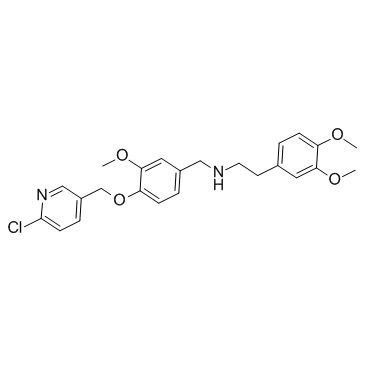
Cas No.: 775294-82-1
Sample solution is provided at 25 µL, 10mM.
_1-3.$$$39978408@51.jpg');)
_1-9.$$$38538795@65.jpg');)
_1-9.$$$39112701@51.jpg');)
_1-7.$$$37316672@70.jpg');)
_366-372.$$$36198801@70.jpg');)
.$$$38565142@65.jpg');)
_1867-1883.$$$33248023@67.jpg');)
_eads6055.$$$39977546@45.jpg');)
_eadm9805.$$$40080571@45.jpg');)
_eadj3020.$$$39666821@45.jpg');)
_1-20.$$$39757301@28.jpg');)
_1-24.$$$38898113@28.jpg');)
_273-287.$$$36806353@46.jpg');)
_1-16.$$$37156877@44.jpg');)
_1-19.$$$37460805@44.jpg');)
_1291-1307.$$$34518654@46.jpg');)
SBE13 is a potent and selective Plk1 inhibitor, with an IC50 of 200 pM; SBE13 poorly inhibits Plk2 (IC50>66 μM) or Plk3 (IC50=875 nM). PLK1|200 pM (IC50)|PLK3|875 nM (IC50)
SBE13 significantly reduce cell proliferation and induce apoptosis in HeLa cells, with an EC50 of 18 μM[1]. SBE13 (1-100 μM) shows no effect on Caspase 3/7 activity in NIH-3T3 cells. SBE13 (66 and 100 μM) does not change morphology after treatment of primary cells. SBE13 (10 and 100 μM) reduces pRb staining in primary cells, and this indicates a G0/G1 arrest[2]. SBE13 (66 and 100 μM) increases levels of cyclin B1, phospho histone H3, Wee1, Emi1 and securin, and results in cleavage of Cdc27 in HeLa cells. SBE13 (10 and 100 μM) also induces apoptosis of HeLa cells[3].
[1]. Keppner S, et al. Identification and validation of a potent type II inhibitor of inactive polo-like kinase 1. ChemMedChem. 2009 Nov;4(11):1806-9. [2]. Keppner S, et al. Fate of primary cells at the G•/S boundary after polo-like kinase 1 inhibition by SBE13. Cell Cycle. 2011 Feb 15;10(4):708-20. Epub 2011 Feb 15. [3]. Keppner S, et al. Biological impact of freezing Plk1 in its inactive conformation in cancer cells. Cell Cycle. 2010 Feb 15;9(4):761-73. Epub 2010 Feb 16.
Kinase experiment: | To assay Plk1 kinase activity, cells are lysed after 13?h release in the presence of SBE13 after double thymidine block and kinase is immunoprecipitated from lysates using antibodies. In brief, for each immunoprecipitation 800?μg of total protein are incubated with Plk1 antibody cocktail (1.5?μg) for 2?h at 4°C on a rotator. Immunoprecipitated protein is collected using Protein A/G Agarose beads. Plk1 immunoprecipitates are incubated with casein (1?μg) and with [γ-32P]ATP (1?μCi) for 30?min at 37°C in kinase buffer. Products from the kinase assays are fractionated on 10?% bis-tris-polyacrylamide gels, and phosphorylated substrate is visualized by autoradiography after an exposure of 12-36?h. Equal amounts of immunoprecipitates are subjected to Western blot analysis to confirm equal loading of Plk1 protein in kinase reactions[1]. |
References: [1]. Keppner S, et al. Identification and validation of a potent type II inhibitor of inactive polo-like kinase 1. ChemMedChem. 2009 Nov;4(11):1806-9. | |
| Cas No. | 775294-82-1 | SDF | |
| Canonical SMILES | COC1=CC=C(CCNCC2=CC=C(OCC3=CC=C(Cl)N=C3)C(OC)=C2)C=C1OC | ||
| Formula | C24H27ClN2O4 | M.Wt | 442.94 |
| Solubility | Soluble in DMSO | Storage | Store at -20°C |
| General tips | Please select the appropriate solvent to prepare the stock solution according to the
solubility of the product in different solvents; once the solution is prepared, please store it in
separate packages to avoid product failure caused by repeated freezing and thawing.Storage method
and period of the stock solution: When stored at -80°C, please use it within 6 months; when stored
at -20°C, please use it within 1 month. To increase solubility, heat the tube to 37°C and then oscillate in an ultrasonic bath for some time. |
||
| Shipping Condition | Evaluation sample solution: shipped with blue ice. All other sizes available: with RT, or with Blue Ice upon request. | ||
| Prepare stock solution | |||

|
1 mg | 5 mg | 10 mg |
| 1 mM | 2.2576 mL | 11.2882 mL | 22.5764 mL |
| 5 mM | 451.5 μL | 2.2576 mL | 4.5153 mL |
| 10 mM | 225.8 μL | 1.1288 mL | 2.2576 mL |
Step 1: Enter information below (Recommended: An additional animal making an allowance for loss during the experiment)
 g
μL
g
μL
Step 2: Enter the in vivo formulation (This is only the calculator, not formulation. Please contact us first if there is no in vivo formulation at the solubility Section.)
Calculation results:
Working concentration: mg/ml;
Method for preparing DMSO master liquid: mg drug pre-dissolved in μL DMSO ( Master liquid concentration mg/mL, Please contact us first if the concentration exceeds the DMSO solubility of the batch of drug. )
Method for preparing in vivo formulation: Take μL DMSO master liquid, next addμL PEG300, mix and clarify, next addμL Tween 80, mix and clarify, next add μL saline, mix and clarify.
Method for preparing in vivo formulation: Take μL DMSO master liquid, next add μL Corn oil, mix and clarify.
Note: 1. Please make sure the liquid is clear before adding the next solvent.
2. Be sure to add the solvent(s) in order. You must ensure that the solution obtained, in the previous addition, is a clear solution before proceeding to add the next solvent. Physical methods such as vortex, ultrasound or hot water bath can be used to aid dissolving.
3. All of the above co-solvents are available for purchase on the GlpBio website.
Quality Control & SDS
- View current batch:
- Purity: >98.00% Appearance: A solid
- COA (Certificate of Analysis)
- SDS (Safety Data Sheet)
- Datasheet
Average Rating: 5 (Based on Reviews and 4 reference(s) in Google Scholar.)