

GSK2126458 (Omipalisib) (Synonyms: GSK212; GSK-2126458; GSK 2126458; GSK-212; GSK 212) |
Catalog No.GC15072
 One-Click Copy Product Info
|

GSK2126458 (GSK2126458) is an orally active and highly selective inhibitor of PI3K with Kis of 0.019 nM/0.13 nM/0.024 nM/0.06 nM and 0.18 nM/0.3 nM for p110α/β/δ/γ, mTORC1/2 , 각각. GSK2126458은 항암 활성이 있습니다.
Products are for research use only. Not for human use. We do not sell to patients.
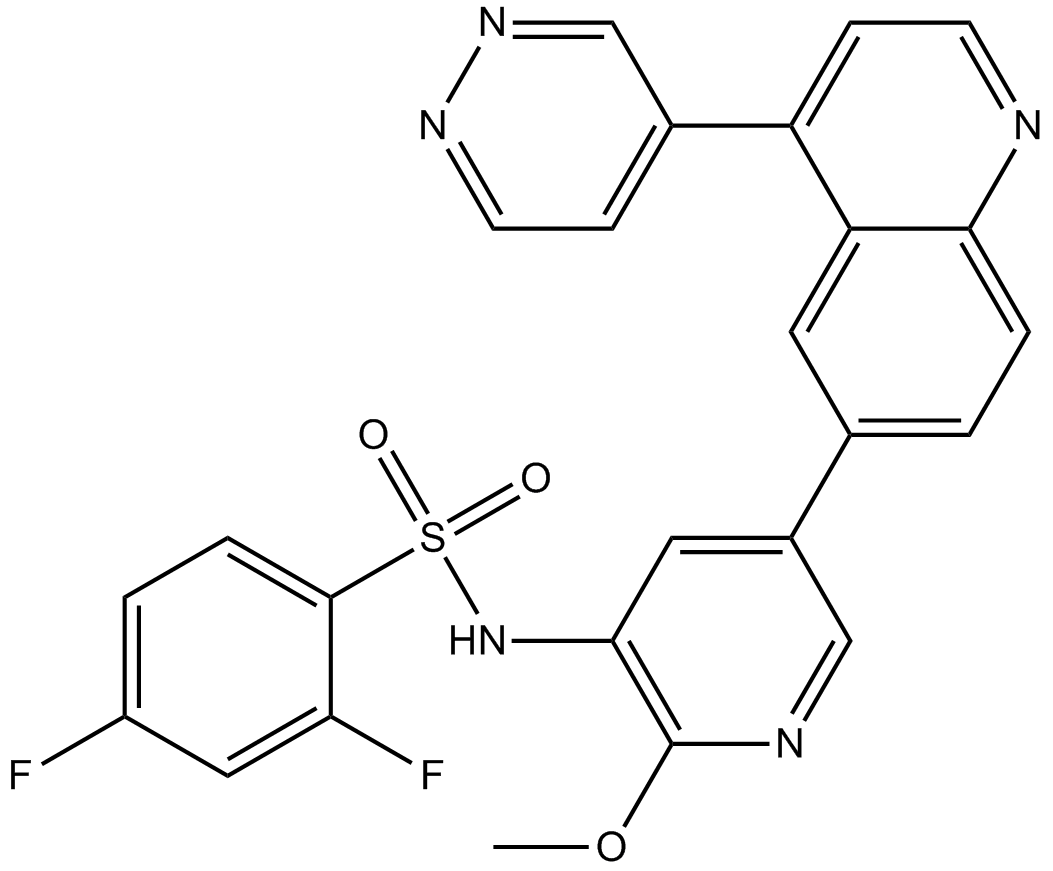
Cas No.: 1086062-66-9
Sample solution is provided at 25 µL, 10mM.
_1-3.$$$39978408@51.jpg');)
_1-9.$$$38538795@65.jpg');)
_1-9.$$$39112701@51.jpg');)
_1-7.$$$37316672@70.jpg');)
_366-372.$$$36198801@70.jpg');)
.$$$38565142@65.jpg');)
_1867-1883.$$$33248023@67.jpg');)
_eads6055.$$$39977546@45.jpg');)
_eadm9805.$$$40080571@45.jpg');)
_eadj3020.$$$39666821@45.jpg');)
_1-20.$$$39757301@28.jpg');)
_1-24.$$$38898113@28.jpg');)
_273-287.$$$36806353@46.jpg');)
_1-16.$$$37156877@44.jpg');)
_1-19.$$$37460805@44.jpg');)
_1291-1307.$$$34518654@46.jpg');)
GSK2126458 (Omipalisib) is an orally active and highly selective inhibitor of PI3K with Ki values of 0.019nM/0.13nM/0.024nM/0.06nM and 0.18nM/0.3nM for p110α/β/δ/γ, mTORC1/2, respectively[1]. GSK2126458 targets the PI3K/Akt/mTOR pathway, reducing the glycolytic activity of cancer cells and causing metabolic disorders in the cells, thereby inhibiting the growth of cancer cells[2]. GSK2126458 has been widely used in cancer research as a radiosensitizer or chemosensitizer to efficiently kill cancer cells[3].
In vitro, GSK2126458 treatment for 72 hours significantly inhibited the viability of A549, HCT116 and MDA-MB-231 cells, with IC50 values of 0.6µM, 0.01µM, and 0.13µM, respectively[4]. Treatment with 160nM GSK2126458 for 24 hours induced cell cycle arrest in esophageal squamous cell carcinoma (ESCC) cells, accompanied by a decrease in CCND1 expression and an increase in the number of apoptotic cells[5]. Treatment with 10µM GSK2126458 for 48 hours led to cell death and autophagy in C76N cells and increased the expression of Atg12, LC3A and LC3B[6]. Incubation with 50nM GSK2126458 for 24 hours downregulated the genes related to amino acid metabolism and mitochondrial biosynthesis in OCI-AML3 cells, and inhibited mitochondrial respiration[7].
In vivo, GSK2126458 treatment via oral administration at a dose of 1mg/kg twice daily for 7 days prolonged the cardiac repolarization in the canine model of atrioventricular block, accompanied by a mild proarrhythmic outcome[8]. Daily intraperitoneal injection of GSK2126458 (1mg/kg) for 2 months reduced the overphosphorylated tau protein expression and mitigated spatial memory deficits in tau P301S (1N4R) mutant (PS19) male mice[9].
References:[1] Knight S D, Adams N D, Burgess J L, et al. Discovery of GSK2126458, a highly potent inhibitor of PI3K and the mammalian target of rapamycin[J]. ACS medicinal chemistry letters, 2010, 1(1): 39.
[2] Bye B A, Jack J L, Pierce A, et al. Combined omipalisib and MAPK Inhibition suppress PDAC growth[J]. Cancers, 2025, 17(7): 1152.
[3] Du J, Chen F, Yu J, et al. The PI3K/mTOR inhibitor ompalisib suppresses nonhomologous end joining and sensitizes cancer cells to radio-and chemotherapy[J]. Molecular Cancer Research, 2021, 19(11): 1889-1899.
[4] Chen Y, Zhang L, Yang C, et al. Discovery of benzenesulfonamide derivatives as potent PI3K/mTOR dual inhibitors with in vivo efficacies against hepatocellular carcinoma[J]. Bioorganic & medicinal chemistry, 2016, 24(5): 957-966.
[5] Zhu D, Dong J, Xu Y, et al. Omipalisib inhibits esophageal squamous cell carcinoma growth through inactivation of phosphoinositide 3-Kinase (PI3K)/AKT/Mammalian target of rapamycin (mTOR) and ERK signaling[J]. Medical Science Monitor: International Medical Journal of Experimental and Clinical Research, 2020, 26: e927106-1.
[6] Basu D, Salgado C M, Bauer B, et al. The dual PI3K/mToR inhibitor omipalisib/GSK2126458 inhibits clonogenic growth in oncogenically-transformed cells from neurocutaneous melanocytosis[J]. Cancer Genomics-Proteomics, 2018, 15(4): 239-248.
[7] Tseng C Y, Fu Y H, Ou D L, et al. Anti-leukemia effects of omipalisib in acute myeloid leukemia: inhibition of PI3K/AKT/mTOR signaling and suppression of mitochondrial biogenesis[J]. Cancer Gene Therapy, 2023, 30(12): 1691-1701.
[8] van Bavel J J A, Pham C, Beekman H D M, et al. PI3K/mTOR inhibitor omipalisib prolongs cardiac repolarization along with a mild proarrhythmic outcome in the AV block dog model[J]. Frontiers in cardiovascular medicine, 2022, 9: 956538.
[9] Hwang H, Kim N, Jeon S, et al. Omipalisib reduces hyperphosphorylated tau protein by modulating mTOR-autophagy pathway[J]. Plos one, 2026, 21(6): e0352120.
| Cell experiment [1]: | |
|
Cell lines |
A549 cells |
|
Preparation Method |
A549 cells were cultured in DMEM medium, supplemented with 10% fetal bovine serum (FBS) and 1% penicillin-streptomycin at 37°C in an incubator with 5% CO2. Cells were inoculated at a density of 5000 cells/well into 96-well plates overnight. Cells were treated with different concentrations (0, 0.001, 0.01, 0.1, 1, and 10μM) of GSK2126458. After 72h incubation, cell viability was measured. |
|
Reaction Conditions |
0, 0.001, 0.01, 0.1, 1, and 10μM; 72h |
|
Applications |
GSK2126458 treatment reduced cell viability of A549 cells in a dose-dependent manner. |
| Animal experiment [2]: | |
|
Animal models |
Male tau P301S (1N4R) mutant (PS19) mice |
|
Preparation Method |
Male PS19 mice (aged 6-month-old) were housed in plastic containers (2-4 mice per container), with controlled temperature (23±1°C), humidity (60±10%), a 12h light/dark cycle, and ad libitum access to food and water. Vehicle or GSK2126458 (1mg/kg) was intraperitoneally injected into the mice once a day for 2 months. The mice were anesthetized by intraperitoneal injection of avertin, and euthanasia was performed by cervical dislocation under deep anesthesia. The brains of the mice were harvested for analysis. |
|
Dosage form |
1mg/kg/day; 2 months; i.p. |
|
Applications |
GSK2126458 treatment decreased phosphorylated tau levels in the brains of PS19 mice. |
| References: [1] Chen Y, Zhang L, Yang C, et al. Discovery of benzenesulfonamide derivatives as potent PI3K/mTOR dual inhibitors with in vivo efficacies against hepatocellular carcinoma[J]. Bioorganic & medicinal chemistry, 2016, 24(5): 957-966. [2] Hwang H, Kim N, Jeon S, et al. Omipalisib reduces hyperphosphorylated tau protein by modulating mTOR-autophagy pathway[J]. Plos one, 2026, 21(6): e0352120. | |
| Cas No. | 1086062-66-9 | SDF | |
| Synonyms | GSK212; GSK-2126458; GSK 2126458; GSK-212; GSK 212 | ||
| Chemical Name | 2,4-difluoro-N-[2-methoxy-5-(4-pyridazin-4-ylquinolin-6-yl)pyridin-3-yl]benzenesulfonamide | ||
| Canonical SMILES | COC1=C(C=C(C=N1)C2=CC3=C(C=CN=C3C=C2)C4=CN=NC=C4)NS(=O)(=O)C5=C(C=C(C=C5)F)F | ||
| Formula | C25H17F2N5O3S | M.Wt | 505.5 |
| Solubility | ≥ 25.3mg/mL in DMSO | Storage | Store at -20°C |
| General tips | Please select the appropriate solvent to prepare the stock solution according to the
solubility of the product in different solvents; once the solution is prepared, please store it in
separate packages to avoid product failure caused by repeated freezing and thawing.Storage method
and period of the stock solution: When stored at -80°C, please use it within 6 months; when stored
at -20°C, please use it within 1 month. To increase solubility, heat the tube to 37°C and then oscillate in an ultrasonic bath for some time. |
||
| Shipping Condition | Evaluation sample solution: shipped with blue ice. All other sizes available: with RT, or with Blue Ice upon request. | ||
| Prepare stock solution | |||

|
1 mg | 5 mg | 10 mg |
| 1 mM | 1.9782 mL | 9.8912 mL | 19.7824 mL |
| 5 mM | 395.6 μL | 1.9782 mL | 3.9565 mL |
| 10 mM | 197.8 μL | 989.1 μL | 1.9782 mL |
Step 1: Enter information below (Recommended: An additional animal making an allowance for loss during the experiment)
 g
μL
g
μL
Step 2: Enter the in vivo formulation (This is only the calculator, not formulation. Please contact us first if there is no in vivo formulation at the solubility Section.)
Calculation results:
Working concentration: mg/ml;
Method for preparing DMSO master liquid: mg drug pre-dissolved in μL DMSO ( Master liquid concentration mg/mL, Please contact us first if the concentration exceeds the DMSO solubility of the batch of drug. )
Method for preparing in vivo formulation: Take μL DMSO master liquid, next addμL PEG300, mix and clarify, next addμL Tween 80, mix and clarify, next add μL saline, mix and clarify.
Method for preparing in vivo formulation: Take μL DMSO master liquid, next add μL Corn oil, mix and clarify.
Note: 1. Please make sure the liquid is clear before adding the next solvent.
2. Be sure to add the solvent(s) in order. You must ensure that the solution obtained, in the previous addition, is a clear solution before proceeding to add the next solvent. Physical methods such as vortex, ultrasound or hot water bath can be used to aid dissolving.
3. All of the above co-solvents are available for purchase on the GlpBio website.
Quality Control & SDS
- View current batch:
- Purity: >99.50% Appearance: A solid
- COA (Certificate of Analysis)
- SDS (Safety Data Sheet)
- Datasheet
Average Rating: 5 (Based on Reviews and 6 reference(s) in Google Scholar.)