

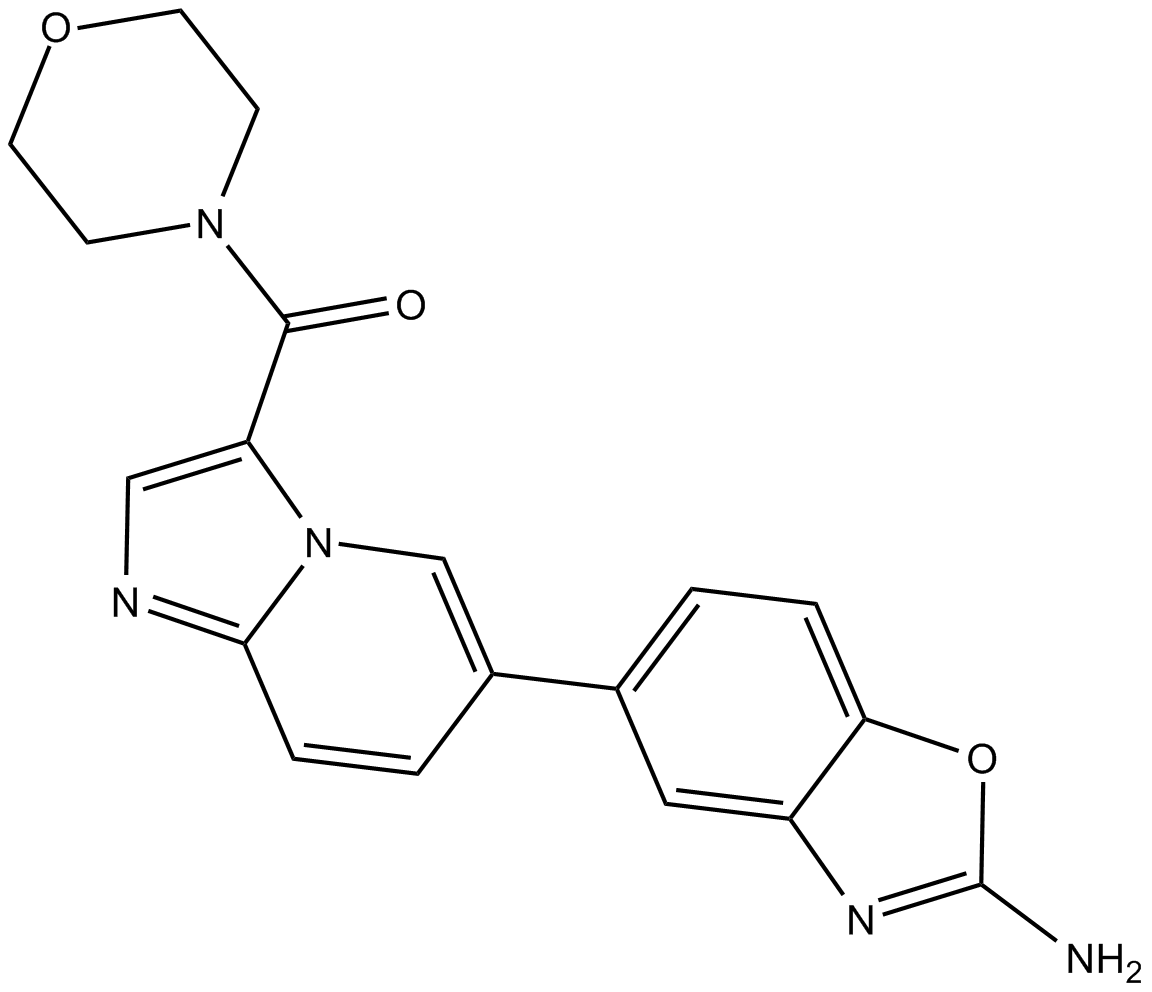
INK1117 (Synonyms: MLN1117,TAK-117;Serabelisib) |
Catalog No.GC12416
 One-Click Copy Product Info
|

INK1117(MLN1117)은 선택적 p110α이고; IC50이 15nM인 억제제.
Products are for research use only. Not for human use. We do not sell to patients.
Cas No.: 1268454-23-4
Sample solution is provided at 25 µL, 10mM.
IC50: 15nM: inhibits phosphoinositide 3-kinase α (PI3Kα) in vitro.
INK1117 is a novel, potent and selective inhibitor of PI3Kα with potential antineoplastic activity, which may induce tumor cell apoptosis and growth inhibition in PI3Kα-expressing tumor cells. INK1117 dampens signaling to Akt and suppresses the growth of cancer cells harboring wild-type or mutated p110α. PI3Ks, a family of eight lipid kinase enzymes, produce 3-phosphorylated phosphoinositides in cellular membranes and are promising targets for therapeutic development in cancer.
In vitro: INK1117 blocked class I PI3K enzymes (p110α, p110β, p110γ or p110δ) in the low to mid-nanomolar range in human natural killer (NK) cell lines. INK1117 selectively inhibited PI3K signaling in cellular assays when used at 0.1-1 μM. INK1117 selectively dampened p110 α when used at 1 μM. INK1117 did not inhibit production of IFN-γ protein in cells with anti-NKG2D, indicating that INK1117 did not decrease IFN-γ mRNA [1].
In vivo: Female C57BL/6 mice were orally given INK1117 at a dose of 60 mg/kg using a sterile disposable 20G-1.5” feeding needle. After 8 days, INK1117 had negligible effects on NK cell maturation or survival. However, INK1117 did not show significantly decrease in the percentage of B cells and did not alter the percentages of T cells or the fractions of CD4 and CD8 T cells, the percentages of NK cells in bone marrow and spleen [1].
Reference:
[1]. Yea, S., So, L., Mallya, S., Lee, J., Rajasekaran, K., Malarkannan, S., & Fruman, D. Effects of Novel Isoform-Selective Phosphoinositide 3-Kinase Inhibitors on Natural Killer Cell Function. Plos ONE. 2014; 9(6): e99486.
|
Cell experiment: |
A total of 5000 SK-OV-3 and U87MG cell lines/well in low serum media (0.2% FBS) are seeded in triplicate wells of a 96-well flat bottom culture plate for 18 h to adhere. Media is aspirated and inhibitors in 0.2% FBS media are added to each well at the indicated concentrations. After 48 h, cell viability is determined using the MTS assay (Cell Titer 96 Aqueous One solution cell proliferation assay kit) with absorbance (490 nm) measured in a microplate spectrophotometer[1]. |
|
Animal experiment: |
Mice[1] Wild-type 8-week-old Balb/cJ mice are used for all experiments. Serabelisib and GDC-0941 are given by oral gavage using a sterile disposable 20-guage 1.5′ feeding needle. IC87114 is delivered via intraperitoneal injection. For the non-immunization experiment, 2 mice per group (Vehicle, GDC-0941, and Serabelisib (MLN1117)) are given the indicated drugs for 9 days before sacrificing on day 10. For the immunization experiment, 4 mice per group are used to perform two independent studies comparing GDC-0941 or IC87114 to Serabelisib (MLN1117). In all cases, the vehicle group receive both vehicles used to formulate the two different drugs. Mice are treated with the drugs throughout day -1 to day 13. On day 0, all mice are immunized with NP-OVA precipitated in alum. Drug treatment is stopped on day 13 and mice are sacrificed for collection of serum and spleens. |
|
References: [1]. So L, et al. Selective inhibition of phosphoinositide 3-kinase p110α preserves lymphocyte function. J Biol Chem. 2013 Feb 22;288(8):5718-31. |
|
| Cas No. | 1268454-23-4 | SDF | |
| Synonyms | MLN1117,TAK-117;Serabelisib | ||
| Chemical Name | [6-(2-amino-5-benzoxazolyl)imidazo[1,2-a]pyridin-3-yl]-4-morpholinyl-methanone | ||
| Canonical SMILES | NC1=NC2=CC(C(C=C3)=CN4C3=NC=C4C(N5CCOCC5)=O)=CC=C2O1 | ||
| Formula | C19H17N5O3 | M.Wt | 363.4 |
| Solubility | ≤1mg/ml in DMSO;0.25mg/ml in dimethyl formamide | Storage | Store at -20°C |
| General tips | Please select the appropriate solvent to prepare the stock solution according to the
solubility of the product in different solvents; once the solution is prepared, please store it in
separate packages to avoid product failure caused by repeated freezing and thawing.Storage method
and period of the stock solution: When stored at -80°C, please use it within 6 months; when stored
at -20°C, please use it within 1 month. To increase solubility, heat the tube to 37°C and then oscillate in an ultrasonic bath for some time. |
||
| Shipping Condition | Evaluation sample solution: shipped with blue ice. All other sizes available: with RT, or with Blue Ice upon request. | ||
| Prepare stock solution | |||

|
1 mg | 5 mg | 10 mg |
| 1 mM | 2.7518 mL | 13.7589 mL | 27.5179 mL |
| 5 mM | 550.4 μL | 2.7518 mL | 5.5036 mL |
| 10 mM | 275.2 μL | 1.3759 mL | 2.7518 mL |
Step 1: Enter information below (Recommended: An additional animal making an allowance for loss during the experiment)
 g
μL
g
μL
Step 2: Enter the in vivo formulation (This is only the calculator, not formulation. Please contact us first if there is no in vivo formulation at the solubility Section.)
Calculation results:
Working concentration: mg/ml;
Method for preparing DMSO master liquid: mg drug pre-dissolved in μL DMSO ( Master liquid concentration mg/mL, Please contact us first if the concentration exceeds the DMSO solubility of the batch of drug. )
Method for preparing in vivo formulation: Take μL DMSO master liquid, next addμL PEG300, mix and clarify, next addμL Tween 80, mix and clarify, next add μL saline, mix and clarify.
Method for preparing in vivo formulation: Take μL DMSO master liquid, next add μL Corn oil, mix and clarify.
Note: 1. Please make sure the liquid is clear before adding the next solvent.
2. Be sure to add the solvent(s) in order. You must ensure that the solution obtained, in the previous addition, is a clear solution before proceeding to add the next solvent. Physical methods such as vortex, ultrasound or hot water bath can be used to aid dissolving.
3. All of the above co-solvents are available for purchase on the GlpBio website.
Quality Control & SDS
- View current batch:
- Purity: >99.00% Appearance: A solid
- COA (Certificate of Analysis)
- SDS (Safety Data Sheet)
- Datasheet
Average Rating: 5 (Based on Reviews and 14 reference(s) in Google Scholar.)