

JW 74 |
Catalog No.GC13978
 One-Click Copy Product Info
|

JW 74는 420nM의 IC50으로 표준 Wnt 신호전달의 LiCl 유도 활성화를 길항합니다.
Products are for research use only. Not for human use. We do not sell to patients.
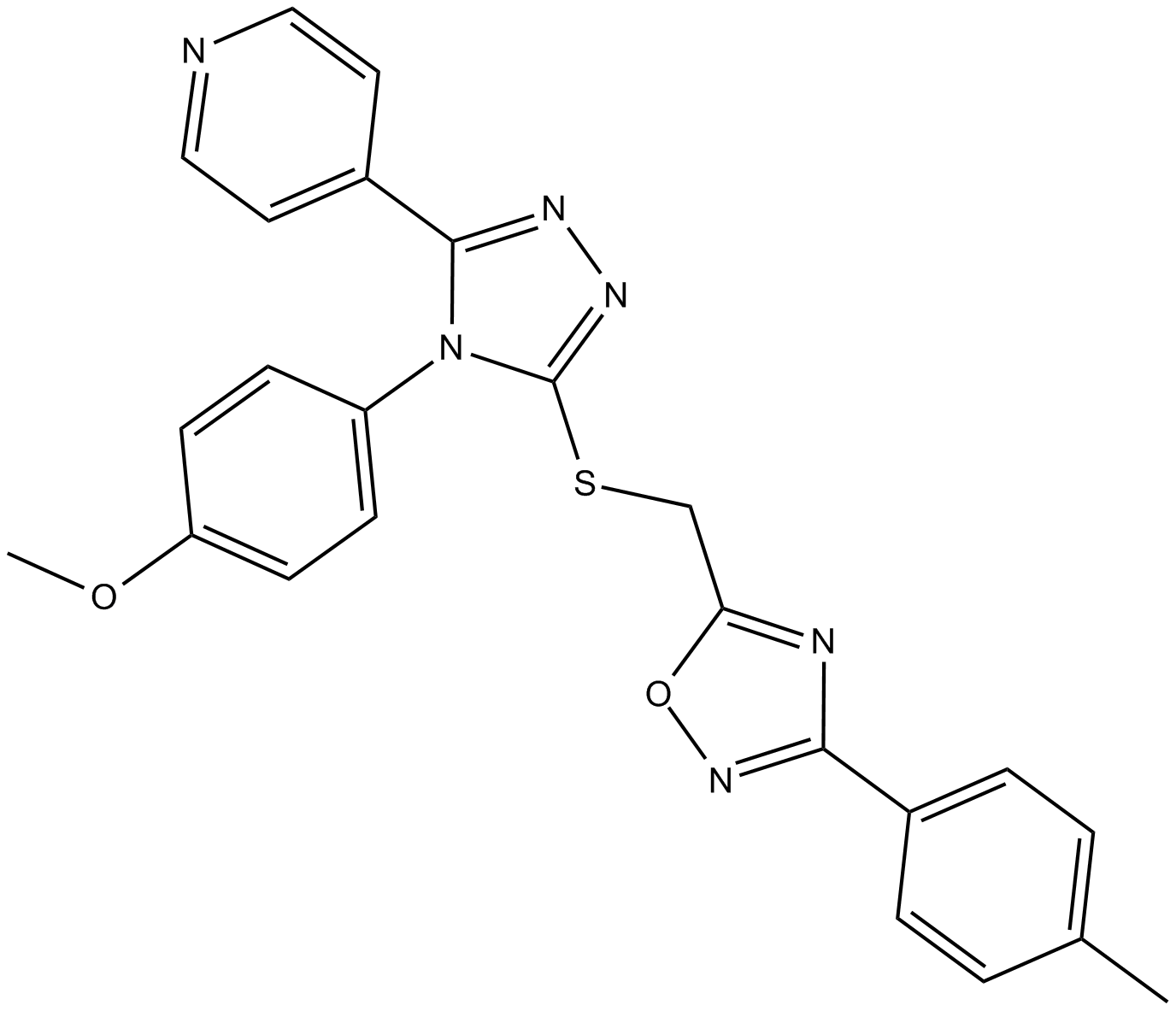
Cas No.: 863405-60-1
Sample solution is provided at 25 µL, 10mM.
_1-3.$$$39978408@51.jpg');)
_1-9.$$$38538795@65.jpg');)
_1-9.$$$39112701@51.jpg');)
_1-7.$$$37316672@70.jpg');)
_366-372.$$$36198801@70.jpg');)
.$$$38565142@65.jpg');)
_1867-1883.$$$33248023@67.jpg');)
_eads6055.$$$39977546@45.jpg');)
_eadm9805.$$$40080571@45.jpg');)
_eadj3020.$$$39666821@45.jpg');)
_1-20.$$$39757301@28.jpg');)
_1-24.$$$38898113@28.jpg');)
_273-287.$$$36806353@46.jpg');)
_1-16.$$$37156877@44.jpg');)
_1-19.$$$37460805@44.jpg');)
_1291-1307.$$$34518654@46.jpg');)
IC50: 790 nM for canonical Wnt signaling
JW 74 is an inhibitor of the catalytic PARP domain of TNKS1/2.
Wnt/β-catenin, a major regulator of stem cell self-renewal and differentiation, is aberrantly activated in a several cancers, including osteosarcoma. Thus, attenuation of Wnt/β-catenin activity by tankyrase inhibitors is an appealing strategy in osteosarcoma treatment.
In vitro: Previous study found that JW74 at the molecular level induced stabilization of AXIN2, a key component of the β-catenin destruction complex, leading to reduced levels of nuclear β-catenin. In addition, JW74 could induce reduced cell growth in all tested cell lines, partially due to a delay in cell cycle progression and partially because of an induction of caspase-3-mediated apoptosis. Moreover, JW74 was able to induce the differentiation in U2OS cells and also enhance differentiation of OS cell lines that did not harbor a differentiation block [1].
In vivo: Previous animal study found that the dose of 150 mg/kg of JW74 in ApcMin model could reduce the small intestinal adenoma by 48% and was comparable with celecoxib or rofecoxib. Furthermore, it was noteworthy that JW74 became rapidly cleared from the blood stream due to its poor in vivo stability [2].
Clinical trial: Up to now, JW 74 is still in the preclinical development stage.
References:
1. E. W. Stratford, J. Daffinrud, E. Munthe, et al. The tankyrase-specific inhibitor JW74 affects cell cycle progression and induces apoptosis and differentiation in osteosarcoma cell lines. Cancer Med. 3(1), 36-46 (2014).
2. Waaler J et al. Novel synthetic antagonists of canonical Wnt signaling inhibit colorectal cancer cell growth. Cancer Res. 2011 Jan 1;71(1):197-205.
Cell experiment: | The cell lines U2OS, SaOS-2, and KPD are cultured in RPMI-1640. Two to three thousand cells attached overnight in 96-well plates are treated with culturing medium containing 0.1% DMSO (control) or JW74 (10-0.1 μM). Proliferation rates based on cell confluence are determined by live cell imaging. Cellular viability is also determined by MTS assay. Expression of the proliferation marker Ki-67 is performed by staining cells with PE-mouse anti-human Ki-67 and by analyzing the expression by flow cytometry[2]. |
Animal experiment: | Mice[1]40 female C.B-Igh-1b/IcrTac-Prkdcscid mice are injected subcutaneously (s.c.) at the right posterior flank with 107 SW480 cells diluted in 100 μL PBS. Injections are initiated when tumor formation is visible in 50 % of the animals (7 days). Mice are randomized and divided into three treatment groups: JW74 150 mg/kg, JW74 300 mg/kg and vehicle control, 1 % Tween 80. Daily intra peritoneal (i.p.) injections (200 μL) with two day injection intermissions after every fifth injection day are performed until the experiment end (29 days). At the termination day, 24 hours after the last injection, blood is collected after cardiac puncture and tumors are dissected and weighed. The compound concentration in tumors and blood are determined using on-line and off-line Solid Phase Extraction-Capillary Liquid Chromatography (SPE-CapLC) instrumentation coupled to a Time of Flight (TOF) mass spectrometer. A Zorbax SB C18 5 μm 150×0.3 mm column is used for separation, and a Knauer K-2600 UV detector is used as a complimentary detector. |
References: [1]. Waaler J, et al. Novel synthetic antagonists of canonical Wnt signaling inhibit colorectal cancer cell growth. Cancer Res. 2011 Jan 1;71(1):197-205. | |
| Cas No. | 863405-60-1 | SDF | |
| Chemical Name | 4-[4-(4-methoxyphenyl)-5-[[[3-(4-methylphenyl)-1,2,4-oxadiazol-5-yl]methyl]thio]-4H-1,2,4-triazol-3-yl]-pyridine | ||
| Canonical SMILES | CC(C=C1)=CC=C1C2=NOC(CSC3=NN=C(C4=CC=NC=C4)N3C5=CC=C(OC)C=C5)=N2 | ||
| Formula | C24H20N6O2S | M.Wt | 456.5 |
| Solubility | ≤20mg/ml in DMSO;20mg/ml in dimethyl formamide | Storage | Store at -20°C |
| General tips | Please select the appropriate solvent to prepare the stock solution according to the
solubility of the product in different solvents; once the solution is prepared, please store it in
separate packages to avoid product failure caused by repeated freezing and thawing.Storage method
and period of the stock solution: When stored at -80°C, please use it within 6 months; when stored
at -20°C, please use it within 1 month. To increase solubility, heat the tube to 37°C and then oscillate in an ultrasonic bath for some time. |
||
| Shipping Condition | Evaluation sample solution: shipped with blue ice. All other sizes available: with RT, or with Blue Ice upon request. | ||
| Prepare stock solution | |||

|
1 mg | 5 mg | 10 mg |
| 1 mM | 2.1906 mL | 10.9529 mL | 21.9058 mL |
| 5 mM | 438.1 μL | 2.1906 mL | 4.3812 mL |
| 10 mM | 219.1 μL | 1.0953 mL | 2.1906 mL |
Step 1: Enter information below (Recommended: An additional animal making an allowance for loss during the experiment)
 g
μL
g
μL
Step 2: Enter the in vivo formulation (This is only the calculator, not formulation. Please contact us first if there is no in vivo formulation at the solubility Section.)
Calculation results:
Working concentration: mg/ml;
Method for preparing DMSO master liquid: mg drug pre-dissolved in μL DMSO ( Master liquid concentration mg/mL, Please contact us first if the concentration exceeds the DMSO solubility of the batch of drug. )
Method for preparing in vivo formulation: Take μL DMSO master liquid, next addμL PEG300, mix and clarify, next addμL Tween 80, mix and clarify, next add μL saline, mix and clarify.
Method for preparing in vivo formulation: Take μL DMSO master liquid, next add μL Corn oil, mix and clarify.
Note: 1. Please make sure the liquid is clear before adding the next solvent.
2. Be sure to add the solvent(s) in order. You must ensure that the solution obtained, in the previous addition, is a clear solution before proceeding to add the next solvent. Physical methods such as vortex, ultrasound or hot water bath can be used to aid dissolving.
3. All of the above co-solvents are available for purchase on the GlpBio website.
Quality Control & SDS
- View current batch:
- Purity: >99.00% Appearance: A solid
- COA (Certificate of Analysis)
- SDS (Safety Data Sheet)
- Datasheet
Average Rating: 5 (Based on Reviews and 14 reference(s) in Google Scholar.)