

Natamycin (Synonyms: Antibiotic A 5283; CL 12,625; Delvocid;E 235; Mycophyt) |
Catalog No.GC12381
 One-Click Copy Product Info
|

나타마이신(피마리신)은 여러 스트렙토마이세스 균주에 의해 생산되는 마크로라이드 항생제입니다.
Products are for research use only. Not for human use. We do not sell to patients.
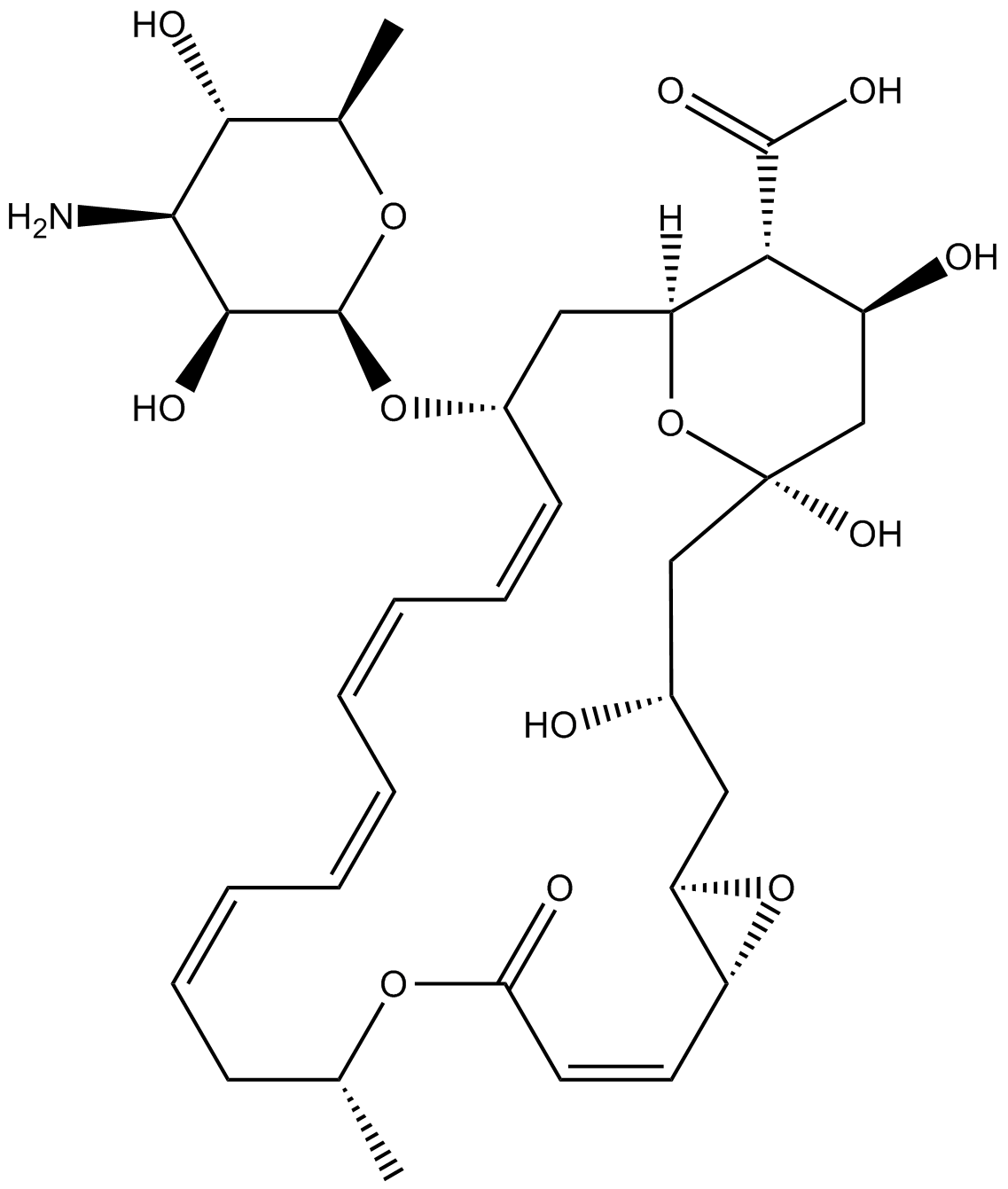
Cas No.: 7681-93-8
Sample solution is provided at 25 µL, 10mM.
_1-3.$$$39978408@51.jpg');)
_1-9.$$$38538795@65.jpg');)
_1-9.$$$39112701@51.jpg');)
_1-7.$$$37316672@70.jpg');)
_366-372.$$$36198801@70.jpg');)
.$$$38565142@65.jpg');)
_1867-1883.$$$33248023@67.jpg');)
_eads6055.$$$39977546@45.jpg');)
_eadm9805.$$$40080571@45.jpg');)
_eadj3020.$$$39666821@45.jpg');)
_1-20.$$$39757301@28.jpg');)
_1-24.$$$38898113@28.jpg');)
_273-287.$$$36806353@46.jpg');)
_1-16.$$$37156877@44.jpg');)
_1-19.$$$37460805@44.jpg');)
_1291-1307.$$$34518654@46.jpg');)
[1]. Lalitha, P., Vijaykumar, R., Prajna, N.V., et al. In vitro natamycin susceptibility of ocular isolates of Fusarium and Aspergillus species: Comparison of commercially formulated natamycin eye drops to pharmaceutical-grade powder. Journal of Clinical Microbiology 46(10), 3477-3478 (2008).
[2]. te Welscher, Y.M., ten Napel, H.H., Balagué, M.M., et al. Natamycin blocks fungal growth by binding specifically to ergosterol without permeabilizing the membrane. The Journal of Biological Chemisty 283(10), 6393-6401 (2008).
[3]. Dong, X.H., Gao, W.J., and He, X.P. Antifungal efficacy of natamycin in experimental fusarium solani keratitis. Int.J.Ophthalmol. 5(2), 143-146 (2012).
[4]. de Vries, R.P., de Lange, E.S., Wösten, H.A.B., et al. Control and possible applications of a novel carrot-spoilage basidiomycete, Fibulorhizoctonia psychrophila. Antonie Van Leeuwenhoek 93, 407-413 (2008).
e
| Cell experiment [1]: | |
|
Cell lines |
human corneal epithelial cells(HCE) |
|
Preparation method |
Soluble in DMSO > 10.75 mg/mL. General tips for obtaining a higher concentration: Please warm the tube at 37℃ for 10 minutes and/or shake it in the ultrasonic bath for a while. Stock solution can be stored below -20℃ for several months. |
|
Reacting condition |
5 μM of FITC(Fluorescein isothiocyanate) labelled natamycin for 1 h at 37°C |
|
Applications |
The drug natamycin had a broad spectrum activity against filamentous fungi in the HCE, therefore, it was considered as the drug of choice for the treatment of filamentous fungi associated Keratitis. |
| Clinical experiment [2]: | |
|
Disease models |
Patients with smear positive or culture-positive filamentous fungal corneal ulcers |
|
Dosage form |
5% natamycin plus 0.02% preservative, one drop to the affected eye every one hour while awake for 1 week, then every 2 hours while awake until 3 weeks |
|
Application |
Topical natamycin was superior to topical voriconazole for the treatment of filamentous fungal corneal ulcers, and in particular those culture-positive for Fusarium species. Vision-related functioning was higher among those treated with natamycin compared with voriconazole. |
|
Other notes |
Please test the solubility of all compounds indoor, and the actual solubility may slightly differ with the theoretical value. This is caused by an experimental system error and it is normal. |
|
References: [1]. Jain A1, Shah SG, Chugh A, Cell penetrating peptides as efficient nanocarriers for delivery of antifungal compound, natamycin for the treatment of fungal keratitis. Pharm Res. 2015 Jun;32(6):1920-30. doi: 10.1007/s11095-014-1586-x. Epub 2014 Dec 3. [2]. Rose-Nussbaumer J1,2,3, Prajna NV4, et al, Risk factors for low vision related functioning in the Mycotic Ulcer Treatment Trial: a randomised trial comparing natamycin with voriconazole. Br J Ophthalmol. 2016 Jul;100(7):929-932. doi: 10.1136/bjophthalmol-2015-306828. Epub 2015 Nov 3. |
|
| Cas No. | 7681-93-8 | SDF | |
| Synonyms | Antibiotic A 5283; CL 12,625; Delvocid;E 235; Mycophyt | ||
| Chemical Name | (5R,7R,24S)-22R-[(3S-amino-3,6-dideoxy-β-D-mannopyranosyl)oxy]-1R,3S,26S-trihydroxy-12R-methyl-10-oxo-6,11,28-trioxatricyclo[22.3.1.05,7]octacosa-8E,14E,16E,18E,20E-pentaene-25R-carboxylic acid | ||
| Canonical SMILES | O[C@](C1)(C[C@H](C[C@H]2O[C@@H]2/C=C\C(O[C@H](C)C/C=C\C=C/C=C\C=C/[C@@H]3O[C@@H]([C@H]([C@H]4N)O)O[C@H](C)[C@H]4O)=O)O)O[C@](C3)([H])[C@H](C(O)=O)[C@H]1O | ||
| Formula | C33H47NO13 | M.Wt | 665.73 |
| Solubility | ≥ 16.425mg/mL in DMSO with gentle warming | Storage | Store at -20°C |
| General tips | Please select the appropriate solvent to prepare the stock solution according to the
solubility of the product in different solvents; once the solution is prepared, please store it in
separate packages to avoid product failure caused by repeated freezing and thawing.Storage method
and period of the stock solution: When stored at -80°C, please use it within 6 months; when stored
at -20°C, please use it within 1 month. To increase solubility, heat the tube to 37°C and then oscillate in an ultrasonic bath for some time. |
||
| Shipping Condition | Evaluation sample solution: shipped with blue ice. All other sizes available: with RT, or with Blue Ice upon request. | ||
| Prepare stock solution | |||

|
1 mg | 5 mg | 10 mg |
| 1 mM | 1.5021 mL | 7.5106 mL | 15.0211 mL |
| 5 mM | 300.4 μL | 1.5021 mL | 3.0042 mL |
| 10 mM | 150.2 μL | 751.1 μL | 1.5021 mL |
Step 1: Enter information below (Recommended: An additional animal making an allowance for loss during the experiment)
 g
μL
g
μL
Step 2: Enter the in vivo formulation (This is only the calculator, not formulation. Please contact us first if there is no in vivo formulation at the solubility Section.)
Calculation results:
Working concentration: mg/ml;
Method for preparing DMSO master liquid: mg drug pre-dissolved in μL DMSO ( Master liquid concentration mg/mL, Please contact us first if the concentration exceeds the DMSO solubility of the batch of drug. )
Method for preparing in vivo formulation: Take μL DMSO master liquid, next addμL PEG300, mix and clarify, next addμL Tween 80, mix and clarify, next add μL saline, mix and clarify.
Method for preparing in vivo formulation: Take μL DMSO master liquid, next add μL Corn oil, mix and clarify.
Note: 1. Please make sure the liquid is clear before adding the next solvent.
2. Be sure to add the solvent(s) in order. You must ensure that the solution obtained, in the previous addition, is a clear solution before proceeding to add the next solvent. Physical methods such as vortex, ultrasound or hot water bath can be used to aid dissolving.
3. All of the above co-solvents are available for purchase on the GlpBio website.
Quality Control & SDS
- View current batch:
- Purity: >99.00% Appearance: A solid
- COA (Certificate of Analysis)
- SDS (Safety Data Sheet)
- Datasheet
Average Rating: 5 (Based on Reviews and 13 reference(s) in Google Scholar.)