

Sinapine |
Catalog No.GC32906
 One-Click Copy Product Info
|

시나핀은 십자화과 종의 씨앗에서 분리된 알칼로이드입니다.
Products are for research use only. Not for human use. We do not sell to patients.
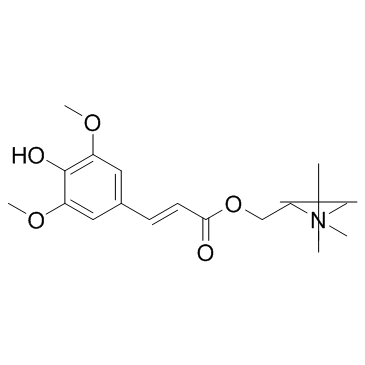
Cas No.: 18696-26-9
Sample solution is provided at 25 µL, 10mM.
_1-3.$$$39978408@51.jpg');)
_1-9.$$$38538795@65.jpg');)
_1-9.$$$39112701@51.jpg');)
_1-7.$$$37316672@70.jpg');)
_366-372.$$$36198801@70.jpg');)
.$$$38565142@65.jpg');)
_1867-1883.$$$33248023@67.jpg');)
_eads6055.$$$39977546@45.jpg');)
_eadm9805.$$$40080571@45.jpg');)
_eadj3020.$$$39666821@45.jpg');)
_1-20.$$$39757301@28.jpg');)
_1-24.$$$38898113@28.jpg');)
_273-287.$$$36806353@46.jpg');)
_1-16.$$$37156877@44.jpg');)
_1-19.$$$37460805@44.jpg');)
_1291-1307.$$$34518654@46.jpg');)
Sinapine is an alkaloid from seeds of the cruciferous species which shows favorable biological activities such as antioxidant and radio-protective activities.
Sinapine increases the sensitivity of Caco-2 cells to doxorubicin in a dose-dependent manner, whereas no or less effect is observed in the cells treated with doxorubicin alone. The combination of Sinapine and doxorubicin has a synergistic effect and increased the cytotoxicity of doxorubicin against Caco-2 cells. Results indicate that Sinapine plays an important role in the down-regulation of P-glycoprotein expression through suppression of FGFR4-FRS2a-ERK1/2 signaling pathway[1]. Sinapine can effectively protect against OH-induced damages to DNA and MSCs, thereby it may have a therapeutic potential in MSCs transplantation[2].
During the first 8 days, the dry matter intake and live weight gain of the rats are significantly reduced by the intake of sinapine and other phenolic compounds. However, after this adaptation period their performances are similar to those of the control group[3].
[1]. Guo Y, et al. Sinapine as an active compound for inhibiting the proliferation of Caco-2 cells via downregulation of P-glycoprotein. Food Chem Toxicol. 2014 May;67:187-92. [2]. Li X, et al. Protective Effect of Sinapine against Hydroxyl Radical-Induced Damage to Mesenchymal Stem Cells and Possible Mechanisms. Chem Pharm Bull (Tokyo). 2016;64(4):319-25. [3]. Vermorel M, et al. Valorization of rapeseed meal. 5. Effects of sinapine and other phenolic compounds on food intake and nutrient utilization in growing rats. Reprod Nutr Dev. 1987;27(4):781-90.
Cell experiment: | The Caco-2 cells are seeded into a 96-well plate with 8000 cells/well for 24 h. After incubation with different doses of Sinapine (0-200 μM), doxorubicin, or both for 24 h, the medium is discarded. Cell survival after exposure to Sinapine alone or a combination of Sinapine and the anti-tumor agent doxorubicin is examined by MTT colorimetric assay[1]. |
Animal experiment: | Rats[3]Sixty male Sprague-Dawley rats (95 g) are randomly allotted to 6 groups of 10 rats each and reared in individual cages. Six groups of 10 growing rats each are fed ad libitum for 15 days one of six diets: diet A, rapeseed (3.80 g of sinapine/kg DM); diet B, ethanol/water-extracted rapeseed (0.48 g of sinapine); diet C, control diet; diet G, control diet+3.74 g of extracted sinapine; diet H, control diet + 3.72 g of sinapine+other phenolic compounds; or diet I, control diet+the hydrolysis products of sinapine and other phenolic compounds. The rats are weighed at 8 a.m. on days 1, 4, 8, 11 and 15 of the trial. After sacrifice the gut contents are eliminated to permit determination of empty body weight gain (EBWG). The distribution, refusal and intake of each rat are recorded every day[3]. |
References: [1]. Guo Y, et al. Sinapine as an active compound for inhibiting the proliferation of Caco-2 cells via downregulation of P-glycoprotein. Food Chem Toxicol. 2014 May;67:187-92. | |
| Cas No. | 18696-26-9 | SDF | |
| Canonical SMILES | O=C(OCC[N+](C)(C)C)/C=C/C1=CC(OC)=C(O)C(OC)=C1 | ||
| Formula | C16H24NO5 | M.Wt | 310.36 |
| Solubility | DMSO: 250 mg/mL (805.52 mM) | Storage | 4°C, away from moisture and light |
| General tips | Please select the appropriate solvent to prepare the stock solution according to the
solubility of the product in different solvents; once the solution is prepared, please store it in
separate packages to avoid product failure caused by repeated freezing and thawing.Storage method
and period of the stock solution: When stored at -80°C, please use it within 6 months; when stored
at -20°C, please use it within 1 month. To increase solubility, heat the tube to 37°C and then oscillate in an ultrasonic bath for some time. |
||
| Shipping Condition | Evaluation sample solution: shipped with blue ice. All other sizes available: with RT, or with Blue Ice upon request. | ||
| Prepare stock solution | |||

|
1 mg | 5 mg | 10 mg |
| 1 mM | 3.2221 mL | 16.1103 mL | 32.2206 mL |
| 5 mM | 644.4 μL | 3.2221 mL | 6.4441 mL |
| 10 mM | 322.2 μL | 1.611 mL | 3.2221 mL |
Step 1: Enter information below (Recommended: An additional animal making an allowance for loss during the experiment)
 g
μL
g
μL
Step 2: Enter the in vivo formulation (This is only the calculator, not formulation. Please contact us first if there is no in vivo formulation at the solubility Section.)
Calculation results:
Working concentration: mg/ml;
Method for preparing DMSO master liquid: mg drug pre-dissolved in μL DMSO ( Master liquid concentration mg/mL, Please contact us first if the concentration exceeds the DMSO solubility of the batch of drug. )
Method for preparing in vivo formulation: Take μL DMSO master liquid, next addμL PEG300, mix and clarify, next addμL Tween 80, mix and clarify, next add μL saline, mix and clarify.
Method for preparing in vivo formulation: Take μL DMSO master liquid, next add μL Corn oil, mix and clarify.
Note: 1. Please make sure the liquid is clear before adding the next solvent.
2. Be sure to add the solvent(s) in order. You must ensure that the solution obtained, in the previous addition, is a clear solution before proceeding to add the next solvent. Physical methods such as vortex, ultrasound or hot water bath can be used to aid dissolving.
3. All of the above co-solvents are available for purchase on the GlpBio website.
Quality Control & SDS
- View current batch:
- Purity: >99.50% Appearance: A solid
- COA (Certificate of Analysis)
- SDS (Safety Data Sheet)
- Datasheet
Average Rating: 5 (Based on Reviews and 25 reference(s) in Google Scholar.)