

Tezosentan (RO 610612) (Synonyms: RO 610612) |
Catalog No.GC30942
 One-Click Copy Product Info
|

Tezosentan(RO 610612)(RO 610612)은 엔도텔린(ET) 수용체 길항제이며, ETA 및 ETB 수용체에 대해 각각 pA2가 9.5, 7.7입니다.
Products are for research use only. Not for human use. We do not sell to patients.
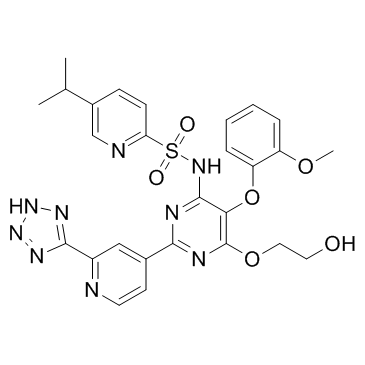
Cas No.: 180384-57-0
Sample solution is provided at 25 µL, 10mM.
_1-3.$$$39978408@51.jpg');)
_1-9.$$$38538795@65.jpg');)
_1-9.$$$39112701@51.jpg');)
_1-7.$$$37316672@70.jpg');)
_366-372.$$$36198801@70.jpg');)
.$$$38565142@65.jpg');)
_1867-1883.$$$33248023@67.jpg');)
_eads6055.$$$39977546@45.jpg');)
_eadm9805.$$$40080571@45.jpg');)
_eadj3020.$$$39666821@45.jpg');)
_1-20.$$$39757301@28.jpg');)
_1-24.$$$38898113@28.jpg');)
_273-287.$$$36806353@46.jpg');)
_1-16.$$$37156877@44.jpg');)
_1-19.$$$37460805@44.jpg');)
_1291-1307.$$$34518654@46.jpg');)
Tezosentan (RO 610612) is an endothelin (ET) receptor antagonist, with pA2s of 9.5, 7.7 for ETA and ETB receptors, respectively.
Affinity of Tezosentan for the ET receptors is assessed in different cells and tissues. Tezosentan inhibits the specific 125I-labeled ET-1 binding to ETA receptors with an inhibitory potency (Ki) of 0.3 nM on CHO cells and of 18 nM on membranes of baculovirus-infected insect cells. Similarly, Tezosentan inhibits the specific binding of 125I-labeled ET-1, ET-3, or sarafotoxin S6c to ETB receptors with an inhibitory affinity of 10 to 21 nM. Tezosentan up to a concentration of 1 μM did not exhibit any binding inhibitory activity in 27 radioligand binding assays different from ET binding. On H1 central, 5-hydroxytryptamine2A, and vasopressin V1 receptors, Tezosentan (1 μM) induces a weak inhibition of less than 20%[1].
In pithed Wistar rats, Tezosentan dose-dependently inhibits the pressor effect of big ET-1 (P<0.001 at all doses). At the lowest dose tested of 1 mg/kg, Tezosentan inhibits the pressor effect of the various doses of big ET-1 by 50 to 80%. Tezosentan has no effect by itself on blood pressure in these pithed rats. Tezosentan is very effective in a rat model of acute renal failure. ET antagonists have been shown to prevent the vasoconstriction and the renal failure that follow acute renal ischemia in rats[1].
[1]. Clozel M, et al. Pharmacology of tezosentan, new endothelin receptor antagonist designed for parenteral use. J Pharmacol Exp Ther. 1999 Aug;290(2):840-6.
Animal experiment: | Rats[1]A pseudocrush syndrome is simulated by injection of i.m. glycerol. A control group does not receive glycerol and is used as a reference. Tezosentan or bosentan for comparison or saline as control is injected as two bolus i.v. doses of 10 mg/kg 1 h and 20 min before glycerol. Rats are allowed to recover for 2 h and then are placed in individual metabolic cages for 48 h. Blood samples withdraw from a catheter placed in the abdominal aorta and urine free of food and feces are collected at 24 and 48 h. Plasma and urinary creatinine levels are measured with a centrifugal analyzer. Renal function is assessed by calculating creatinine clearance at 24 and 48 h after glycerol administration[1]. |
References: [1]. Clozel M, et al. Pharmacology of tezosentan, new endothelin receptor antagonist designed for parenteral use. J Pharmacol Exp Ther. 1999 Aug;290(2):840-6. | |
| Cas No. | 180384-57-0 | SDF | |
| Synonyms | RO 610612 | ||
| Canonical SMILES | O=S(C1=NC=C(C(C)C)C=C1)(NC2=NC(C3=CC(C4=NNN=N4)=NC=C3)=NC(OCCO)=C2OC5=CC=CC=C5OC)=O | ||
| Formula | C27H27N9O6S | M.Wt | 605.63 |
| Solubility | DMSO : 50 mg/mL (82.56 mM; Need ultrasonic) | Storage | Store at -20°C |
| General tips | Please select the appropriate solvent to prepare the stock solution according to the
solubility of the product in different solvents; once the solution is prepared, please store it in
separate packages to avoid product failure caused by repeated freezing and thawing.Storage method
and period of the stock solution: When stored at -80°C, please use it within 6 months; when stored
at -20°C, please use it within 1 month. To increase solubility, heat the tube to 37°C and then oscillate in an ultrasonic bath for some time. |
||
| Shipping Condition | Evaluation sample solution: shipped with blue ice. All other sizes available: with RT, or with Blue Ice upon request. | ||
| Prepare stock solution | |||

|
1 mg | 5 mg | 10 mg |
| 1 mM | 1.6512 mL | 8.2559 mL | 16.5117 mL |
| 5 mM | 330.2 μL | 1.6512 mL | 3.3023 mL |
| 10 mM | 165.1 μL | 825.6 μL | 1.6512 mL |
Step 1: Enter information below (Recommended: An additional animal making an allowance for loss during the experiment)
 g
μL
g
μL
Step 2: Enter the in vivo formulation (This is only the calculator, not formulation. Please contact us first if there is no in vivo formulation at the solubility Section.)
Calculation results:
Working concentration: mg/ml;
Method for preparing DMSO master liquid: mg drug pre-dissolved in μL DMSO ( Master liquid concentration mg/mL, Please contact us first if the concentration exceeds the DMSO solubility of the batch of drug. )
Method for preparing in vivo formulation: Take μL DMSO master liquid, next addμL PEG300, mix and clarify, next addμL Tween 80, mix and clarify, next add μL saline, mix and clarify.
Method for preparing in vivo formulation: Take μL DMSO master liquid, next add μL Corn oil, mix and clarify.
Note: 1. Please make sure the liquid is clear before adding the next solvent.
2. Be sure to add the solvent(s) in order. You must ensure that the solution obtained, in the previous addition, is a clear solution before proceeding to add the next solvent. Physical methods such as vortex, ultrasound or hot water bath can be used to aid dissolving.
3. All of the above co-solvents are available for purchase on the GlpBio website.
Quality Control & SDS
- View current batch:
- Purity: >98.00% Appearance: A solid
- COA (Certificate of Analysis)
- SDS (Safety Data Sheet)
- Datasheet
Average Rating: 5 (Based on Reviews and 5 reference(s) in Google Scholar.)