

Alternariol (Synonyms: AOH,NSC 638263) |
Catalog No.GC10779
 One-Click Copy Product Info
|

Alternariol es una micotoxina producida por Alternariafungi, que está distribuida en la naturaleza, en materia de grasas, frutas y verduras en condiciones cálidas y húmedas. Alternariol inhibe la actividad catalítica de ka topoisomerasa I y IIα, estorba con la función normal del DNA y efectos disruptivos endocrinos
Products are for research use only. Not for human use. We do not sell to patients.
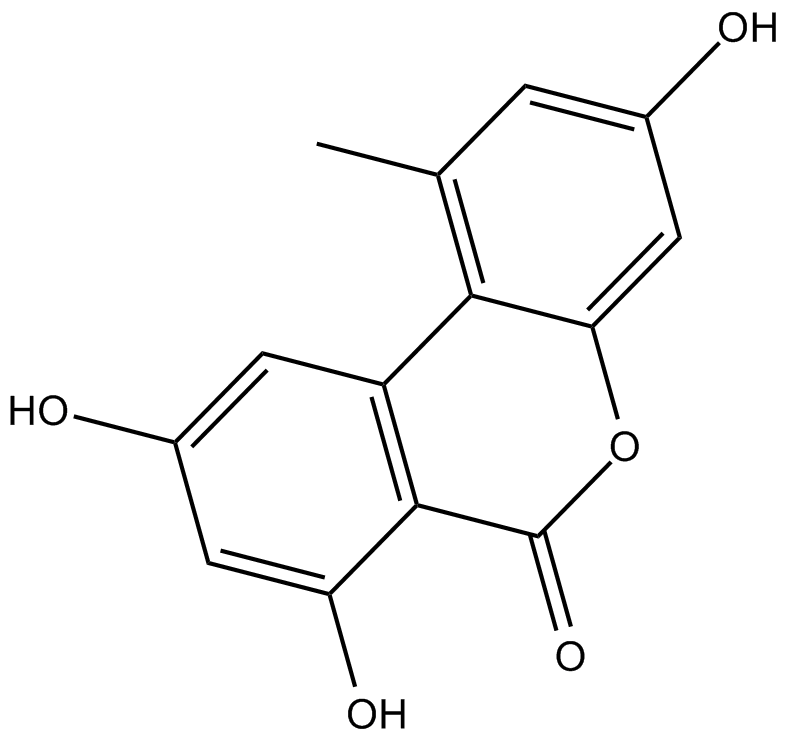
Cas No.: 641-38-3
Sample solution is provided at 25 µL, 10mM.
_1-3.$$$39978408@51.jpg');)
_1-9.$$$38538795@65.jpg');)
_1-9.$$$39112701@51.jpg');)
_1-7.$$$37316672@70.jpg');)
_366-372.$$$36198801@70.jpg');)
.$$$38565142@65.jpg');)
_1867-1883.$$$33248023@67.jpg');)
_eads6055.$$$39977546@45.jpg');)
_eadm9805.$$$40080571@45.jpg');)
_eadj3020.$$$39666821@45.jpg');)
_1-20.$$$39757301@28.jpg');)
_1-24.$$$38898113@28.jpg');)
_273-287.$$$36806353@46.jpg');)
_1-16.$$$37156877@44.jpg');)
_1-19.$$$37460805@44.jpg');)
_1291-1307.$$$34518654@46.jpg');)
Alternariol es una micotoxina producida por Alternariafungi, que está distribuida en la naturaleza, en materia de grasas, frutas y verduras en condiciones cálidas y húmedas[1]. Alternariol inhibe la actividad catalítica de ka topoisomerasa I y IIα, estorba con la función normal del DNA y efectos disruptivos endocrinos[2]. Si bien demuesta toxicidad, también se ha encontrado que Alternariol posee varias actividades biológicas, como propiedades antimicrobianas, anti-HIV, anticancerosas e inmunomoduladoras[3-4].
In vitro, el tratamiento de células de adenocarcinoma de colon humano Caco-2 con Alternariol (15–60μM) durante 24–48 horas indujo la detención de ciclo de celular en las fases S y G2/M, acompañado de pérdida de potencial membranal mitocondrial y muerte celular necrótica/apoptótica[5]. El tratamiento de macrófagos RAW 264.7 de ratón con Alternariol (15–30μM) durante 24–48 horas dio como resultado una detención en el ciclo de celular fase G2/M, junto con una morfología nuclear anormal y formación de poliploides[6].
In vivo, una sola aplicación tópica de Alternariol (12.5–50μg por ratón) a la piel de ratones albinos suizos durante 24 horas indujo que se ponga más grueso del pliegue de la piel, edema, hiperplasia epidérmica y respeuestas inflamatorias[7]. La exposición dietética de ratones C57BL/6 a Alternariol (5–20μg/kg) durante 90 días causó hepatotoxicidad dependientre de la dosis, caracterizada por un aumento del índice hepático, niveles séricos elevados de ALT y AST, y alteraciones histopatológicas en el tejido hepático[8].
References:
[1] Siegel D, Troyanov S, Noack J, et al. Acta Crystallogr Sect E Struct Rep Online. 2010 May 15;66(Pt 6):o1366.
[2] Saleh I, Zeidan R, Abu-Dieyeh M. The characteristics, occurrence, and toxicological effects of alternariol: a mycotoxin. Arch Toxicol. 2024 Jun;98(6):1659-1683.
[3] Islam MT, Martorell M, González-Contreras C, et al. An updated overview of anticancer effects of alternariol and its derivatives: underlying molecular mechanisms. Front Pharmacol. 2023 Mar 23;14:1099380.
[4] Ding J, Zhao J, Yang Z, et al. Microbial Natural Product Alternariol 5-O-Methyl Ether Inhibits HIV-1 Integration by Blocking Nuclear Import of the Pre-Integration Complex. Viruses. 2017 May 10;9(5):105.
[5] Fernández-Blanco C, Juan-García A, Juan C, et al. Alternariol induce toxicity via cell death and mitochondrial damage on Caco-2 cells. Food Chem Toxicol. 2016 Feb;88:32-9.
[6] Solhaug A, Holme JA, Haglund K, et al. Alternariol induces abnormal nuclear morphology and cell cycle arrest in murine RAW 264.7 macrophages. Toxicol Lett. 2013 May 10;219(1):8-17.
[7] Bansal M, Singh N, Alam S, et al. Alternariol induced proliferation in primary mouse keratinocytes and inflammation in mouse skin is regulated via PGE2/EP2/cAMP/p-CREB signaling pathway. Toxicology. 2019 Jan 15;412:79-88.
[8] Yu S, Shen X, Huang Y, et al. Mycotoxin Alternariol Exposure Promotes Endoplasmic Reticulum Stress-induced Hepatotoxicity to Exacerbate Chronic Liver Injury. Environ Pollut. 2025 Oct 6:127217.
| Experimentos celulares [1]: | |
Líneas celulares | Células Caco-2 (línea celular de adenocarcinoma de colon humano) |
Método de preparación | Las células Caco-2 se mantuvieron en el Medio de Águila Modificada (DMEM) de Dulbecco, suplementado con tampón HEPES de 25mM, 1% de aminoácidos no sesenciales, 100U/mL de penicillin, 100µg/mL de streptomycin y 10% de suero bovino fetal a 37°C, 5% de CO₂. Las células Caco-2 se trataron con Alternariol aa concentraciones subcitotóxicas (15, 30 y 60µM) durante 24 y 48 horas. |
Condiciones de reacción | 15-60μM; 24-48 horas |
Áreas de aplicación | Alternariol interrumpió el ciclo celular al disminuir la proporción de células en la fase G1 y aumentar la acumulación en las fases S y G2/M de unamanera dependiente de la dosis y el tiempo. Alternariol también indujo necrosis y apoptosis/necrosis, como se ha demostrado, y causó una pérdida de potencial de membrana mitocondrial que indica daño mitocondrial. |
| Experimentos con animales [2]: | |
Modelos animales | C57BL/6 ratones |
Método de preparación | Los ratones machos C57BL/6 (4 semanas de edad) recibieron una dieta que contenía Alternariol (AOH) en dosis de 5, 10 y 20µg/kg diarios durante 90 días. Un grupo de intervención separado recibió la administración conjunta de Alternariol (10µg/kg) con ácido Tauroursodeoxycholic (TUDCA, 500mg/kg) a través de agua potable. Los ratones fueron sacrificados después de 90 días de exposición para su análisis. |
Forma de dosificación | 5, 10 y 20mg/kg; administración dietética. |
Áreas de aplicación | La exposición al Alternariol indujo hepatotoxicidad dependiente de la dosis caracterizada por un aumento del índice hepático, niveles séricos elevados de ALT y AST, y lesión hepática histopatológica, incluida la congestión del parenquima, la dilatación sinusoidal y la infiltración de células inflamatorias. |
References: | |
| Cas No. | 641-38-3 | SDF | |
| Sinónimos | AOH,NSC 638263 | ||
| Chemical Name | 3,7,9-trihydroxy-1-methyl-6H-dibenzo[b,d]pyran-6-one | ||
| Canonical SMILES | CC1=C(C2=C(C(O3)=O)C(O)=CC(O)=C2)C3=CC(O)=C1 | ||
| Formula | C14H10O5 | M.Wt | 258.2 |
| Solubility | ≤0.5mg/ml in ethanol;30mg/ml in DMSO;30mg/ml in dimethyl formamide | Storage | Store at -20°C,protect from light |
| General tips | Please select the appropriate solvent to prepare the stock solution according to the
solubility of the product in different solvents; once the solution is prepared, please store it in
separate packages to avoid product failure caused by repeated freezing and thawing.Storage method
and period of the stock solution: When stored at -80°C, please use it within 6 months; when stored
at -20°C, please use it within 1 month. To increase solubility, heat the tube to 37°C and then oscillate in an ultrasonic bath for some time. |
||
| Shipping Condition | Evaluation sample solution: shipped with blue ice. All other sizes available: with RT, or with Blue Ice upon request. | ||
| Prepare stock solution | |||

|
1 mg | 5 mg | 10 mg |
| 1 mM | 3.873 mL | 19.3648 mL | 38.7297 mL |
| 5 mM | 774.6 μL | 3.873 mL | 7.7459 mL |
| 10 mM | 387.3 μL | 1.9365 mL | 3.873 mL |
Step 1: Enter information below (Recommended: An additional animal making an allowance for loss during the experiment)
 g
μL
g
μL
Step 2: Enter the in vivo formulation (This is only the calculator, not formulation. Please contact us first if there is no in vivo formulation at the solubility Section.)
Calculation results:
Working concentration: mg/ml;
Method for preparing DMSO master liquid: mg drug pre-dissolved in μL DMSO ( Master liquid concentration mg/mL, Please contact us first if the concentration exceeds the DMSO solubility of the batch of drug. )
Method for preparing in vivo formulation: Take μL DMSO master liquid, next addμL PEG300, mix and clarify, next addμL Tween 80, mix and clarify, next add μL saline, mix and clarify.
Method for preparing in vivo formulation: Take μL DMSO master liquid, next add μL Corn oil, mix and clarify.
Note: 1. Please make sure the liquid is clear before adding the next solvent.
2. Be sure to add the solvent(s) in order. You must ensure that the solution obtained, in the previous addition, is a clear solution before proceeding to add the next solvent. Physical methods such as vortex, ultrasound or hot water bath can be used to aid dissolving.
3. All of the above co-solvents are available for purchase on the GlpBio website.
Quality Control & SDS
- View current batch:
- Purity: >98.00% Appearance: A solid
- COA (Certificate of Analysis)
- SDS (Safety Data Sheet)
- Datasheet
Average Rating: 5 (Based on Reviews and 19 reference(s) in Google Scholar.)