

Alternariol (Synonyms: AOH,NSC 638263) |
Catalog No.GC10779
 One-Click Copy Product Info
|

Alternariol est une mycotoxine produite par les champignons du genre Alternaria, ce qui est largement distribuée dans la nature, en particulier dans les céréales, fruits et légumes dasn des conditions chaudes et humides. Alternariol inhibe l'activité catalytique des topoisomérases I et IIa, perturbe la fonction normale de DNA, et exhibe des effets cytotoxiques, génotoxiques, mutagènes et perturbateurs endocriniens.
Products are for research use only. Not for human use. We do not sell to patients.
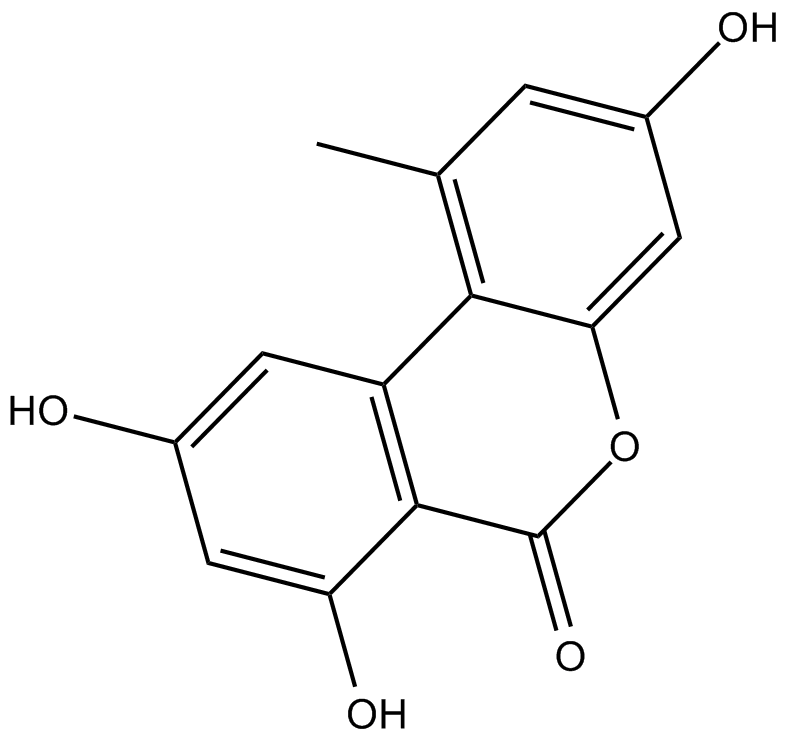
Cas No.: 641-38-3
Sample solution is provided at 25 µL, 10mM.
_1-3.$$$39978408@51.jpg');)
_1-9.$$$38538795@65.jpg');)
_1-9.$$$39112701@51.jpg');)
_1-7.$$$37316672@70.jpg');)
_366-372.$$$36198801@70.jpg');)
.$$$38565142@65.jpg');)
_1867-1883.$$$33248023@67.jpg');)
_eads6055.$$$39977546@45.jpg');)
_eadm9805.$$$40080571@45.jpg');)
_eadj3020.$$$39666821@45.jpg');)
_1-20.$$$39757301@28.jpg');)
_1-24.$$$38898113@28.jpg');)
_273-287.$$$36806353@46.jpg');)
_1-16.$$$37156877@44.jpg');)
_1-19.$$$37460805@44.jpg');)
_1291-1307.$$$34518654@46.jpg');)
Alternariol est une mycotoxine produite par les champignons du genre Alternaria, ce qui est largement distribuée dans la nature, en particulier dans les céréales, fruits et légumes dasn des conditions chaudes et humides[1]. Alternariol inhibe l'activité catalytique des topoisomérases I et IIa, perturbe la fonction normale de DNA, et exhibe des effets cytotoxiques, génotoxiques, mutagènes et perturbateurs endocriniens[2]. Bien qu'il soit toxique, Alternariol possède également diverses activités biologiques : antimicrobienne, anti-HIV, anticancéreuse et immunodulatrice[3-4].
Le traitement in vitro avec Alternariol (15–60μM) aux cellules d'adénocarcinome colique humain Caco-2 pendant 24-48 heures a entraîné un arrêt du cycle cellulaire en phase S et G2/M, accompagné d'une perte du potentiel membranaire mitochondrial et d'une mort cellulaire nécrotique/apoptotique[5]. Le traitement avec Alternariol (15–30μM) aux macrophages murins RAW 264.7 pendant 24-48 heures entraîne un arrêt du cycle cellulaire en phase G2/M, ainsi qu'une morphologie nucléaire anormale et la formation de polyploïdies[6].
In vivo, une application topique unique de Alternariol (12.5–50μg par rat) sur la peau de rats Swiss albino pendant 24 heures a entraîné une augmentation de l'épaisseur du pli cutané, un oedème, une hyperplasie épidermique et des réponses inflammatoires[7]. L'exposition alimentaire de rats C57BL/6 à Alternariol (5–20μg/kg) pendant 90 jours provoque une hépatotoxicité dose-dépendante, caractérisée par une augmentation de l'indice hépatique, du niveau sérique élevé d'ALT et d'AST, et des altérations histopathologiques du tissu hépatique[8].
References:
[1] Siegel D, Troyanov S, Noack J, et al. Acta Crystallogr Sect E Struct Rep Online. 2010 May 15;66(Pt 6):o1366.
[2] Saleh I, Zeidan R, Abu-Dieyeh M. The characteristics, occurrence, and toxicological effects of alternariol: a mycotoxin. Arch Toxicol. 2024 Jun;98(6):1659-1683.
[3] Islam MT, Martorell M, González-Contreras C, et al. An updated overview of anticancer effects of alternariol and its derivatives: underlying molecular mechanisms. Front Pharmacol. 2023 Mar 23;14:1099380.
[4] Ding J, Zhao J, Yang Z, et al. Microbial Natural Product Alternariol 5-O-Methyl Ether Inhibits HIV-1 Integration by Blocking Nuclear Import of the Pre-Integration Complex. Viruses. 2017 May 10;9(5):105.
[5] Fernández-Blanco C, Juan-García A, Juan C, et al. Alternariol induce toxicity via cell death and mitochondrial damage on Caco-2 cells. Food Chem Toxicol. 2016 Feb;88:32-9.
[6] Solhaug A, Holme JA, Haglund K, et al. Alternariol induces abnormal nuclear morphology and cell cycle arrest in murine RAW 264.7 macrophages. Toxicol Lett. 2013 May 10;219(1):8-17.
[7] Bansal M, Singh N, Alam S, et al. Alternariol induced proliferation in primary mouse keratinocytes and inflammation in mouse skin is regulated via PGE2/EP2/cAMP/p-CREB signaling pathway. Toxicology. 2019 Jan 15;412:79-88.
[8] Yu S, Shen X, Huang Y, et al. Mycotoxin Alternariol Exposure Promotes Endoplasmic Reticulum Stress-induced Hepatotoxicity to Exacerbate Chronic Liver Injury. Environ Pollut. 2025 Oct 6:127217.
| Expériences cellulaires [1]: | |
Lignées cellulaires | Cellules Caco-2 (lignée cellulaire d'adénocarcinome colique humain) |
Méthode de préparation | Les cellules Caco-2 ont été maintenues dans le milieu d'Eagle modifié de Dulbecco (DMEM) supplémenté avec un tampon HEPES à 25mM, 1% d'acides aminés non-essentiels, 100U/mL de pénicilline,100µg/ml de streptomycine et 10% de sérum de veau foetal, à 37°C et 5% CO₂. Les cellules Caco-2 ont été traitées à des concentrations sub-cytotoxiques de Alternariol (15, 30, et 60µM) pendant 24 et 48 heures. |
Conditions de réaction | 15-60μM; 24-48 heures. |
Domaines d'application | Alternariol a significativement perturbé le cycle cellulaire par voie de réduire la proportion de cellules en phase G1 et augmenté leur accumulation en phase S et G2/M, de manière dépendante de la dose et du temps. Alternariol a également induit la nécrose et l'apoptose/nécrose (comme le démontre les observations) et provoqué une perte du potentiel membranaire mitochondrial, indiquant une lésion mitochondriale. |
| Expériences animales [2]: | |
Modèles animaux | Rats C57BL/6 |
Méthode de préparation | Les rats C57BL/6 âgés de 4 semaines ont reçu un régime contenant Alternariol (AOH) à des doses de 5, 10, et 20µg/kg par jour pendant 90 jours. Un groupe d'intervention séparé a reçu une co-administration de Alternariol (10µg/kg) avec l'acide Tauroursodéoxycholique (TUDCA, 500mg/kg) via l'eau de boisson. Les rats ont été sacrifiés après 90 jours d'exposition pour analyse. |
Forme de dosage | 5, 10, et 20mg/kg; administration alimentaire |
Domaines d'application | L'exposition à Alternariol a induit une hépatotoxicité dépendante de la dose, caractérisées par une augmentation de l'indice hépatique, du niveau sérique élevé d' ALT et d' AST, ainsi qu'une lésion hépatique histopathologique (congestion parenchymateuse, dilatation sinusoïdale et infiltration de cellules inflammatoires). |
References: | |
| Cas No. | 641-38-3 | SDF | |
| Synonymes | AOH,NSC 638263 | ||
| Chemical Name | 3,7,9-trihydroxy-1-methyl-6H-dibenzo[b,d]pyran-6-one | ||
| Canonical SMILES | CC1=C(C2=C(C(O3)=O)C(O)=CC(O)=C2)C3=CC(O)=C1 | ||
| Formula | C14H10O5 | M.Wt | 258.2 |
| Solubility | ≤0.5mg/ml in ethanol;30mg/ml in DMSO;30mg/ml in dimethyl formamide | Storage | Store at -20°C,protect from light |
| General tips | Please select the appropriate solvent to prepare the stock solution according to the
solubility of the product in different solvents; once the solution is prepared, please store it in
separate packages to avoid product failure caused by repeated freezing and thawing.Storage method
and period of the stock solution: When stored at -80°C, please use it within 6 months; when stored
at -20°C, please use it within 1 month. To increase solubility, heat the tube to 37°C and then oscillate in an ultrasonic bath for some time. |
||
| Shipping Condition | Evaluation sample solution: shipped with blue ice. All other sizes available: with RT, or with Blue Ice upon request. | ||
| Prepare stock solution | |||

|
1 mg | 5 mg | 10 mg |
| 1 mM | 3.873 mL | 19.3648 mL | 38.7297 mL |
| 5 mM | 774.6 μL | 3.873 mL | 7.7459 mL |
| 10 mM | 387.3 μL | 1.9365 mL | 3.873 mL |
Step 1: Enter information below (Recommended: An additional animal making an allowance for loss during the experiment)
 g
μL
g
μL
Step 2: Enter the in vivo formulation (This is only the calculator, not formulation. Please contact us first if there is no in vivo formulation at the solubility Section.)
Calculation results:
Working concentration: mg/ml;
Method for preparing DMSO master liquid: mg drug pre-dissolved in μL DMSO ( Master liquid concentration mg/mL, Please contact us first if the concentration exceeds the DMSO solubility of the batch of drug. )
Method for preparing in vivo formulation: Take μL DMSO master liquid, next addμL PEG300, mix and clarify, next addμL Tween 80, mix and clarify, next add μL saline, mix and clarify.
Method for preparing in vivo formulation: Take μL DMSO master liquid, next add μL Corn oil, mix and clarify.
Note: 1. Please make sure the liquid is clear before adding the next solvent.
2. Be sure to add the solvent(s) in order. You must ensure that the solution obtained, in the previous addition, is a clear solution before proceeding to add the next solvent. Physical methods such as vortex, ultrasound or hot water bath can be used to aid dissolving.
3. All of the above co-solvents are available for purchase on the GlpBio website.
Quality Control & SDS
- View current batch:
- Purity: >98.00% Appearance: A solid
- COA (Certificate of Analysis)
- SDS (Safety Data Sheet)
- Datasheet
Average Rating: 5 (Based on Reviews and 19 reference(s) in Google Scholar.)