

DBCO-NHS ester |
Catalog No.GC39241
 One-Click Copy Product Info
|

DBCO-NHS ester es un reticulador utilizado para unir covalentemente grupos DBCO a moléculas que contienen aminas
Products are for research use only. Not for human use. We do not sell to patients.
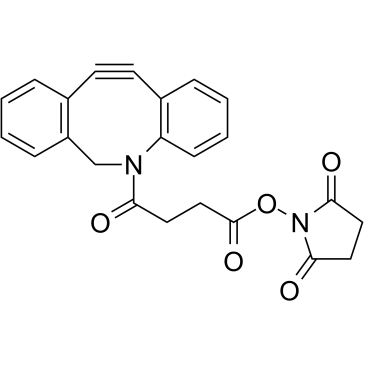
Cas No.: 1353016-71-3
Sample solution is provided at 25 µL, 10mM.
DBCO-NHS ester es un reticulador utilizado para unir covalentemente grupos DBCO a moléculas que contienen aminas [1]. DBCO-NHS ester se utiliza comúnmente para el etiquetado bioortogonal y el acoplamiento molecular en la química de clic sin cobre [2-3].
References:
[1]. Hu B, Ji C, Zhou Z, et al. Bioorthogonal reaction-mediated photosensitizer–peptide conjugate anchoring on cell membranes for enhanced photodynamic therapy. Biomaterials Science. 2025.
[2]. Tan A, Liu Q, Septiadi D, et al. Understanding selectivity of metabolic labelling and click-targeting in multicellular environments as a route to tissue selective drug delivery. Journal of Materials Chemistry B. 2021 Jul 7; 9(26): 5365-5373.
[3]. Wiener J, Kokotek D, Rosowski S, et al. Preparation of single-and double-oligonucleotide antibody conjugates and their application for protein analytics. Scientific reports. 2020 Jan 29; 10(1): 1457.
Este protocolo describe la reacción de clic libre de cobre de las proteínas modificadas con DBCO-NHS ester con tintes azida. Es posible que sea necesario optimizar las condiciones reales de aplicación de acuerdo con el diseño del estudio [1-2].
1. Preparación de reactivos y materiales
DBCO-NHS ester, proteína objetivo, tinte fluorescente modificado con azida, PBS, tampón de carbonato.
2. Pasos experimentales
(1) Modificación de las proteínas DBCO
Disuelva la proteína objetivo en un tampón de carbonato de pH 8,5 a una concentración ≥ 1 mg/mL. Disuelva DBCO-NHS ester en DMSO anhidro (controle la concentración final de DMSO en la solución de etiquetado ≤ 10%) y agréguelo a la solución de proteínas en una proporción de DBCO:proteína de 5-20:1. Vórtice para mezclar e incubar a temperatura ambiente durante 2 horas (o durante la noche a 4℃) en la oscuridad. Equilibre la columna de desalinización con PBS preenfriado (pH 7,4), cargue la solución de reacción en la columna y recoja la proteína purificada por centrifugación. Determine la concentración de proteína, alícuota y congele a -80℃.
(2) Reacción de clic de ácido DBCO
Prepare el tinte azida (como Azide-Cy5) con DMSO a una solución de stock de 1-10 mM y uárdelo en la oscuridad. Mezcle la proteína modificada por DBCO y el tinte azida en PBS (pH 7,4) a un DBCO:Azide = 1:1,5-3 (relación molar). Vórtice para mezclar y reaccionar a temperatura ambiente en la oscuridad durante 1-4 horas (o a 4℃ durante la noche). Retire el tinte libre usando una columna de desalinización o diálisis (PBS, 4℃ en la oscuridad). SDS-PAGE (escaneo de fluorescencia) o espectroscopia visible en los rayos UV (calcular la relación colorante/proteína, DOL).
Notas y precauciones
(1) Operación anhídra: DBCO-NHS ester se hidroliza fácilmente y debe disolverse en un ambiente seco (disuelto en DMSO purgado con nitrógeno).
(2) Optimización de la relación molar: La alta relación DBCO puede causar agregación de proteínas, y se recomienda probar primero el gradiente 5:1, 10:1, 15:1.
(3) Protección contra la luz y baja temperatura: DBCO y los tintes fluorescentes son sensibles a la luz, por lo que todo el proceso debe mantenerse alejado de la luz; la purificación se realiza a 4℃.
(4) Evitación de interferencias: Evite la contaminación del sistema de reacción con tampones que contengan tioles (como DTT, β-mercaptoethanol) o azidas.
(5) Verificación del experimento celular: Si se utiliza para el etiquetado de células vivas, es necesario verificar la actividad biológica de la proteína modificada y la permeabilidad celular del tinte azídico.
References:
[1]. Ciferri MC, Bruno S, Rosenwasser N, et al. Standardized method to Functionalize plasma-extracellular vesicles via copper-free click Chemistry for targeted drug delivery strategies. ACS Applied Bio Materials. 2024 Jan 16; 7(2): 827-838.
[2]. Lee HJ, Fernandes-Cunha GM, Putra I, et al. Tethering growth factors to collagen surfaces using copper-free click chemistry: surface characterization and in vitro biological response. ACS applied materials & interfaces. 2017 Jul 19; 9(28): 23389-23399.
| Cas No. | 1353016-71-3 | SDF | |
| Canonical SMILES | O=C(N1CC2=CC=CC=C2C#CC3=CC=CC=C31)CCC(ON4C(CCC4=O)=O)=O | ||
| Formula | C23H18N2O5 | M.Wt | 402.4 |
| Solubility | DMSO: 100 mg/mL (248.51 mM) | Storage | Store at -20°C |
| General tips | Please select the appropriate solvent to prepare the stock solution according to the
solubility of the product in different solvents; once the solution is prepared, please store it in
separate packages to avoid product failure caused by repeated freezing and thawing.Storage method
and period of the stock solution: When stored at -80°C, please use it within 6 months; when stored
at -20°C, please use it within 1 month. To increase solubility, heat the tube to 37°C and then oscillate in an ultrasonic bath for some time. |
||
| Shipping Condition | Evaluation sample solution: shipped with blue ice. All other sizes available: with RT, or with Blue Ice upon request. | ||
| Prepare stock solution | |||

|
1 mg | 5 mg | 10 mg |
| 1 mM | 2.4851 mL | 12.4254 mL | 24.8509 mL |
| 5 mM | 497 μL | 2.4851 mL | 4.9702 mL |
| 10 mM | 248.5 μL | 1.2425 mL | 2.4851 mL |
Step 1: Enter information below (Recommended: An additional animal making an allowance for loss during the experiment)
 g
μL
g
μL
Step 2: Enter the in vivo formulation (This is only the calculator, not formulation. Please contact us first if there is no in vivo formulation at the solubility Section.)
Calculation results:
Working concentration: mg/ml;
Method for preparing DMSO master liquid: mg drug pre-dissolved in μL DMSO ( Master liquid concentration mg/mL, Please contact us first if the concentration exceeds the DMSO solubility of the batch of drug. )
Method for preparing in vivo formulation: Take μL DMSO master liquid, next addμL PEG300, mix and clarify, next addμL Tween 80, mix and clarify, next add μL saline, mix and clarify.
Method for preparing in vivo formulation: Take μL DMSO master liquid, next add μL Corn oil, mix and clarify.
Note: 1. Please make sure the liquid is clear before adding the next solvent.
2. Be sure to add the solvent(s) in order. You must ensure that the solution obtained, in the previous addition, is a clear solution before proceeding to add the next solvent. Physical methods such as vortex, ultrasound or hot water bath can be used to aid dissolving.
3. All of the above co-solvents are available for purchase on the GlpBio website.
Quality Control & SDS
- View current batch:
- Purity: >98.00% Appearance: A solid
- COA (Certificate of Analysis)
- SDS (Safety Data Sheet)
- Datasheet
Average Rating: 5 (Based on Reviews and 22 reference(s) in Google Scholar.)