

DBCO-NHS ester |
Catalog No.GC39241
 One-Click Copy Product Info
|

DBCO-NHS ester is a crosslinker used to covalently attach DBCO groups to amine-containing molecules .
Products are for research use only. Not for human use. We do not sell to patients.
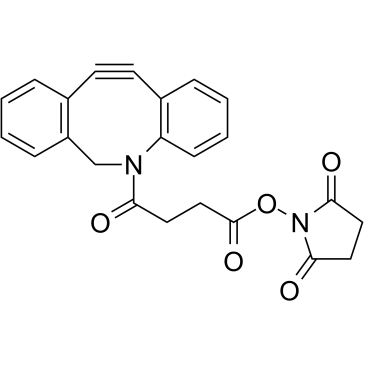
Cas No.: 1353016-71-3
Sample solution is provided at 25 µL, 10mM.
DBCO-NHS ester is a crosslinker used to covalently attach DBCO groups to amine-containing molecules [1]. DBCO-NHS ester is commonly used for bioorthogonal labeling and molecular coupling in copper-free click chemistry [2-3].
References:
[1]. Hu B, Ji C, Zhou Z, et al. Bioorthogonal reaction-mediated photosensitizer–peptide conjugate anchoring on cell membranes for enhanced photodynamic therapy. Biomaterials Science. 2025.
[2]. Tan A, Liu Q, Septiadi D, et al. Understanding selectivity of metabolic labelling and click-targeting in multicellular environments as a route to tissue selective drug delivery. Journal of Materials Chemistry B. 2021 Jul 7; 9(26): 5365-5373.
[3]. Wiener J, Kokotek D, Rosowski S, et al. Preparation of single-and double-oligonucleotide antibody conjugates and their application for protein analytics. Scientific reports. 2020 Jan 29; 10(1): 1457.
This protocol describes the copper-free click reaction of DBCO-NHS ester modified proteins with azide dyes. Actual application conditions may need to be optimized according to the study design [1-2].
1. Preparation of reagents and materials
DBCO-NHS ester, target protein, azide-modified fluorescent dye, PBS, carbonate buffer.
2. Experimental steps
(1) DBCO modification of proteins
Dissolve the target protein in pH 8.5 carbonate buffer at a concentration ≥ 1mg/mL. Dissolve DBCO-NHS ester in anhydrous DMSO (control the final concentration of DMSO in the labeling solution ≤ 10%) and add it to the protein solution at a DBCO:protein ratio of 5-20:1. Vortex to mix and incubate at room temperature for 2h (or overnight at 4℃) in the dark. Equilibrate the desalting column with pre-cooled PBS (pH 7.4), load the reaction solution onto the column, and collect the purified protein by centrifugation. Determine the protein concentration, aliquot and freeze at -80℃.
(2) DBCO-azide click reaction
Prepare azide dye (such as Azide-Cy5) with DMSO to a 1-10mM stock solution and store in the dark. Mix DBCO-modified protein and azide dye in PBS (pH 7.4) at a DBCO:Azide = 1:1.5-3 (molar ratio). Vortex to mix, and react at room temperature in the dark for 1-4h (or at 4℃ overnight). Remove free dye using a desalting column or dialysis (PBS, 4℃ in the dark). SDS-PAGE (fluorescence scanning) or UV-visible spectroscopy (calculate dye/protein ratio, DOL).
Notes and Precautions
(1) Anhydrous operation: DBCO-NHS ester is easily hydrolyzed and needs to be dissolved in a dry environment (dissolved in DMSO purged with nitrogen).
(2) Molar ratio optimization: High DBCO ratio may cause protein aggregation, and it is recommended to test 5:1, 10:1, 15:1 gradient first.
(3) Light protection and low temperature: DBCO and fluorescent dyes are both light-sensitive, so the whole process should be kept away from light; purification is performed at 4℃.
(4) Interference avoidance: Avoid contamination of the reaction system with buffers containing thiols (such as DTT, β-mercaptoethanol) or azides.
(5) Cell experiment verification: If used for live cell labeling, the biological activity of the modified protein and the cell permeability of the azide dye need to be verified.
References:
[1]. Ciferri MC, Bruno S, Rosenwasser N, et al. Standardized method to Functionalize plasma-extracellular vesicles via copper-free click Chemistry for targeted drug delivery strategies. ACS Applied Bio Materials. 2024 Jan 16; 7(2): 827-838.
[2]. Lee HJ, Fernandes-Cunha GM, Putra I, et al. Tethering growth factors to collagen surfaces using copper-free click chemistry: surface characterization and in vitro biological response. ACS applied materials & interfaces. 2017 Jul 19; 9(28): 23389-23399.
| Cas No. | 1353016-71-3 | SDF | |
| Canonical SMILES | O=C(N1CC2=CC=CC=C2C#CC3=CC=CC=C31)CCC(ON4C(CCC4=O)=O)=O | ||
| Formula | C23H18N2O5 | M.Wt | 402.4 |
| Solubility | DMSO: 100 mg/mL (248.51 mM) | Storage | Store at -20°C |
| General tips | Please select the appropriate solvent to prepare the stock solution according to the
solubility of the product in different solvents; once the solution is prepared, please store it in
separate packages to avoid product failure caused by repeated freezing and thawing.Storage method
and period of the stock solution: When stored at -80°C, please use it within 6 months; when stored
at -20°C, please use it within 1 month. To increase solubility, heat the tube to 37°C and then oscillate in an ultrasonic bath for some time. |
||
| Shipping Condition | Evaluation sample solution: shipped with blue ice. All other sizes available: with RT, or with Blue Ice upon request. | ||
| Prepare stock solution | |||

|
1 mg | 5 mg | 10 mg |
| 1 mM | 2.4851 mL | 12.4254 mL | 24.8509 mL |
| 5 mM | 497 μL | 2.4851 mL | 4.9702 mL |
| 10 mM | 248.5 μL | 1.2425 mL | 2.4851 mL |
Step 1: Enter information below (Recommended: An additional animal making an allowance for loss during the experiment)
 g
μL
g
μL
Step 2: Enter the in vivo formulation (This is only the calculator, not formulation. Please contact us first if there is no in vivo formulation at the solubility Section.)
Calculation results:
Working concentration: mg/ml;
Method for preparing DMSO master liquid: mg drug pre-dissolved in μL DMSO ( Master liquid concentration mg/mL, Please contact us first if the concentration exceeds the DMSO solubility of the batch of drug. )
Method for preparing in vivo formulation: Take μL DMSO master liquid, next addμL PEG300, mix and clarify, next addμL Tween 80, mix and clarify, next add μL saline, mix and clarify.
Method for preparing in vivo formulation: Take μL DMSO master liquid, next add μL Corn oil, mix and clarify.
Note: 1. Please make sure the liquid is clear before adding the next solvent.
2. Be sure to add the solvent(s) in order. You must ensure that the solution obtained, in the previous addition, is a clear solution before proceeding to add the next solvent. Physical methods such as vortex, ultrasound or hot water bath can be used to aid dissolving.
3. All of the above co-solvents are available for purchase on the GlpBio website.
Quality Control & SDS
- View current batch:
- Purity: >98.00% Appearance: A solid
- COA (Certificate of Analysis)
- SDS (Safety Data Sheet)
- Datasheet
Average Rating: 5 (Based on Reviews and 22 reference(s) in Google Scholar.)