

Fexofenadine HCl (Synonyms: MDL 16455A) |
Catalog No.GC10966
 One-Click Copy Product Info
|

Fexofenadine HCl es un antagonista del receptor de la histamina H1 oralmente activo y no sedante
Products are for research use only. Not for human use. We do not sell to patients.
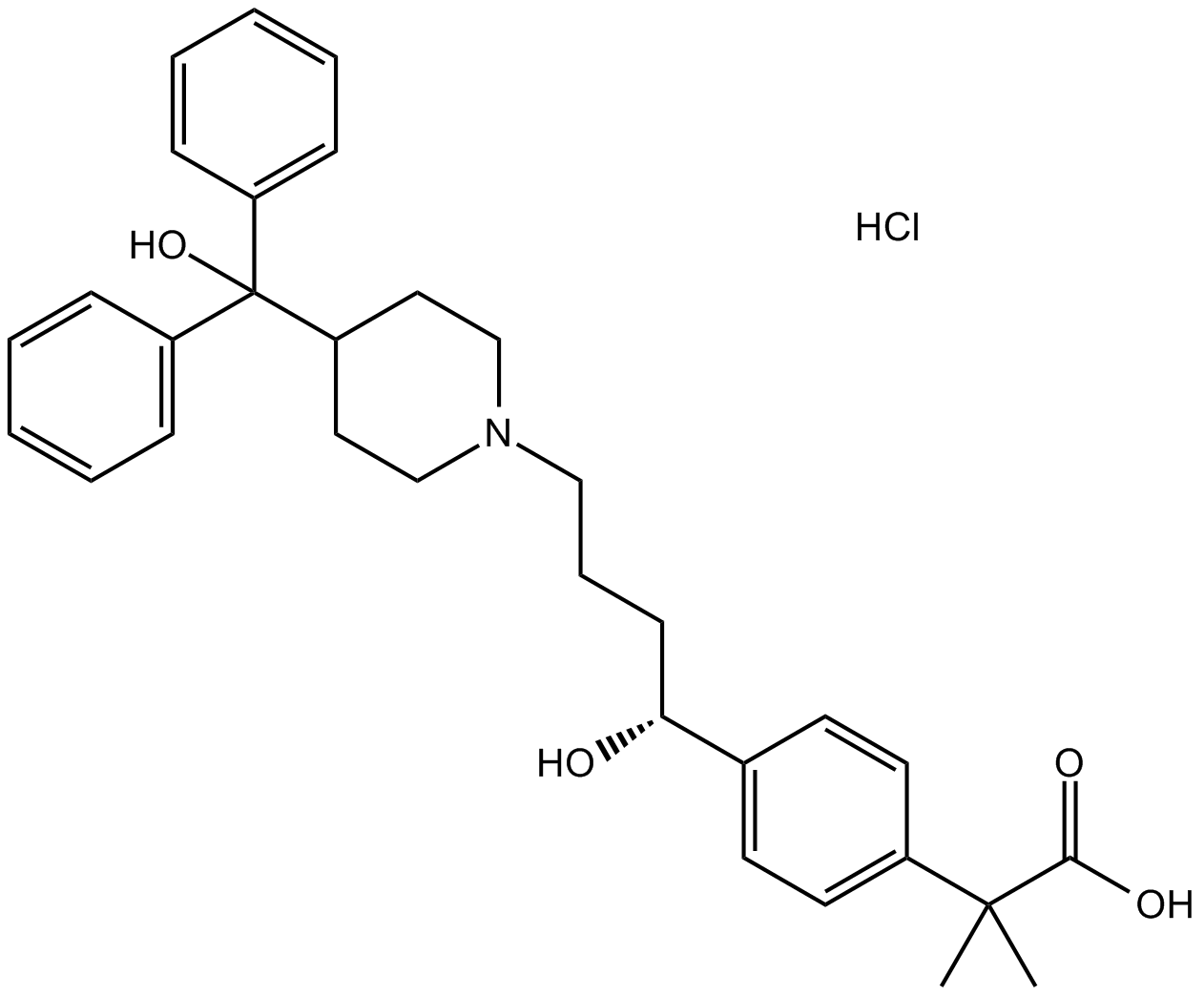
Cas No.: 153439-40-8
Sample solution is provided at 25 µL, 10mM.
_1-3.$$$39978408@51.jpg');)
_1-9.$$$38538795@65.jpg');)
_1-9.$$$39112701@51.jpg');)
_1-7.$$$37316672@70.jpg');)
_366-372.$$$36198801@70.jpg');)
.$$$38565142@65.jpg');)
_1867-1883.$$$33248023@67.jpg');)
_eads6055.$$$39977546@45.jpg');)
_eadm9805.$$$40080571@45.jpg');)
_eadj3020.$$$39666821@45.jpg');)
_1-20.$$$39757301@28.jpg');)
_1-24.$$$38898113@28.jpg');)
_273-287.$$$36806353@46.jpg');)
_1-16.$$$37156877@44.jpg');)
_1-19.$$$37460805@44.jpg');)
_1291-1307.$$$34518654@46.jpg');)
Fexofenadine HCl es un antagonista del receptor de la histamina H1 oralmente activo y no sedante[1]. El receptor de Histamine H1 es un receptor acoplado a proteína G (GPCR) ampliamente expresado en las vías respiratorias, el músculo liso vascular y el sistema nervioso central (CNS) que, al unirse a la histamina, media reacciones de hipersensibilidad clásicas de tipo I, incluida la inflamación alérgica, el aumento de la permeabilidad vascular y el prurito[2]. Fexofenadine HCl se puede usar en investigaciones de rinitis alérgica e investigación urticarial idiopática crónica a través del antagonismo del receptor histamine H1[3][4].
In vitro, el pretratamiento de fibroblastos nasales con 1, 10 o 100μM de Fexofenadine HCl durante 1 hora antes de la estimulación por histamina inhibió significativamente la expresión de la proteína IL-6 de una manera dependientte de la dosis y suprimió activamente la expresión de pp38 y NF-κB, pero no pERK y pJNK[5]. El pretratamiento de monocitos humanos cultivados con Fexofenadine HCl (0.1mM o 1mM; 20h) inhibe significativamente la producción de LTC4, LTD4 y LTE4 estimulados por zymosán, así como la producción de PGE2 estimulada por lipopolisacáridos[6].
In vivo, Fexofenadine HCl (5-20mg/kg/día; p.o.; 3 semanas) inhibió la eosinofilia y las respuestas alérgicas sistémicas en ratones C57BL/6 infectados con T. spiralis[1]. Fexofenadine HCl (2.5mg por dosis; dos veces al día; p.o.; 6 días) de ratones sensibilizados evitó la hiperreactividad de las vías respiratorias tanto en la sensibilización primaria como en el desafío, así como en los experimentos de transferencia adoptiva, y se acompañó de un lavado broncoalveolar y se acompañó con una disminución de la eosinofilia tisular, el número de linfocitos y la producción de citoquinas TH2 [7].
References:
[1] Watanabe N, Matsuda E, Masuda A, Nariai K, Shibasaki T. The effects of fexofenadine on eosinophilia and systemic anaphylaxis in mice infected with Trichinella spiralis. Int Immunopharmacol. 2004;4(3):367-375.
[2] Smit MJ, Hoffmann M, Timmerman H, Leurs R. Molecular properties and signalling pathways of the histamine H1 receptor. Clin Exp Allergy. 1999;29 Suppl 3:19-28.
[3] Ming X, Knight BM, Thakker DR. Vectorial transport of fexofenadine across Caco-2 cells: involvement of apical uptake and basolateral efflux transporters. Mol Pharm. 2011;8(5):1677-1686.
[4] Markham A, Wagstaff AJ. Fexofenadine. Drugs. 1998;55(2):269-276.
[5] Park IH, Um JY, Cho JS, Lee SH, Lee SH, Lee HM. Histamine Promotes the Release of Interleukin-6 via the H1R/p38 and NF-κB Pathways in Nasal Fibroblasts. Allergy Asthma Immunol Res. 2014;6(6):567-572.
[6] Juergens UR, Darlath W, Stober M, et al. Differential effects of fexofenadine on arachidonic acid metabolism in cultured human monocytes. Pharmacology. 2006;76(1):40-45.
[7] Gelfand EW, Cui ZH, Takeda K, Kanehiro A, Joetham A. Fexofenadine modulates T-cell function, preventing allergen-induced airway inflammation and hyperresponsiveness. J Allergy Clin Immunol. 2002;110(1):85-95.
| Experimentos celulares [1]: | |
Líneas celulares | Fibroblastos nasales |
Método de preparación | Los fibroblastos nasales se aislaron de los tejidos quirúrgicos mediante digestión enzimática con colagenasa (500U/mL), hialuronidasa (30U/mL) y DNasa (10U/mL). Las células se cultivaron en el medio de águila modificada de Dulbecco que contenía un 10% (v/v) de suero bovino fetal inactivado por calor, 1% (v/v), 10.000U/mL de penicilina y 10.000 μg/mL de estreptococicina. Las células se trataron previamente con 1, 10 o 100 μM de Fexofenadin HCl durante 1 hora y luego se estimularon con histamina (100 μM) durante 24 horas. |
Condiciones de reacción | 1, 10 o 100 μM; 1h |
Áreas de aplicación | Fexofenadin HCl inhibió la expresión de la proteína IL-6 de una manera dependiente de la dosis. |
| Experimentos con animales [2]: | |
Modelos animales | Ratones BALB/c hembra |
Método de preparación | Ratones BALB/c hembra de 10 a 12 semanas de edad fueron sensibilizados por medio de inyección intraperitoneal de 20µg de OVA emulsionado en 2,25 mg de hidróxido de aluminio en un volumen total de 100µL los días 1 y 14. Los ratones fueron desafiados durante 20 minutos a través de las vías respiratorias diariamente con OVA (1% en solución salina) durante 3 días (días 26, 27 y 28) mediante el uso de nebulización ultrasónica. El medicamento Fexofenadin HCl se suspendió en solución salina y se administró por medio de gavage (sin anestesia) a una dosis de 2,5 mg dos veces al día a partir de 3 días antes del desafío de alérgenos y en cada uno de los días de desafío de alérgenos. La capacidad de respuesta de las vías respiratorias se evaluó con un pletismógrafo de cuerpo completo de una sola cámara. |
Forma de dosificación | 2,5 mg dos veces al día; p.o.; 6 días |
Áreas de aplicación | El tratamiento con Fexofenadin HCl de ratones sensibilizados evitó la hiperreactividad de las vías respiratorias. |
References: | |
| Cas No. | 153439-40-8 | SDF | |
| Sinónimos | MDL 16455A | ||
| Chemical Name | 2-[4-[1-hydroxy-4-[4-[hydroxy(diphenyl)methyl]piperidin-1-yl]butyl]phenyl]-2-methylpropanoic acid;hydrochloride | ||
| Canonical SMILES | CC(C)(C1=CC=C(C=C1)C(CCCN2CCC(CC2)C(C3=CC=CC=C3)(C4=CC=CC=C4)O)O)C(=O)O.Cl | ||
| Formula | C32H39NO4.HCl | M.Wt | 538.12 |
| Solubility | ≥ 26.9mg/mL in DMSO | Storage | Store at -20°C |
| General tips | Please select the appropriate solvent to prepare the stock solution according to the
solubility of the product in different solvents; once the solution is prepared, please store it in
separate packages to avoid product failure caused by repeated freezing and thawing.Storage method
and period of the stock solution: When stored at -80°C, please use it within 6 months; when stored
at -20°C, please use it within 1 month. To increase solubility, heat the tube to 37°C and then oscillate in an ultrasonic bath for some time. |
||
| Shipping Condition | Evaluation sample solution: shipped with blue ice. All other sizes available: with RT, or with Blue Ice upon request. | ||
| Prepare stock solution | |||

|
1 mg | 5 mg | 10 mg |
| 1 mM | 1.8583 mL | 9.2916 mL | 18.5832 mL |
| 5 mM | 371.7 μL | 1.8583 mL | 3.7166 mL |
| 10 mM | 185.8 μL | 929.2 μL | 1.8583 mL |
Step 1: Enter information below (Recommended: An additional animal making an allowance for loss during the experiment)
 g
μL
g
μL
Step 2: Enter the in vivo formulation (This is only the calculator, not formulation. Please contact us first if there is no in vivo formulation at the solubility Section.)
Calculation results:
Working concentration: mg/ml;
Method for preparing DMSO master liquid: mg drug pre-dissolved in μL DMSO ( Master liquid concentration mg/mL, Please contact us first if the concentration exceeds the DMSO solubility of the batch of drug. )
Method for preparing in vivo formulation: Take μL DMSO master liquid, next addμL PEG300, mix and clarify, next addμL Tween 80, mix and clarify, next add μL saline, mix and clarify.
Method for preparing in vivo formulation: Take μL DMSO master liquid, next add μL Corn oil, mix and clarify.
Note: 1. Please make sure the liquid is clear before adding the next solvent.
2. Be sure to add the solvent(s) in order. You must ensure that the solution obtained, in the previous addition, is a clear solution before proceeding to add the next solvent. Physical methods such as vortex, ultrasound or hot water bath can be used to aid dissolving.
3. All of the above co-solvents are available for purchase on the GlpBio website.
Quality Control & SDS
- View current batch:
- Purity: >99.50% Appearance: A solid
- COA (Certificate of Analysis)
- SDS (Safety Data Sheet)
- Datasheet
Average Rating: 5 (Based on Reviews and 17 reference(s) in Google Scholar.)