

Flavopiridol (Synonyms: Alvocidib, HL 275, HMR 1275, L-868,275) |
Catalog No.GC16063
 One-Click Copy Product Info
|

An inhibitor of cyclin-dependent kinases
Products are for research use only. Not for human use. We do not sell to patients.
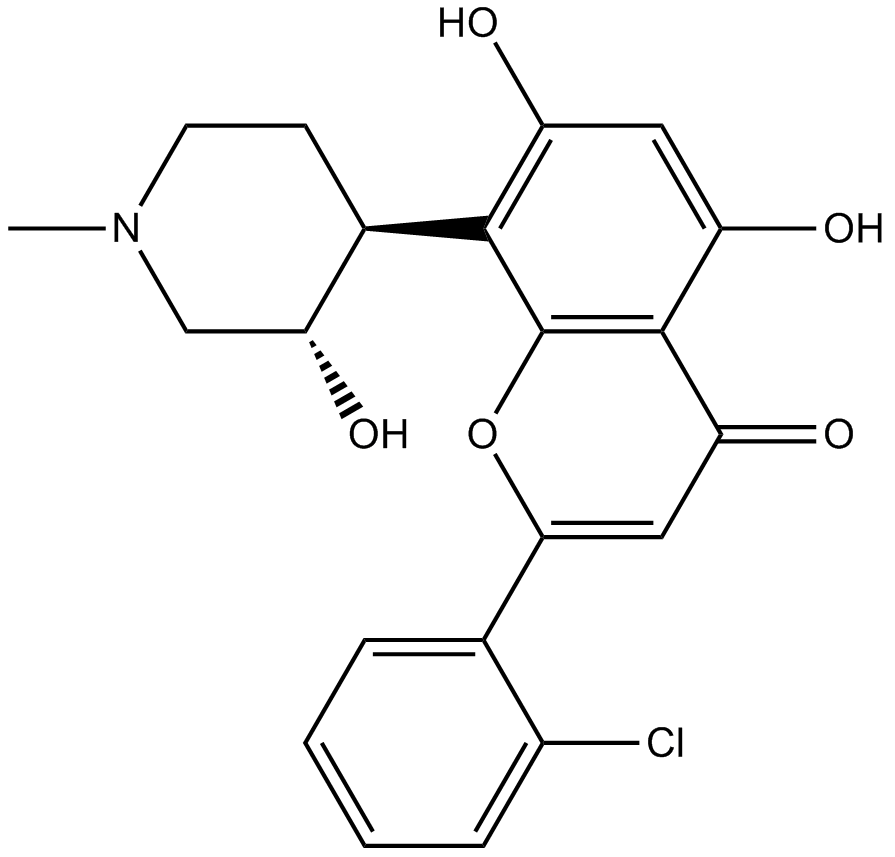
Cas No.: 146426-40-6
Sample solution is provided at 25 µL, 10mM.
Flavopiridol is a potent and selective inhibitor of cyclin-dependent kinases (CDKs) with IC50 values of ~41 nM for CDK1, CDK2, CDK4, CDK6 and 300 nM for CDK7, respectively [1].
CDKs are a family of protein kinases regulating the cell cycle and play an important role in transcription, mRNA processing, and cell differentiation.
Analysis of the crystal structure suggested flavopiridol binded to the ATP-binding pocket of CDK2. In MCF-7 breast cancer cells, flavopiridol reduced the mRNA level of cyclin D1 protein and cyclin D3 protein [1]. In 23 human tumor cell models, flavopiridol significantly inhibited human bone marrow colony formation between 10 and 100 ng/ml [2].
In prostate cancer xenograft PRXFI369, flavopinidol (10 mg/kg/day) had antitumor activity of optimal test/control (T/C) of 33% and a growth delay of 30 days. Also, it reduced tumor volume by 85%. In prostate cancer xenograft PRXFI337, the optimal T/C was 27% and the growth delay was 17 days [2].
References:
[1]. Senderowicz AM. The cell cycle as a target for cancer therapy: basic and clinical findings with the small molecule inhibitors flavopiridol and UCN-01. Oncologist, 2002, 7 Suppl 3: 12-9.
[2]. Drees M, Dengler WA, Roth T, et al. Flavopiridol (L86-8275): selective antitumor activity in vitro and activity in vivo for prostate carcinoma cells. Clin Cancer Res, 1997, 3(2): 273-279.
[3]. Carlson BA, Dubay MM, Sausville EA, et al. Flavopiridol induces G1 arrest with inhibition of cyclin-dependent kinase (CDK) 2 and CDK4 in human breast carcinoma cells. Cancer Res, 1996, 56(13): 2973-2978.
| Cell experiment [1]: | |
|
Cell lines |
23 human tumor cells |
|
Preparation method |
This compound is soluble in DMSO. General tips for obtaining a higher concentration: Please warm the tube at 37 °C for 10 minutes and/or shake it in the ultrasonic bath for a while. Stock solution can be stored below - 20 °C for several months. |
|
Reacting condition |
0.1 ng/mL ~ 10 μg/mL; 6 ~ 18 days |
|
Applications |
In 3 prostate cancer cell lines (PRXFI369, PC3MX and LNCaPX) and 1 melanoma cell line (MEXFI341), Flavopiridol potently inhibited colony formation, even at the concentration down to 0.1 ng/mL. At the concentrations between 10 and 100 ng/mL, Flavopiridol significantly inhibited colony formation of human bone marrow cells. For most of the human tumor cells, the inhibitory effect of Flavopiridol on colony formation was first observed at 10 ng/mL. |
| Animal experiment [1]: | |
|
Animal models |
Nude mice bearing PRXFI369 xenografts |
|
Dosage form |
10 mg/kg/day; p.o. |
|
Applications |
In tumor-bearing nude mice, Flavopiridol caused 12.5% deaths at the maximum tolerated dose (MTD). In nude mice bearing PRXFI369 xenografts, Flavopiridol at MTD resulted in an optimal T/C value of 33% and a growth delay of 30 days. However, at day 28, tumor volume increased slightly to 115%. Flavopiridol at the dose of 15 mg/kg/day was toxic, whereas at the dose of 5 mg/kg/day was inactive. |
|
Other notes |
Please test the solubility of all compounds indoor, and the actual solubility may slightly differ with the theoretical value. This is caused by an experimental system error and it is normal. |
|
References: [1]. Drees M, Dengler WA, Roth T, Labonte H, Mayo J, Malspeis L, Grever M, Sausville EA, Fiebig HH. Flavopiridol (L86-8275): selective antitumor activity in vitro and activity in vivo for prostate carcinoma cells. Clin Cancer Res. 1997 Feb;3(2):273-9. |
|
| Cas No. | 146426-40-6 | SDF | |
| Sinónimos | Alvocidib, HL 275, HMR 1275, L-868,275 | ||
| Chemical Name | 2-(2-chlorophenyl)-5,7-dihydroxy-8-[(3S,4R)-3-hydroxy-1-methylpiperidin-4-yl]chromen-4-one | ||
| Canonical SMILES | CN1CCC(C(C1)O)C2=C(C=C(C3=C2OC(=CC3=O)C4=CC=CC=C4Cl)O)O | ||
| Formula | C21H20ClNO5 | M.Wt | 401.85 |
| Solubility | ≥ 40.2 mg/mL in DMSO, ≥ 85.4 mg/mL in EtOH with ultrasonic and warming | Storage | Store at -20°C |
| General tips | Please select the appropriate solvent to prepare the stock solution according to the
solubility of the product in different solvents; once the solution is prepared, please store it in
separate packages to avoid product failure caused by repeated freezing and thawing.Storage method
and period of the stock solution: When stored at -80°C, please use it within 6 months; when stored
at -20°C, please use it within 1 month. To increase solubility, heat the tube to 37°C and then oscillate in an ultrasonic bath for some time. |
||
| Shipping Condition | Evaluation sample solution: shipped with blue ice. All other sizes available: with RT, or with Blue Ice upon request. | ||
| Prepare stock solution | |||

|
1 mg | 5 mg | 10 mg |
| 1 mM | 2.4885 mL | 12.4425 mL | 24.8849 mL |
| 5 mM | 497.7 μL | 2.4885 mL | 4.977 mL |
| 10 mM | 248.8 μL | 1.2442 mL | 2.4885 mL |
Step 1: Enter information below (Recommended: An additional animal making an allowance for loss during the experiment)
 g
μL
g
μL
Step 2: Enter the in vivo formulation (This is only the calculator, not formulation. Please contact us first if there is no in vivo formulation at the solubility Section.)
Calculation results:
Working concentration: mg/ml;
Method for preparing DMSO master liquid: mg drug pre-dissolved in μL DMSO ( Master liquid concentration mg/mL, Please contact us first if the concentration exceeds the DMSO solubility of the batch of drug. )
Method for preparing in vivo formulation: Take μL DMSO master liquid, next addμL PEG300, mix and clarify, next addμL Tween 80, mix and clarify, next add μL saline, mix and clarify.
Method for preparing in vivo formulation: Take μL DMSO master liquid, next add μL Corn oil, mix and clarify.
Note: 1. Please make sure the liquid is clear before adding the next solvent.
2. Be sure to add the solvent(s) in order. You must ensure that the solution obtained, in the previous addition, is a clear solution before proceeding to add the next solvent. Physical methods such as vortex, ultrasound or hot water bath can be used to aid dissolving.
3. All of the above co-solvents are available for purchase on the GlpBio website.
Quality Control & SDS
- View current batch:
- Purity: >98.00% Appearance: A solid
- COA (Certificate of Analysis)
- SDS (Safety Data Sheet)
- Datasheet
Average Rating: 5 (Based on Reviews and 30 reference(s) in Google Scholar.)