

Haloperidol (Synonyms: McNJR 1625, NSC 170973, NSC 615296, R 1625) |
Catalog No.GC17599
 One-Click Copy Product Info
|

Haloperidol es un antipsicótico clásico y antagonista de los receptores dopaminérgicos tipo D2, así como un inhibidor de canales iónicos que bloquea una variedad de canales iónicos, como los canales de potasio activados por proteínas G, los canales de potasio activados por calcio, los canales de potasio HERG y HEAG, además de los canales de calcio de tipo L, N y P.
Products are for research use only. Not for human use. We do not sell to patients.
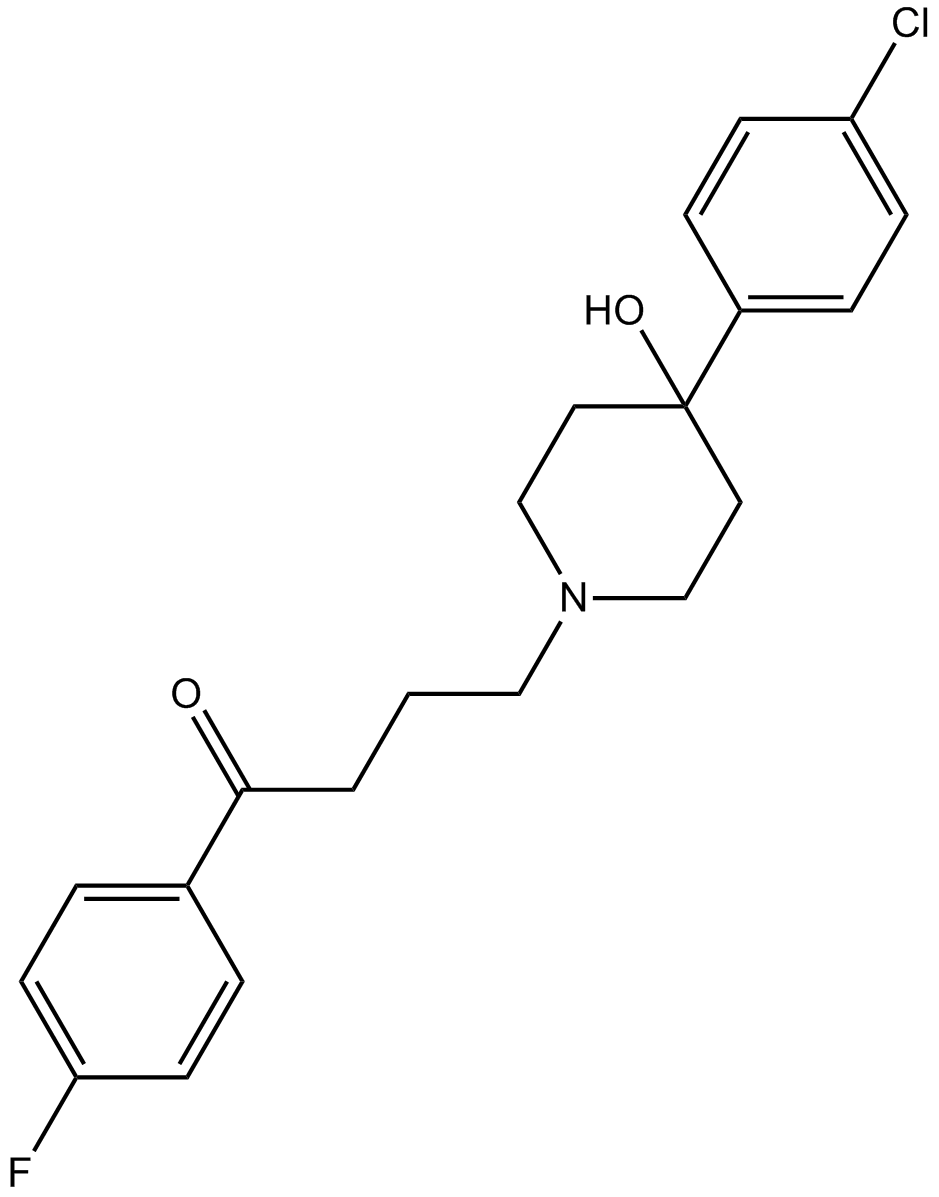
Cas No.: 52-86-8
Sample solution is provided at 25 µL, 10mM.
_1-3.$$$39978408@51.jpg');)
_1-9.$$$38538795@65.jpg');)
_1-9.$$$39112701@51.jpg');)
_1-7.$$$37316672@70.jpg');)
_366-372.$$$36198801@70.jpg');)
.$$$38565142@65.jpg');)
_1867-1883.$$$33248023@67.jpg');)
_eads6055.$$$39977546@45.jpg');)
_eadm9805.$$$40080571@45.jpg');)
_eadj3020.$$$39666821@45.jpg');)
_1-20.$$$39757301@28.jpg');)
_1-24.$$$38898113@28.jpg');)
_273-287.$$$36806353@46.jpg');)
_1-16.$$$37156877@44.jpg');)
_1-19.$$$37460805@44.jpg');)
_1291-1307.$$$34518654@46.jpg');)
Haloperidol es un antipsicótico clásico y antagonista de los receptores dopaminérgicos tipo D2, así como un inhibidor de canales iónicos que bloquea una variedad de canales iónicos, como los canales de potasio activados por proteínas G, los canales de potasio activados por calcio, los canales de potasio HERG y HEAG, además de los canales de calcio de tipo L, N y P[1-4].
El tratamiento con haloperidol (5-100 μM) disminuyó significativamente la viabilidad de las células U87, U251 y T98, con valores de IC50 de 23, 38 y 35 μM, respectivamente. El haloperidol indujo apoptosis en células de glioblastoma de manera dependiente de la dosis e inhibió la migración celular y la expresión de CD24 y CD44[2]. Concentraciones no tóxicas de haloperidol (1-30 μM) mostraron un aumento dependiente de la dosis de la citotoxicidad de VBL en células de leucemia humana resistentes a VBL (K562/VBL), pero no tuvieron un efecto similar en las células parentales[3].
En ratas macho adultas de la cepa Sprague-Dawley, el haloperidol (0,05 y 2 mg/kg) no tuvo efecto sobre la proliferación celular en el giro dentado (DG) ni en el número de nuevas neuronas generadas en el DG tras la administración de bromodesoxiuridina (BrdU)[4]. En ratas macho adultas de la cepa Wistar tratadas con haloperidol (1-10 mg/kg), los niveles de la sustancia activa de ácido tiobarbitúrico (TBAR) en el estriado (ST) aumentaron y los niveles de TBAR en la corteza (CX) disminuyeron[5].
References:
[1] Yang S B, Proks P, Ashcroft F M, et al. Inhibition of ATP‐sensitive potassium channels by haloperidol[J]. British journal of pharmacology, 2004, 143(8): 960-967.
[2] Papadopoulos F, Isihou R, Alexiou G A, et al. Haloperidol induced cell cycle arrest and apoptosis in glioblastoma cells[J]. Biomedicines, 2020, 8(12): 595.
[3] Kataoka Y, Ishikawa M, Miura M, et al. Reversal of vinblastine resistance in human leukemic cells by haloperidol and dihydrohaloperidol[J]. Biological and Pharmaceutical Bulletin, 2001, 24(6): 612-617.
[4] Halim N D, Weickert C S, McClintock B W, et al. Effects of chronic haloperidol and clozapine treatment on neurogenesis in the adult rat hippocampus[J]. Neuropsychopharmacology, 2004, 29(6): 1063-1069.
[5] Toru M, Takashima M. Haloperidol in large doses reduces the cataleptic response and increases noradrenaline metabolism in the brain of the rat[J]. Neuropharmacology, 1985, 24(3): 231-236.
| Experimentos celulares [1]: | |
Líneas celulares | Líneas celulares U87 y U251 |
Método de preparación | Las células U87 y U251 fueron expuestas a concentraciones crecientes de haloperidol durante 72 horas, y la viabilidad celular se midió utilizando el ensayo MTT. |
Condiciones de reacción | 5, 10, 20, 50 y 100 μM, 72 horas |
Áreas de aplicación | El haloperidol inhibió la viabilidad de las células U87 y U251, con valores de IC50 de 23 μM y 38 μM, respectivamente. |
| Experimentos con animales [2]: | |
Modelos animales | Ratas adultas hembras Long-Evans |
Método de preparación | Después de la inyección intraperitoneal de haloperidol, las ratas fueron decapitadas y el tejido cerebral fue extraído para realizar cortes congelados. |
Forma de dosificación | 1, 2.5, 5, 7.5 o 10 mg/kg, 2 horas, i.p. |
Áreas de aplicación | El haloperidol en dosis altas reduce la respuesta cataléptica y aumenta el metabolismo de la noradrenalina en el cerebro de la rata. |
Referencias: [1] Papadopoulos F, Isihou R, Alexiou G A, et al. Haloperidol induced cell cycle arrest and apoptosis in glioblastoma cells[J]. Biomedicines, 2020, 8(12): 595. [2] Toru M, Takashima M. Haloperidol in large doses reduces the cataleptic response and increases noradrenaline metabolism in the brain of the rat[J]. Neuropharmacology, 1985, 24(3): 231-236. | |
| Cas No. | 52-86-8 | SDF | |
| Sinónimos | McNJR 1625, NSC 170973, NSC 615296, R 1625 | ||
| Chemical Name | 4-[4-(4-chlorophenyl)-4-hydroxypiperidin-1-yl]-1-(4-fluorophenyl)butan-1-one | ||
| Canonical SMILES | C1CN(CCC1(C2=CC=C(C=C2)Cl)O)CCCC(=O)C3=CC=C(C=C3)F | ||
| Formula | C21H23ClFNO2 | M.Wt | 375.86 |
| Solubility | 100mg/mL in DMSO(ultrasonic and warming and heat to 60°C) | Storage | Store at -20°C |
| General tips | Please select the appropriate solvent to prepare the stock solution according to the
solubility of the product in different solvents; once the solution is prepared, please store it in
separate packages to avoid product failure caused by repeated freezing and thawing.Storage method
and period of the stock solution: When stored at -80°C, please use it within 6 months; when stored
at -20°C, please use it within 1 month. To increase solubility, heat the tube to 37°C and then oscillate in an ultrasonic bath for some time. |
||
| Shipping Condition | Evaluation sample solution: shipped with blue ice. All other sizes available: with RT, or with Blue Ice upon request. | ||
| Prepare stock solution | |||

|
1 mg | 5 mg | 10 mg |
| 1 mM | 2.6606 mL | 13.3028 mL | 26.6057 mL |
| 5 mM | 532.1 μL | 2.6606 mL | 5.3211 mL |
| 10 mM | 266.1 μL | 1.3303 mL | 2.6606 mL |
Step 1: Enter information below (Recommended: An additional animal making an allowance for loss during the experiment)
 g
μL
g
μL
Step 2: Enter the in vivo formulation (This is only the calculator, not formulation. Please contact us first if there is no in vivo formulation at the solubility Section.)
Calculation results:
Working concentration: mg/ml;
Method for preparing DMSO master liquid: mg drug pre-dissolved in μL DMSO ( Master liquid concentration mg/mL, Please contact us first if the concentration exceeds the DMSO solubility of the batch of drug. )
Method for preparing in vivo formulation: Take μL DMSO master liquid, next addμL PEG300, mix and clarify, next addμL Tween 80, mix and clarify, next add μL saline, mix and clarify.
Method for preparing in vivo formulation: Take μL DMSO master liquid, next add μL Corn oil, mix and clarify.
Note: 1. Please make sure the liquid is clear before adding the next solvent.
2. Be sure to add the solvent(s) in order. You must ensure that the solution obtained, in the previous addition, is a clear solution before proceeding to add the next solvent. Physical methods such as vortex, ultrasound or hot water bath can be used to aid dissolving.
3. All of the above co-solvents are available for purchase on the GlpBio website.
Quality Control & SDS
- View current batch:
- Purity: >98.00% Appearance: A solid
- COA (Certificate of Analysis)
- SDS (Safety Data Sheet)
- Datasheet
Average Rating: 5 (Based on Reviews and 22 reference(s) in Google Scholar.)