

KN-93 |
Catalog No.GC10629
 One-Click Copy Product Info
|

KN-93 es un inhibidor efectivo, permeable a la membrana celular y selectivo de la proteína quinasa II dependiente de Ca2+/calmodulin (CaMKII) con un valor de IC50 de 0.37μM
Products are for research use only. Not for human use. We do not sell to patients.
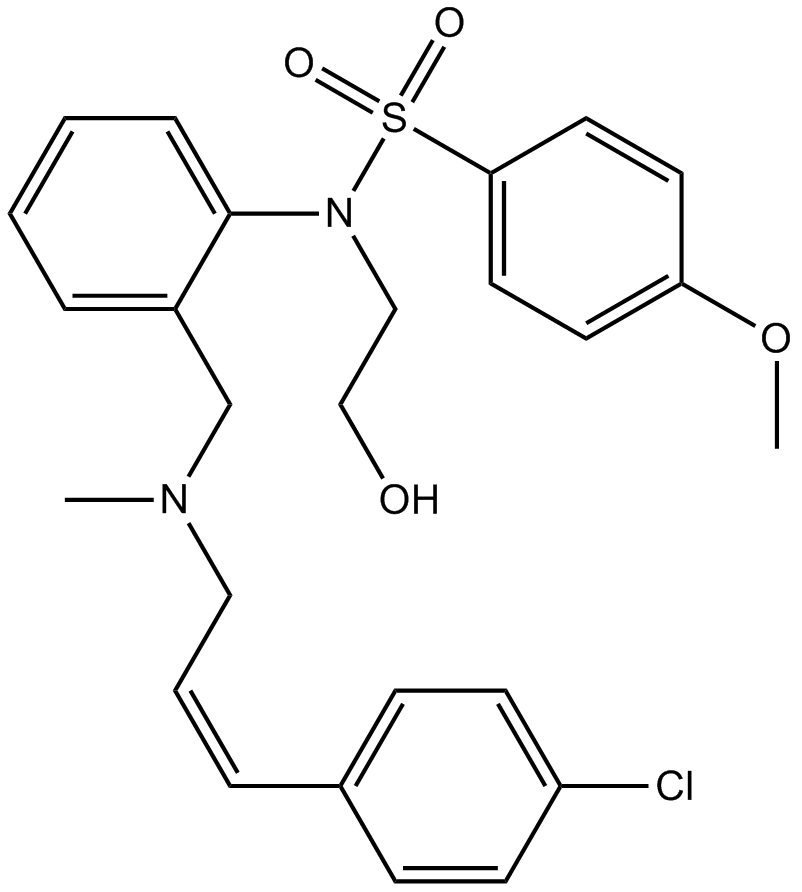
Cas No.: 139298-40-1
Sample solution is provided at 25 µL, 10mM.
KN-93 es un inhibidor efectivo, permeable a la membrana celular y selectivo de la proteína quinasa II dependiente de Ca2+/calmodulin (CaMKII) con un valor de IC50 de 0.37μM[1, 2]. KN-93 inhibe el componente rápido de la corriente de potasio rectificadora retardada (IKr) en los cardiomiocitos de mamíferos[3]. KN-93 induce la translocación nuclear de la histona desacetilasa 4 (HDAC4), promoviendo así la oxidación de ácidos grasos en el infarto de miocardio[4].
In vitro, el tratamiento de células estrelladas hepáticas humanas LX-2 con KN-93 (0-50μM) durante 24h disminuyó la viabilidad celular y la expresión de las proteínas reguladores del ciclo celular p53 y p21 de una manera dependiente de la dosis[5]. El tratamiento de células neuronales inducidas por NMDA con KN-93 (1μM) redujo significativamente la apoptosis celular, la liberación de LDH y la concentración de calcio intracelular[6].
In vivo, el tratamiento de 21 días de ratas con enfermedades de Parkinson con KN-93 (2μg, 5μg) a través de inyección estriatal alivió significativamente la disfunción motora inducida por levodopa, redujo los niveles de fosforilación de GluR1 ene l núcleo accumbens y disminuyó los niveles de expresión de glutamato descarboxilasa 1 (Gad1) y Nur77 (NR4A1, un receptor huérfano de la superfamilia de receptores nucleares)[7].
References:
[1] Anderson M E, Braun A P, Wu Y, et al. KN-93, an inhibitor of multifunctional Ca++/calmodulin-dependent protein kinase, decreases early afterdepolarizations in rabbit heart[J]. The Journal of pharmacology and experimental therapeutics, 1998, 287(3): 996-1006.
[2] Agulló L, Garcia-Dorado D, Escalona N, et al. Membrane association of nitric oxide-sensitive guanylyl cyclase in cardiomyocytes[J]. Cardiovascular research, 2005, 68(1): 65-74.
[3] Hegyi B, Chen-Izu Y, Jian Z, et al. KN-93 inhibits IKr in mammalian cardiomyocytes[J]. Journal of Molecular and Cellular Cardiology, 2015, 89: 173-176.
[4] Zhao J, Li L, Wang X, et al. KN-93 promotes HDAC4 nucleus translocation to promote fatty acid oxidation in myocardial infarction[J]. Experimental Cell Research, 2024, 438(2): 114050.
[5] An P, Zhu J Y, Yang Y, et al. KN-93, a specific inhibitor of CaMKII inhibits human hepatic stellate cell proliferation in vitro[J]. World Journal of Gastroenterology: WJG, 2007, 13(9): 1445.
[6] Liu X, Ma C, Xing R, et al. The calmodulin-dependent protein kinase II inhibitor KN-93 protects rat cerebral cortical neurons from N-methyl-D-aspartic acid-induced injury☆[J]. Neural Regeneration Research, 2013, 8(2): 111-120.
[7] Yang X, Wu N, Song L, et al. Intrastriatal injections of KN-93 ameliorates levodopa-induced dyskinesia in a rat model of Parkinson’s disease[J]. Neuropsychiatric disease and treatment, 2013: 1213-1220.
| Experimentos celulares [1]: | |
Líneas celulares | Células LX-2 |
Método de preparación | Las células LX-2 se incubaron con 0, 5, 10, 25, 50 μM de KN-93 durante 24 horas, y luego se midió la viabilidad celular utilizando el ensayo CCK-8. |
Condiciones de reacción | 0, 5, 10, 25, 50 μM; 24h |
Áreas de aplicación | Después de la incubación de KN-93 a varias concentraciones durante 24 horas, el número de células LX-2 se redujo drásticamente del 81,76 % (5μM) al 27,15 % (50 μM). |
| Experimentos con animales [2]: | |
Modelos animales | Ratas de Sprague Dawley |
Método de preparación | Se utilizaron inyecciones de 6-hidroxidopamina (OHDA) para crear un modelo de rata de la enfermedad de Parkinson (EP). Después de 3 semanas de inyecciones, las ratas que exhiben rotaciones estables inducidas por apomorfina (≥0,7 vueltas/minuto) fueron seleccionadas como ratas PD válidas. Fortarenta de estas ratas con EP fueron tratadas con levodopa más benserazida dos veces al día durante 21 días. Las puntuaciones de movimiento involuntario anormal (AIM) se midieron los días 1, 7, 14 y 21 del tratamiento. Además, un grupo de ratas con EP (grupo PD, n=10) y otro grupo de ratas operadas simuladas (grupo simulado, n=10) fueron tratados con vehículo dos veces al día durante 21 días. El día 22, las 40 ratas con EP tratadas con levodopa se dividieron aleatoriamente en cuatro grupos: grupo levodopa+KN-93 (1µg), grupo levodopa+KN-93 (2µg), grupo levodoap+KN-93 (5µg) y grupo levodopa+vehículo. Estas ratas recibieron inyecciones intraestriatales de diferentes dosis de KN-93 (1µg, 2µg o 5µg) o vehículo antes del tratamiento con levodopa. Como control, el grupo simulado y las ratas del grupo PD recibieron inyecciones intraestriatales del vehículo antes del tratamiento del vehículo. Se midieron las rotaciones inducidas por apomorfina para evaluar el efecto antiparkinsoniano de KN-93 en los días 1 y 22. Las puntuaciones AIM se midieron para evaluar el efecto antidiscinético de KN-93 en los días 1, 7, 14, 21 y 22. Al final del experimento, las ratas fueron sacrificadas con anestesia profunda utilizando fenobarbital al 3%. Se utilizó el análisis de Western blot para determinar los niveles de GluR1 y pGluR1S845. Se utilizó la reacción en cadena de la polimerasa (PCR) en tiempo real para medir los niveles de Gad1 y Nurr77. |
Forma de dosificación | 1, 2, 5 μg; 21 días; tratado por vía intraestriatal |
Áreas de aplicación | El tratamiento KN-93 de 2µg y 5µg redujo las puntuaciones de AIM en ratas PD de cebado de levodopa sin afectar el efecto antiparkinsoniano de la levodopa. De acuerdo con el análisis de comportamiento, el tratamiento KN-93 redujo los niveles de pGluR1S845 en ratas con EP. Además, el tratamiento con KN-93 redujo la expresión de Gad1 y Nur77 en ratas con EP. |
References: | |
| Cas No. | 139298-40-1 | SDF | |
| Chemical Name | N-[2-[[[(E)-3-(4-chlorophenyl)prop-2-enyl]-methylamino]methyl]phenyl]-N-(2-hydroxyethyl)-4-methoxybenzenesulfonamide | ||
| Canonical SMILES | CN(CC=CC1=CC=C(C=C1)Cl)CC2=CC=CC=C2N(CCO)S(=O)(=O)C3=CC=C(C=C3)OC | ||
| Formula | C26H29ClN2O4S | M.Wt | 501.04 |
| Solubility | ≥ 19.15mg/mL in DMSO | Storage | Store at -20°C |
| General tips | Please select the appropriate solvent to prepare the stock solution according to the
solubility of the product in different solvents; once the solution is prepared, please store it in
separate packages to avoid product failure caused by repeated freezing and thawing.Storage method
and period of the stock solution: When stored at -80°C, please use it within 6 months; when stored
at -20°C, please use it within 1 month. To increase solubility, heat the tube to 37°C and then oscillate in an ultrasonic bath for some time. |
||
| Shipping Condition | Evaluation sample solution: shipped with blue ice. All other sizes available: with RT, or with Blue Ice upon request. | ||
| Prepare stock solution | |||

|
1 mg | 5 mg | 10 mg |
| 1 mM | 1.9958 mL | 9.9792 mL | 19.9585 mL |
| 5 mM | 399.2 μL | 1.9958 mL | 3.9917 mL |
| 10 mM | 199.6 μL | 997.9 μL | 1.9958 mL |
Step 1: Enter information below (Recommended: An additional animal making an allowance for loss during the experiment)
 g
μL
g
μL
Step 2: Enter the in vivo formulation (This is only the calculator, not formulation. Please contact us first if there is no in vivo formulation at the solubility Section.)
Calculation results:
Working concentration: mg/ml;
Method for preparing DMSO master liquid: mg drug pre-dissolved in μL DMSO ( Master liquid concentration mg/mL, Please contact us first if the concentration exceeds the DMSO solubility of the batch of drug. )
Method for preparing in vivo formulation: Take μL DMSO master liquid, next addμL PEG300, mix and clarify, next addμL Tween 80, mix and clarify, next add μL saline, mix and clarify.
Method for preparing in vivo formulation: Take μL DMSO master liquid, next add μL Corn oil, mix and clarify.
Note: 1. Please make sure the liquid is clear before adding the next solvent.
2. Be sure to add the solvent(s) in order. You must ensure that the solution obtained, in the previous addition, is a clear solution before proceeding to add the next solvent. Physical methods such as vortex, ultrasound or hot water bath can be used to aid dissolving.
3. All of the above co-solvents are available for purchase on the GlpBio website.
Quality Control & SDS
- View current batch:
- Purity: >99.50% Appearance: A solid
- COA (Certificate of Analysis)
- SDS (Safety Data Sheet)
- Datasheet
Average Rating: 5 (Based on Reviews and 30 reference(s) in Google Scholar.)