

KN-93 |
Katalog-Nr.GC10629
 One-Click Copy Product Info
|

Selektiver Inhibitor der Ca2+/Calmodulin-abhängigen Kinase Typ II
Products are for research use only. Not for human use. We do not sell to patients.
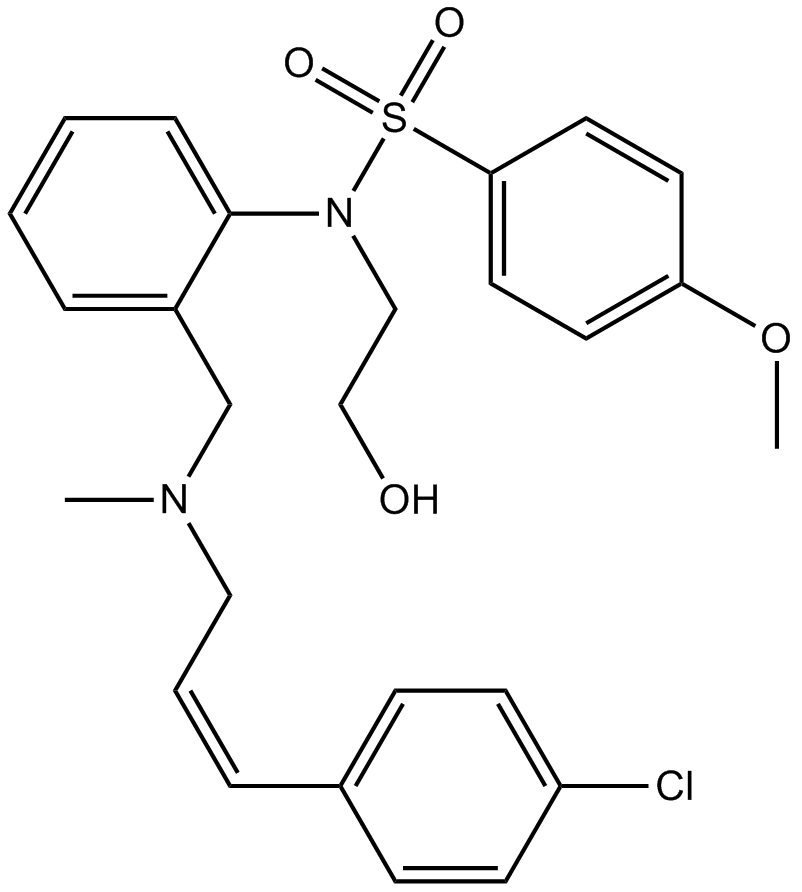
Cas No.: 139298-40-1
Sample solution is provided at 25 µL, 10mM.
KN-93 is an effective, cell-membrane permeable, and selective inhibitor of Ca2+/calmodulin-dependent protein kinase II (CaMKII) with an IC50 value of 0.37μM[1, 2]. KN-93 inhibits the rapid component of the delayed rectifier potassium current (IKr) in mammalian cardiomyocytes[3]. KN-93 induces nuclear translocation of histone deacetylase 4 (HDAC4), thereby promoting fatty acid oxidation in myocardial infarction[4].
In vitro, treatment of LX-2 human hepatic stellate cells with KN-93 (0-50μM) for 24h decreased cell viability and the expression of cell cycle regulatory proteins p53 and p21 in a dose-dependent manner[5]. Treatment of NMDA-induced neuronal cells with KN-93 (1μM) significantly reduced cell apoptosis, LDH release, and intracellular calcium concentration[6].
In vivo, 21-day treatment of Parkinson's disease rats with KN-93 (2μg, 5μg) via striatal injection significantly alleviated levodopa-induced motor dysfunction, reduced phosphorylation levels of GluR1 in the nucleus accumbens, and decreased the expression levels of glutamate decarboxylase 1 (Gad1) and Nur77 (NR4A1, an orphan receptor of the nuclear receptor superfamily)[7].
References:
[1] Anderson M E, Braun A P, Wu Y, et al. KN-93, an inhibitor of multifunctional Ca++/calmodulin-dependent protein kinase, decreases early afterdepolarizations in rabbit heart[J]. The Journal of pharmacology and experimental therapeutics, 1998, 287(3): 996-1006.
[2] Agulló L, Garcia-Dorado D, Escalona N, et al. Membrane association of nitric oxide-sensitive guanylyl cyclase in cardiomyocytes[J]. Cardiovascular research, 2005, 68(1): 65-74.
[3] Hegyi B, Chen-Izu Y, Jian Z, et al. KN-93 inhibits IKr in mammalian cardiomyocytes[J]. Journal of Molecular and Cellular Cardiology, 2015, 89: 173-176.
[4] Zhao J, Li L, Wang X, et al. KN-93 promotes HDAC4 nucleus translocation to promote fatty acid oxidation in myocardial infarction[J]. Experimental Cell Research, 2024, 438(2): 114050.
[5] An P, Zhu J Y, Yang Y, et al. KN-93, a specific inhibitor of CaMKII inhibits human hepatic stellate cell proliferation in vitro[J]. World Journal of Gastroenterology: WJG, 2007, 13(9): 1445.
[6] Liu X, Ma C, Xing R, et al. The calmodulin-dependent protein kinase II inhibitor KN-93 protects rat cerebral cortical neurons from N-methyl-D-aspartic acid-induced injury☆[J]. Neural Regeneration Research, 2013, 8(2): 111-120.
[7] Yang X, Wu N, Song L, et al. Intrastriatal injections of KN-93 ameliorates levodopa-induced dyskinesia in a rat model of Parkinson’s disease[J]. Neuropsychiatric disease and treatment, 2013: 1213-1220.
| Cell experiment [1]: | |
|
Cell lines |
LX-2 cells |
|
Preparation Method |
LX-2 cells were incubated with 0, 5, 10, 25, 50μM of KN-93 for 24h, and cell viability was then measured using the CCK-8 assay. |
|
Reaction Conditions |
0, 5, 10, 25, 50μM; 24h |
|
Applications |
After incubation of KN-93 at various concentrations for 24h, the number of LX-2 cells reduced dramatically from 81.76% (5μM) to 27.15% (50μM). |
| Animal experiment [2]: | |
|
Animal models |
Sprague Dawley rats |
|
Preparation Method |
6-hydroxydopamine (OHDA) injections were used to create a rat model of Parkinson's disease (PD). After 3 weeks of injections, rats exhibiting stable apomorphine-induced rotations (≥0.7 turns/minute) were selected as valid PD rats. Forty of these PD rats were treated with levodopa plus benserazide twice daily for 21 days. Abnormal involuntary movement (AIM) scores were measured on days 1, 7, 14, and 21 of treatment. In addition, one group of PD rats (PD group, n=10) and another group of sham-operated rats (sham group, n=10) were treated with vehicle twice daily for 21 days. On day 22, the 40 levodopa-treated PD rats were randomly divided into four groups: levodopa+KN-93 (1µg) group, levodopa+KN-93 (2µg) group, levodoap+KN-93 (5µg) group, and levodopa+vehicle group. These rats received intrastriatal injections of different doses of KN-93 (1µg, 2µg, or 5µg) or vehicle before levodopa treatment. As a control, the sham group and PD group rats received intrastriatal injections of vehicle before vehicle treatment. Apomorphine-induced rotations were measured to assess the antiparkinsonian effect of KN-93 on days 1 and 22. AIM scores were measured to assess the antidyskinetic effect of KN-93 on days 1, 7, 14, 21, and 22. At the end of the experiment, rats were euthanized with deep anesthesia using 3% phenobarbital. Western blot analysis was used to determine the levels of GluR1 and pGluR1S845. Real-time polymerase chain reaction (PCR) was used to measure the levels of Gad1 and Nurr77. |
|
Dosage form |
1, 2, 5μg; 21 days; intrastriatally treated |
|
Applications |
2µg and 5µg KN-93 treatment lowered AIMs scores in levodopa priming PD rats without affecting the antiparkinsonian effect of levodopa. In agreement with behavioral analysis, KN-93 treatment reduced pGluR1S845 levels in PD rats. Moreover, KN-93 treatment reduced the expression of Gad1 and Nur77 in PD rats. |
|
References: |
|
| Cas No. | 139298-40-1 | SDF | |
| Chemical Name | N-[2-[[[(E)-3-(4-chlorophenyl)prop-2-enyl]-methylamino]methyl]phenyl]-N-(2-hydroxyethyl)-4-methoxybenzenesulfonamide | ||
| Canonical SMILES | CN(CC=CC1=CC=C(C=C1)Cl)CC2=CC=CC=C2N(CCO)S(=O)(=O)C3=CC=C(C=C3)OC | ||
| Formula | C26H29ClN2O4S | M.Wt | 501.04 |
| Löslichkeit | ≥ 19.15mg/mL in DMSO | Storage | Store at -20°C |
| General tips | Please select the appropriate solvent to prepare the stock solution according to the
solubility of the product in different solvents; once the solution is prepared, please store it in
separate packages to avoid product failure caused by repeated freezing and thawing.Storage method
and period of the stock solution: When stored at -80°C, please use it within 6 months; when stored
at -20°C, please use it within 1 month. To increase solubility, heat the tube to 37°C and then oscillate in an ultrasonic bath for some time. |
||
| Shipping Condition | Evaluation sample solution: shipped with blue ice. All other sizes available: with RT, or with Blue Ice upon request. | ||
| Prepare stock solution | |||

|
1 mg | 5 mg | 10 mg |
| 1 mM | 1.9958 mL | 9.9792 mL | 19.9585 mL |
| 5 mM | 399.2 μL | 1.9958 mL | 3.9917 mL |
| 10 mM | 199.6 μL | 997.9 μL | 1.9958 mL |
Step 1: Enter information below (Recommended: An additional animal making an allowance for loss during the experiment)
 g
μL
g
μL
Step 2: Enter the in vivo formulation (This is only the calculator, not formulation. Please contact us first if there is no in vivo formulation at the solubility Section.)
Calculation results:
Working concentration: mg/ml;
Method for preparing DMSO master liquid: mg drug pre-dissolved in μL DMSO ( Master liquid concentration mg/mL, Please contact us first if the concentration exceeds the DMSO solubility of the batch of drug. )
Method for preparing in vivo formulation: Take μL DMSO master liquid, next addμL PEG300, mix and clarify, next addμL Tween 80, mix and clarify, next add μL saline, mix and clarify.
Method for preparing in vivo formulation: Take μL DMSO master liquid, next add μL Corn oil, mix and clarify.
Note: 1. Please make sure the liquid is clear before adding the next solvent.
2. Be sure to add the solvent(s) in order. You must ensure that the solution obtained, in the previous addition, is a clear solution before proceeding to add the next solvent. Physical methods such as vortex, ultrasound or hot water bath can be used to aid dissolving.
3. All of the above co-solvents are available for purchase on the GlpBio website.
Quality Control & SDS
- View current batch:
- Purity: >99.50% Appearance: A solid
- COA (Certificate of Analysis)
- SDS (Safety Data Sheet)
- Datasheet
Average Rating: 5 (Based on Reviews and 30 reference(s) in Google Scholar.)