

RSL3
|
Catalog No.GC12431
 One-Click Copy Product Info
|


RSL3 es identifica como un potente agente desencadenante de ferroptosis, que depende de la actividad de GPX4.
Products are for research use only. Not for human use. We do not sell to patients.
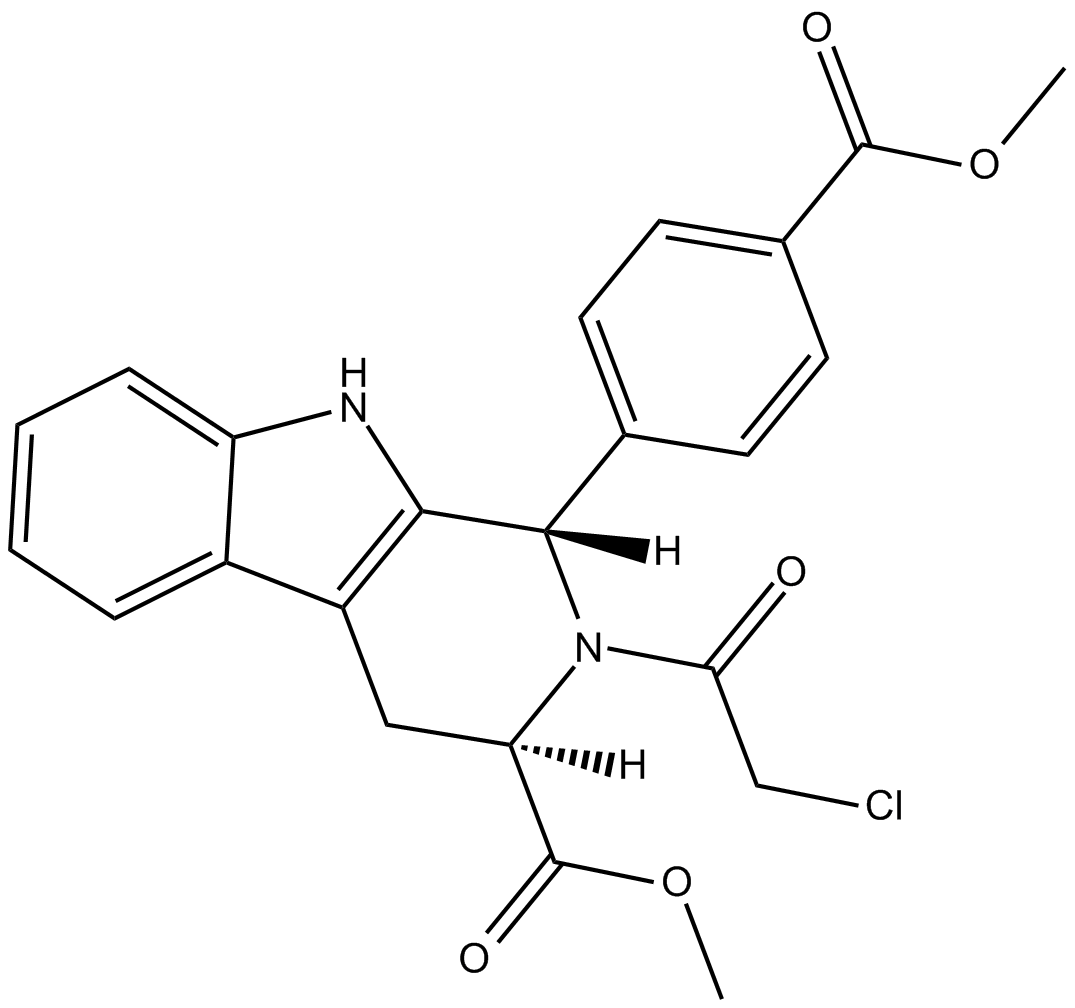
Cas No.: 1219810-16-8
Sample solution is provided at 25 µL, 10mM.
- Clin. Transl. Med. 15.3 (2025):e70270.PMID:40088428
- Int J Mol Sci 22.21 (2021):11334.PMID:34768761
- J Agr Food Chem (2025).PMID:40493028
- Chem-Biol Interact (2023):110828.PMID:38081571
- Eur J Pharmacol (2026):178864.
- Neuropharmacology 298 (2026):111050.PMID:42214457
- Bba-Mol Basis Dis: (2026): 168432.PMID:42637154
- Neurochem Res 50.3 (2025):149.PMID:40257585
- Diabetol Metab Syndr (2026).PMID:41530851
- Pathogens 14.6 (2025):590.
- Mol Oral Microbiol: (2026).PMID:42713739
- Available at SSRN 4854749.
- Int immunopharmacol 141 (2024) 113020:
RSL3 es identifica como un potente agente desencadenante de ferroptosis, que depende de la actividad de GPX4. RSL3 se comportó como un inhibidor de GPX4, reduciendo la expresión de GPX4 e induciendo la muerte ferroptótica de células cancerosas de cabeza y cuello[1]
Un estudio in vitro demostró que RSL3 tiene un grado de letalidad sintética con RAS. RSL3 ,ostró una capacidad rápida y potente para inducir letalidad sintética con RAS oncogénico. RSL3 inhibió el crecimiento de las células BJ-TERT/LT/ST/RASV12 y DRD tan bajo como 10 ng/ml y comenzó a matar las células sensibles tan pronto como 8 h después del tratamiento. El efecto inhibidor del crecimiento y la selectividad de RSL3 se confirmaron mediante el ensayo de exclusión azul de tripano, que demostró la potencia y selectividad de RSL3. Además, el tratamiento más largo con RSL3 tuvo poco efecto en la viabilidad de RAS oncogénico, lo que confirma la naturaleza cualitativa de la selectividad de RSL3.[2]
Un estudio in vitro determinó que la ferroptosis inducida por RSL3 podría mejorarse con cetuximab con el mecanismo de suprimir el eje Nrf2/HO-1. Se estableció un modelo de ratón desnudo con xenoinjerto DLD-1 para explorar más a fondo si el cetuximab promueve la ferrroptosis inducida por RSL3 in vivo. Todos los ratones sobrevivieron bien después de la implantación celular o fueron tratados con vehículo, RSL3, cetuximab o RSL3 en combinación con cetuximab. Sin embargo, la administración de RSL3 solo y el tratamiento con RSL3 y cetuximab condujeron a una disminución en el tamaño y volumen del tumor. Mientras tanto, los niveles relativos de Nrf2 y HO-1 disminuyeron y ese keap1 expresado aumentó relativamente conjunto con RSL3 y cetuximab.[3]
References:
[1]. Sui X, et al. RSL3 Drives Ferroptosis Through GPX4 Inactivation and ROS Production in Colorectal Cancer. Front Pharmacol. 2018 Nov 22;9:1371.
[2]. Shin D, et al. Nrf2 inhibition reverses resistance to GPX4 inhibitor-induced ferroptosis in head and neck cancer. Free Radic Biol Med. 2018 Dec;129:454-462.
[3]. Yang J, et al. Cetuximab promotes RSL3-induced ferroptosis by suppressing the Nrf2/HO-1 signalling pathway in KRAS mutant colorectal cancer. Cell Death Dis. 2021 Nov 13;12(11):1079.
| Experimentos celulares [1]: | |
Líneas celulares | Células BJ-TERT/LT/ST/RASV12 y DRD |
Método de preparación | Soluble en DMSO. Consejos generales para obtener una mayor concentración: Por favor, caliente el tubo a 37 ℃ durante 10 minutos y/o agítelo en el baño ultrasónico por un tiempo. La solución de stock se puede almacenar por debajo de -20℃ durante varios meses. |
Condiciones de reacción | 5 μg/ml, 2 días |
Áreas de aplicación | RSL3 mostró letalidad sintética con RAS oncogénico tanto en células BJ-TERT/LT/ST/RASV12 como en células DRD. RSL3 inhibió el crecimiento de las células BJ-TERT/LT/ST/RASV12 y DRD tan bajo como 10 ng/ml y comenzó a matar las células sensibles tan pronto como 8 horas después del tratamiento. El tratamiento más prolongado con RSL3 tuvo poco efecto en la viabilidad de las células que carecen de RAS oncogénico. RSL3 indujo la muerte celular rápida y no apoptótica en ras oncogénico que contienen células tumorigénicas. |
| Experimentos con animales [2]: | |
Modelos animales | Ratones desnudos atímicos xenoinjertados con células BJeLR |
Método de preparación | Inyección subcutánea (s.c.), 100 mg/kg, dos veces por semana durante 2 semanas. |
Forma de dosificación | RSL3 impidió el crecimiento tumoral en un modelo de xenoinjerto.(1S, 3R)-RSL3 impidió significativamente el crecimiento tumoral. (1S, 3R)-RSL3 redujo significativamente el volumen tumoral a través de la inducción de la ferroptosis. La inyección intraperitoneal de (1S, 3R)-RSL3 no mostró toxicidad hasta una dosis de 400 mg/kg, lo que sugirió que (1S, 3R)-RSL3 fue bien tolerado. |
Áreas de aplicación | Por favor, pruebe la solubilidad de todos los compuestos en interiores, y la solubilidad real puede diferir ligeramente del valor teórico. Esto es causado por un error experimental del sistema y es normal. |
References: | |
| Cas No. | 1219810-16-8 | SDF | |
| Sinónimos | (1S,3R)-RSL3 | ||
| Chemical Name | (1S,3R)-methyl 2-(2-chloroacetyl)-1-(4-(methoxycarbonyl)phenyl)-2,3,4,9-tetrahydro-1H-pyrido[3,4-b]indole-3-carboxylate | ||
| Canonical SMILES | COC(C1=CC=C([C@@]2([H])C3=C(C4=CC=CC=C4N3)C[C@](N2C(CCl)=O)([H])C(OC)=O)C=C1)=O | ||
| Formula | C23H21ClN2O5 | M.Wt | 440.88 |
| Solubility | ≥ 125.4 mg/mL in DMSO | Storage | Store at -20°C, sealed storage, away from moisture |
| General tips | Please select the appropriate solvent to prepare the stock solution according to the
solubility of the product in different solvents; once the solution is prepared, please store it in
separate packages to avoid product failure caused by repeated freezing and thawing.Storage method
and period of the stock solution: When stored at -80°C, please use it within 6 months; when stored
at -20°C, please use it within 1 month. To increase solubility, heat the tube to 37°C and then oscillate in an ultrasonic bath for some time. |
||
| Shipping Condition | Evaluation sample solution: shipped with blue ice. All other sizes available: with RT, or with Blue Ice upon request. | ||
| Prepare stock solution | |||

|
1 mg | 5 mg | 10 mg |
| 1 mM | 2.2682 mL | 11.341 mL | 22.6819 mL |
| 5 mM | 453.6 μL | 2.2682 mL | 4.5364 mL |
| 10 mM | 226.8 μL | 1.1341 mL | 2.2682 mL |
Step 1: Enter information below (Recommended: An additional animal making an allowance for loss during the experiment)
 g
μL
g
μL
Step 2: Enter the in vivo formulation (This is only the calculator, not formulation. Please contact us first if there is no in vivo formulation at the solubility Section.)
Calculation results:
Working concentration: mg/ml;
Method for preparing DMSO master liquid: mg drug pre-dissolved in μL DMSO ( Master liquid concentration mg/mL, Please contact us first if the concentration exceeds the DMSO solubility of the batch of drug. )
Method for preparing in vivo formulation: Take μL DMSO master liquid, next addμL PEG300, mix and clarify, next addμL Tween 80, mix and clarify, next add μL saline, mix and clarify.
Method for preparing in vivo formulation: Take μL DMSO master liquid, next add μL Corn oil, mix and clarify.
Note: 1. Please make sure the liquid is clear before adding the next solvent.
2. Be sure to add the solvent(s) in order. You must ensure that the solution obtained, in the previous addition, is a clear solution before proceeding to add the next solvent. Physical methods such as vortex, ultrasound or hot water bath can be used to aid dissolving.
3. All of the above co-solvents are available for purchase on the GlpBio website.
Quality Control & SDS
- View current batch:
- Purity: >98.00% Appearance: A solid
- COA (Certificate of Analysis)
- SDS (Safety Data Sheet)
- Datasheet
-
Related Biological Data

Inhibition of APE1 promotes ferroptosis in HCC cells. A, B CCK-8 assay of cell viability in control and APE1-KD HepG2 and Huh7 cells after treatment with different concentrations of erastin and RSL3 for 24 h.
E3330, RSL-3, Z-VAD-FMK, Necrostatin 2, Chloroquine, and AR-A014418 were obtained from GlpBio (Montclair, CA,USA).
Cell Death & Differentiation (2024): 1-16. PMID: 38418695 IF: 12.4002 -
Related Biological Data

STAT6 attenuated LPS-induced ferroptosis with the improvement of SLC7A11 expression.(G-I) HBE cells were transfected with sh-Ctrl or sh-STAT6 and then treated with Erastin or RSL3.
Deferoxamine (DFO, GC13554),Erastin (GC16630), and RSL3 (GC12431) were purchased from Glpbio (Shanghai, China).
Cell Death & Disease 13.6 (2022): 1-14. PMID: 35668064 IF: 8.4685 -
Related Biological Data

Effects of different incubation patterns of 1,25(OH)2D3 on survival rate of ZFL after being treated with 3 uM RSL3 for 6 h (n = 6).
0-R (positive control group): First 1,25(OH)2D3-free for 72 h, then 3 uM RSL3 for 6 h;0-V-R (1,25(OH)2D3 preincubated for 6 h): First 1,25(OH)2D3-free for 66 h, then 200 pM 1,25(OH)2D3 for 6 h, and then 3 uM RSL3 for 6 h;V-R (1,25(OH)2D3 preincubated for 72 h): First 200 pM 1,25(OH)2D3 for 72 h, then 3 uM RSL3 for 6 h;
Int J Mol Sci 22.21 (2021): 11334. PMID: 34768761 IF: 5.924 -
Related Biological Data

Effects of 1,25(OH)2D3/VD3 on survival rate, morphology and mitochondrial membrane potential of zebrafish. (A) Effect of 1,25(OH)2D3 on the survival of larval zebrafish after RSL3 treatment (n = 60).
0+RSL3: egg water 72 h + 10 μM RSL3 24 h; 1,25(OH)2D3+RSL3: 50 nM 1,25(OH)2D3 72 h + 10 μM RSL3 24 h; Fer-1+RSL3:1 μM Fer-1 72 h + 10 μM RSL3 24 h.
Chemico-Biological Interactions (2023): 110828. PMID: 38081571 IF: 5.1
Average Rating: 5 (Based on Reviews and 25 reference(s) in Google Scholar.)