

Calcitriol (Synonyms: 1,25-dihydroxy Cholecalciferol, 1α,25-dihydroxy Cholecalciferol, 1,25-dihydroxy Vitamin D3, 1α,25-dihydroxy Vitamin D3) |
Catalog No.GC13852
 One-Click Copy Product Info
|

Calcitriol est un analogue de la vitamine D biologiquement actif sur le plan hormonal, capable de pénétrer dans les cellules.
Products are for research use only. Not for human use. We do not sell to patients.
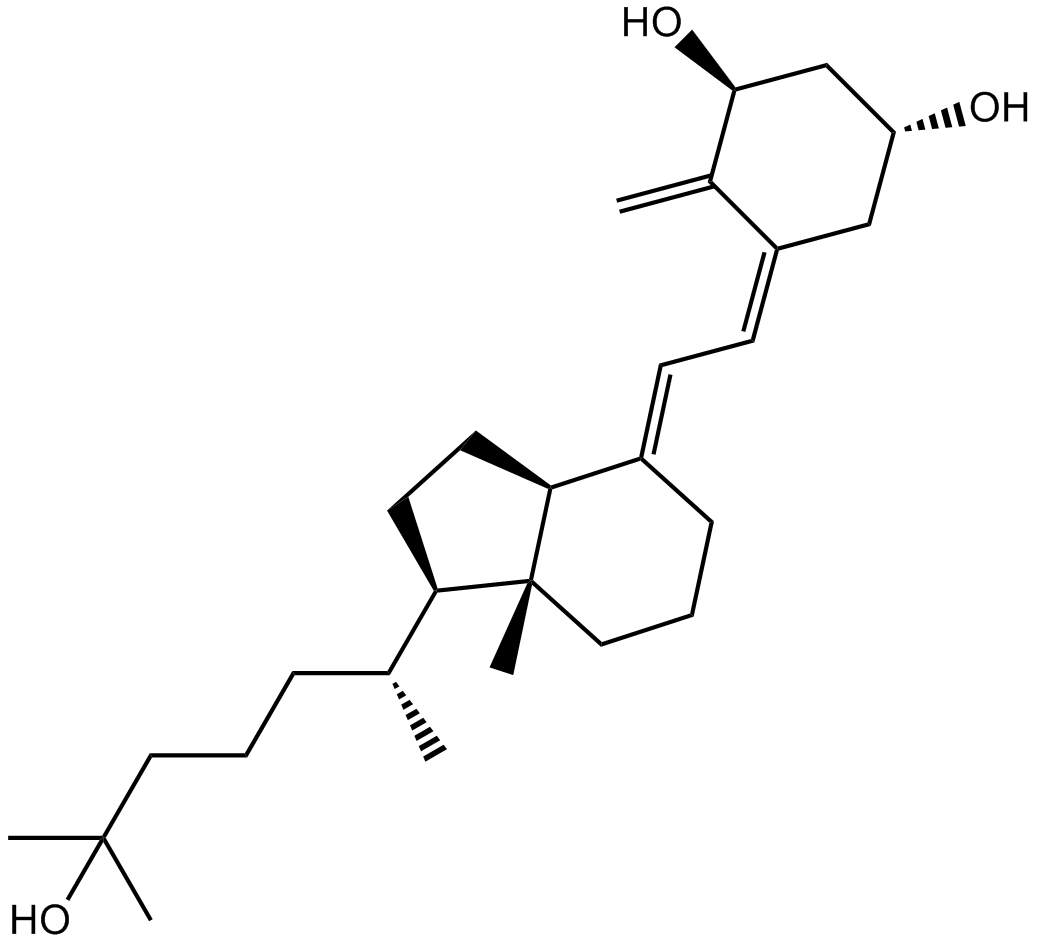
Cas No.: 32222-06-3
Sample solution is provided at 25 µL, 10mM.
Calcitriol est un analogue de la vitamine D biologiquement actif sur le plan hormonal, capable de pénétrer dans les cellules[1]. Calcitriol connecte les récepteurs de la vitamine D présents dans les reins, les glandes parathyroïdiennes, l'intestin et les os; il augmente ainsi la calcémie en stimulant l'absorption intestinale du calcium, sa réabsorption tubulaire rénale, sa libération à partir du tissu osseux[2]. Calcitriol est couramment utilisé à rechercher les tumeurs afin de réguler le signal mitotique, d'inhiber la prolifération de différents types de cellules cancéreuses[3].
Le traitement in vitro avec Calcitriol pendant 24h a significativement supprimé la viabilité des cellules BXPC-3, MCF-7 et PC-3, ses valeurs d'IC50 sont respectivment 21μM, 11.43μM et 9.53μM[4]. Le traitement avec 0.44μM de Calcitriol pendant 24h a induit la mort des cellules B16-F10, parallèlement à une hausse du taux protéique de la caspase-3 clivée, de la caspase-8, de la caspase-9, de la bécline, de la RARP[5]. Un traitement avec 10nM de Calcitriol pendant 48h a réduit l'expression de la protéine COX-2 dans les cellules LNCaP, augmente l'expression de la protéine 15-PGDH, ralentit la croissance des cellules[6].
Le traitement in vivo avec Calcitriol via l'application topique sur la peau dorsale à la dose de 1nmol (dissous dans 150μl d'éthanol) pendant quatre jours améliore significativement le dysfonctionnement de la barrière cutanée chez les rats NC/Nga atteints de dermatite atopique, réduit l'épaisseur épidermique, diminue le taux de IL-13 et IL-33[7]. Une injection intra-péritonéale quotidienne de Calcitriol (5μg/kg) pendant 14 jours atténue l'infiltration de cellule inflammatoire dans les poumons des rats traités par la bléomycine (BLM), inhibe la transition épithélio-mésenchymateuse pulmonaire[8]. Les injections intra-péritonéales de Calcitriol à la dose de 5µg/kg, administrées tous les deux jours pendant 16 jours, réduisent la neuro-inflammation de la moelle épinière, diminuent la démyélinisation dans un modèle murin d'encéphalomyélite auto-immune expérimentale (EAE)[9].
| Expérience cellulaire [1] : | |
|
Lignées cellulaires |
Cellules B16-F10 |
|
Méthode de préparation |
Les cellules B16-F10 sont cultivées dans le milieu DMEM supplémenté avec 15% de sérum foetal bovin (SFB), 100U/mL de pénicilline et 100µg/ml de streptomycine à 37°C dans un incubateur à 5% CO2. Les cellules B16-F10 (1.7×10² cellules/puits) sont ensemencées dans les plaques à 96 puits, dans un volume de 100μl. Vingt-quatre heures plus tard, les cellules sont traitées avec différentes concentrations de Calcitriol (0, 0.02, 0.04, 0.08, 0.16, et 0.32μM) pendant 24h, puis la viabilité cellulaire est mesurée. |
|
Conditions de réaction |
0, 0.02, 0.04, 0.08, 0.16, et 0.32μM; 24h |
|
Applications |
Le traitement avec Calcitriol diminue la viabilité des cellules B16-F10 de manière dose-dépendante. |
| Expérience animale [2] : | |
|
Modèles animaux |
Rats femelles C57BL/6J |
|
Méthode de préparation |
Les rats femelles C57BL/6J (âgés de 9 semaines) sont immunisés par injection sous-cutanée à la base de la queue avec 100μg de MOG35–55 émulsifié dans l'adjuvant complet de Freund (ACF) contenant 4mg/ml de Mycobacterium tuberculosis. Les rats reçoivent deux injections intra-péritonéales de toxine de Bordetella pertussis à 200ng chacune : une le jour de l'immunisation, l'autre 48h après l'induction de EAE. Le poids corporel et les scores cliniques de la maladie sont relevés quotidiennement. Les scores cliniques sont définis selon les manifestations suivantes : aucun symptôme (0); queue flasque (1); faiblesse des pattes arrières (2); paralysie partielle des pattes arrières (3); paralysie complète des pattes arrières (4); paralysie totale (5); Des injections intra-péritonéales de Calcitriol à la dose de 5µg/kg sont réalisées tous les deux jours pendant 16 jours, puis des échantillons de moelle épinière lombaire sont prélevés sur les rats pour analyse. |
|
Forme posologique |
5µg/kg; tous les deux jours; 16 jours; i.p. |
|
Applications |
Le traitement avec Calcitriol atténue l'inflammation et la démyélinisation de la moelle épinière chez les rats atteints d'EAE. |
| Cas No. | 32222-06-3 | SDF | |
| Synonymes | 1,25-dihydroxy Cholecalciferol, 1α,25-dihydroxy Cholecalciferol, 1,25-dihydroxy Vitamin D3, 1α,25-dihydroxy Vitamin D3 | ||
| Chemical Name | (1R,3S,5Z)-5-[(2E)-2-[(1R,3aS,7aR)-1-[(2R)-6-hydroxy-6-methylheptan-2-yl]-7a-methyl-2,3,3a,5,6,7-hexahydro-1H-inden-4-ylidene]ethylidene]-4-methylidenecyclohexane-1,3-diol | ||
| Canonical SMILES | CC(CCCC(C)(C)O)C1CCC2C1(CCCC2=CC=C3CC(CC(C3=C)O)O)C | ||
| Formula | C27H44O3 | M.Wt | 416.64 |
| Solubility | ≥ 20.832mg/mL in DMSO | Storage | -20°C, protect from light, stored under nitrogen,unstable in solution, ready to use. |
| Shipping Condition | Evaluation sample solution: shipped with blue ice. All other sizes available: with RT, or with Blue Ice upon request. | ||
| Prepare stock solution | |||

|
1 mg | 5 mg | 10 mg |
| 1 mM | 2.4002 mL | 12.0008 mL | 24.0015 mL |
| 5 mM | 480 μL | 2.4002 mL | 4.8003 mL |
| 10 mM | 240 μL | 1.2001 mL | 2.4002 mL |
Step 1: Enter information below (Recommended: An additional animal making an allowance for loss during the experiment)
 g
μL
g
μL
Step 2: Enter the in vivo formulation (This is only the calculator, not formulation. Please contact us first if there is no in vivo formulation at the solubility Section.)
Calculation results:
Working concentration: mg/ml;
Method for preparing DMSO master liquid: mg drug pre-dissolved in μL DMSO ( Master liquid concentration mg/mL, Please contact us first if the concentration exceeds the DMSO solubility of the batch of drug. )
Method for preparing in vivo formulation: Take μL DMSO master liquid, next addμL PEG300, mix and clarify, next addμL Tween 80, mix and clarify, next add μL saline, mix and clarify.
Method for preparing in vivo formulation: Take μL DMSO master liquid, next add μL Corn oil, mix and clarify.
Note: 1. Please make sure the liquid is clear before adding the next solvent.
2. Be sure to add the solvent(s) in order. You must ensure that the solution obtained, in the previous addition, is a clear solution before proceeding to add the next solvent. Physical methods such as vortex, ultrasound or hot water bath can be used to aid dissolving.
3. All of the above co-solvents are available for purchase on the GlpBio website.
Quality Control & SDS
- View current batch:
- Purity: >99.00% Appearance: A solid
- COA (Certificate of Analysis)
- SDS (Safety Data Sheet)
- Datasheet
-
Related Biological Data

VD reduces ferroptosis induced by high glucose in HK-2 cells and down-regulation of Klotho attenuates the protective effect of VD on ferroptosis in HK-2 cells. (F-K) Protein levels of SLC7A11, GPX4, TFR1, Klotho and p53 were detected by western blot.
HG + VD group (30 mmol/L D-glucose + 10 nmol/L 1,25(OH)2D3);1,25(OH)2D3 (GLPBIO, Beijing, China) was pretreated for 2 h before intervention.
Apoptosis (2024): 1-13. PMID: 38558206 IF: 7.2002 -
Related Biological Data

Effect of vitamin D deficiency on migration of human trophoblast cells. D&E: Cell migration was measured using wound-healing assay. After 12 and 24 h migration, the scratches were photographed and wounded areas were calculated.
And calcitriol (GLPBIO, China) was dissolved in DMSO at the final concentration of 1 mM, and the final concentration of calcitriol were 0.1 μM.
Placenta (2022). PMID: 36103800 IF: 3.2867
Average Rating: 5 (Based on Reviews and 24 reference(s) in Google Scholar.)