

Necrostatin 2 racemate (Synonyms: 7-Cl-O-Nec-1, Nec-1s) |
Catalog No.GC36711
 One-Click Copy Product Info
|

Necrostatin 2 racemate est un inhibiteur hautement spécifique de la protéine kinase 1 interagissant avec le récepteur (RIPK1) qui n'affecte pas l'activité de l'indoléamine 2,3-dioxygénase (IDO).
Products are for research use only. Not for human use. We do not sell to patients.
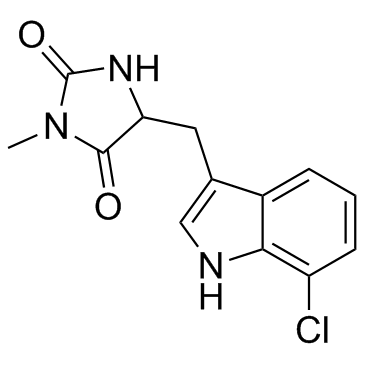
Cas No.: 852391-15-2
Sample solution is provided at 25 µL, 10mM.
Necrostatin 2 racemate est un inhibiteur hautement spécifique de la protéine kinase 1 interagissant avec le récepteur (RIPK1) qui n'affecte pas l'activité de l'indoléamine 2,3-dioxygénase (IDO)[1]. Necrostatin 2 racemate est couramment utilisé dans la recherche de maladies inflammatoires (comme l'arthrite rhumatoïde), les maladies neurodégénéractives (comme la maladie d'Alzheimer et la maladie de Parkinson), ainsi que pour la protection des organes[2, 3].
Le traitement in vitro avec Necrostatin 2 racemate (1μM) aux exosomes pro-B + lymphocytes pendant 48h a significativement renforcé l'apoptose induite par la cytosporone B (10µM) - le taux d'apoptose moyen a atteint 63,14%, soit environ 628% supérieur à celui du groupe témoin (10%)[4]. Le pré-traitement avec Necrostatin 2 racemate (45μM) aux macrophages dérivés de la moelle osseuse de type sauvage (BMDM), suivi d'un co-traitement avec l'hème et Pam3CSK4 (Pam3) pendant 48h, a partiellement inhibé la mort cellulaire induite par l'hème et Pam3; cet effet protecteur a été encore renforcé lorsqu'il est associé à z-VAD-FMK (zVAD)[5]. Le co-traitement avec Necrostatin 2 racemate (10μM) et les charpentes métallo-organiques à base de cuivre (Cu-MOF) aux cellules A549 et H538 pendant 72h a significativement inversé la cytotoxicité induite par Cu-MOF et partiellement restauré la viabilité cellulaire[6].
In vivo, l'administration intra-péritonéale quotidienne de Necrostatin 2 racemate (1.6mg/kg/jour) chez les rats déficients en apolipoprotéine E (ApoE-/-), débutant lors de l'infusion d'angiotensine II (Ang II) et se poursuivant pendant 28 jours, a significativement atténué la formation d'anévrysme de l'aorte abdominale (AAA) et réduit son incidence[7]. L'administration intra-péritonéale quotidienne de Necrostatin 2 racemate (2mg/kg/jour, une fois par jour) dans un modèle de rat néonatal d'entérocolite nécrosante (NEC), débutant lors de l'induction de NEC et se poursuivant pendant 3 jours, a considérablement amélioré les taux de survie, atténué les lésions histopathologiques intestinales et réduit l'expression des cytokines pro-inflammatoires (IL-1β, IL-17, TNF-α, et IFN-γ)[8].
References:
[1] YU J, ZHONG B, ZHAO L, et al. Receptor-interacting serine/threonine-protein kinase 1 (RIPK1) inhibitors Necrostatin-1 (Nec-1) and 7-Cl-O-Nec-1 (Nec-1s) are potent inhibitors of NAD(P)H: Quinone oxidoreductase 1 (NQO1)[J]. Free Radical Biology and Medicine, 2021, 173: 64-69.
[2] YU Z, JIANG N, SU W, et al. Necroptosis: a novel pathway in neuroinflammation[J]. Frontiers in Pharmacology, 2021, 12: 701564.
[3] MIFFLIN L, OFENGEIM D, YUAN J. Receptor-interacting protein kinase 1 (RIPK1) as a therapeutic target[J]. Nature Reviews Drug Discovery, 2020, 19(8): 553-571.
[4] GENTIMIR C A, GELEŢU G, CHELARU L, et al. Biochemical effects of TLRs, CXCL12, and necrosome activation on pro-B lymphocyte apoptosis in the presence of fibroblasts[J]. Romanian Journal of Oral Rehabilitation, 2022, 14(3).
[5] SUNDARAM B, PANDIAN N, MALL R, et al. NLRP12-PANoptosome activates PANoptosis and pathology in response to heme and PAMPs[J]. Cell, 2023, 186(13): 2783-2801.
[6] LI K, WU L, WANG H, et al. Apoptosis and cuproptosis co-activated copper-based metal-organic frameworks for cancer therapy[J]. Journal of Nanobiotechnology, 2024, 22(1): 546.
[7] WANG Q, ZHOU T, LIU Z, et al. Inhibition of Receptor-Interacting Protein Kinase 1 with Necrostatin-1s ameliorates disease progression in elastase-induced mouse abdominal aortic aneurysm model[J]. Scientific Reports, 2017, 7(1): 42159.
[8] LIU T, ZONG H, CHEN X, et al. Toll-like receptor 4-mediated necroptosis in the development of necrotizing enterocolitis[J]. Pediatric Research, 2022, 91(1): 73-82.
| Expériences cellulaires [1]: | |
Lignées cellulaires | BMDMs (macrophages dérivés de la moelle osseuse) |
Méthode de préparation | BMDMs ont été traités par une combinaison de 45µM de Necrostatin 2 racemate (avec ou sans zVAD), d'hème et de Pam3 pendant 48h, et la cinétique de la mort cellulaire a été surveillée à l'aide du système d'analyse de cellules vivantes IncuCyte S3 ou SX5. |
Conditions de réaction | 45μM; 48h |
Domaines d'application | Par rapport au témoin PBS, le traitement avec Necrostatin 2 racemate a partiellement réduit la mort cellulaire induite par l'hème associé à Pam3, et l'ajout de zVAD a encore diminué cette mort cellulaire. |
| Expériences animales [2]: | |
Modèles animaux | Rats ApoE-/- (rats déficients en apolipoprotéine E) |
Méthode de préparation | Les rats ApoE-/- ont reçu des pompes osmotiques dispensant Ang II à 1000ng/kg/minutes. L'injection quotidienne de Necrostatin 2 racemate (1.6mg/kg/jour; i.p.) a débuté immédiatement après l'implantation de la pompe. Les rats ont été euthanasiés 28 jours plus tard. Le diamètre externe de l'aorte a été mesuré à la région présentant la dilatation maximale à l'aide d'un pied à coulisse numérique. L'indicence d'anévrysme est définie comme une augmentation de 50% ou plus de la largeur externe de l'aorte susrénale par rapport à celle de la région infrarénale. |
Forme de dosage | 1.6mg/kg/jour; 28 jours; i.p. |
Domaines d'application | Par rapport au groupe DMSO, les rats traités avec Necrostatin 2 racemate ont montré une atténuation significative de la formation d'anévrysme, ce qui se traduit à la fois par une dilatation aortique beaucoup plus faible (Nec-1s: 55.40 ± 13.08% vs. DMSO: 121.1 ± 16.44%, P < 0.05) et par une réduction de l'incidence de AAA (passant de 90.5% à 33.3%). |
References: | |
| Cas No. | 852391-15-2 | SDF | |
| Synonymes | 7-Cl-O-Nec-1, Nec-1s | ||
| Canonical SMILES | ClC1=C2C(C(CC3C(N(C)C(N3)=O)=O)=CN2)=CC=C1 | ||
| Formula | C13H12ClN3O2 | M.Wt | 277.71 |
| Solubility | DMSO: ≥ 50 mg/mL (180.04 mM) | Storage | Store at -20°C |
| General tips | Please select the appropriate solvent to prepare the stock solution according to the
solubility of the product in different solvents; once the solution is prepared, please store it in
separate packages to avoid product failure caused by repeated freezing and thawing.Storage method
and period of the stock solution: When stored at -80°C, please use it within 6 months; when stored
at -20°C, please use it within 1 month. To increase solubility, heat the tube to 37°C and then oscillate in an ultrasonic bath for some time. |
||
| Shipping Condition | Evaluation sample solution: shipped with blue ice. All other sizes available: with RT, or with Blue Ice upon request. | ||
| Prepare stock solution | |||

|
1 mg | 5 mg | 10 mg |
| 1 mM | 3.6009 mL | 18.0044 mL | 36.0088 mL |
| 5 mM | 720.2 μL | 3.6009 mL | 7.2018 mL |
| 10 mM | 360.1 μL | 1.8004 mL | 3.6009 mL |
Step 1: Enter information below (Recommended: An additional animal making an allowance for loss during the experiment)
 g
μL
g
μL
Step 2: Enter the in vivo formulation (This is only the calculator, not formulation. Please contact us first if there is no in vivo formulation at the solubility Section.)
Calculation results:
Working concentration: mg/ml;
Method for preparing DMSO master liquid: mg drug pre-dissolved in μL DMSO ( Master liquid concentration mg/mL, Please contact us first if the concentration exceeds the DMSO solubility of the batch of drug. )
Method for preparing in vivo formulation: Take μL DMSO master liquid, next addμL PEG300, mix and clarify, next addμL Tween 80, mix and clarify, next add μL saline, mix and clarify.
Method for preparing in vivo formulation: Take μL DMSO master liquid, next add μL Corn oil, mix and clarify.
Note: 1. Please make sure the liquid is clear before adding the next solvent.
2. Be sure to add the solvent(s) in order. You must ensure that the solution obtained, in the previous addition, is a clear solution before proceeding to add the next solvent. Physical methods such as vortex, ultrasound or hot water bath can be used to aid dissolving.
3. All of the above co-solvents are available for purchase on the GlpBio website.
Quality Control & SDS
- View current batch:
- Purity: >99.50% Appearance: A solid
- COA (Certificate of Analysis)
- SDS (Safety Data Sheet)
- Datasheet
Average Rating: 5 (Based on Reviews and 21 reference(s) in Google Scholar.)