

Lycopene (Synonyms: NSC 407322) |
Catalog No.GN10448
 One-Click Copy Product Info
|

Lycopene est une molécule caroténoïde liposoluble présentes en fortes concentrations dans les fruits et légumes rouges et possède un fort effet anti-oxydant.
Products are for research use only. Not for human use. We do not sell to patients.
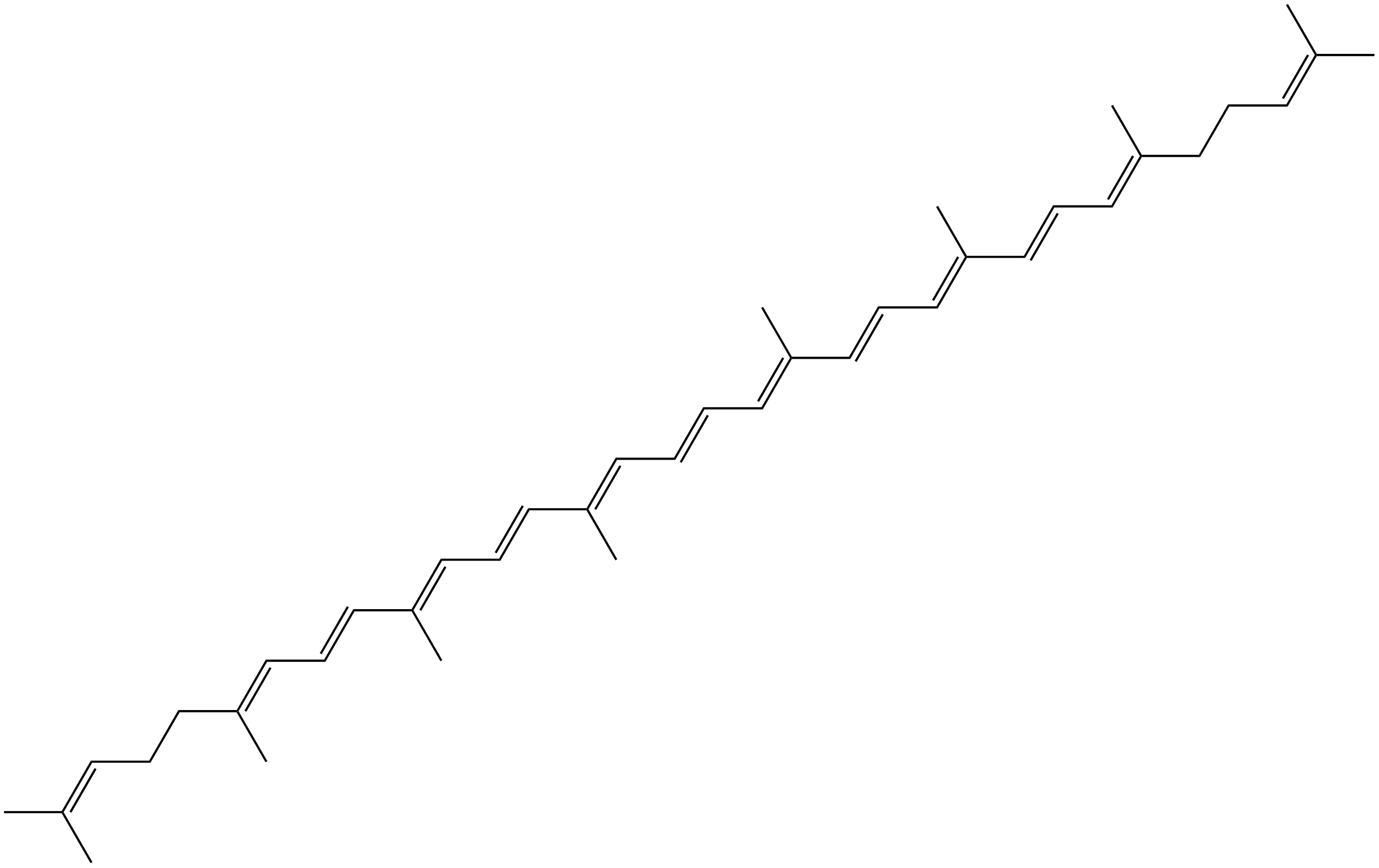
Cas No.: 502-65-8
Sample solution is provided at 25 µL, 10mM.
_1-3.$$$39978408@51.jpg');)
_1-9.$$$38538795@65.jpg');)
_1-9.$$$39112701@51.jpg');)
_1-7.$$$37316672@70.jpg');)
_366-372.$$$36198801@70.jpg');)
.$$$38565142@65.jpg');)
_1867-1883.$$$33248023@67.jpg');)
_eads6055.$$$39977546@45.jpg');)
_eadm9805.$$$40080571@45.jpg');)
_eadj3020.$$$39666821@45.jpg');)
_1-20.$$$39757301@28.jpg');)
_1-24.$$$38898113@28.jpg');)
_273-287.$$$36806353@46.jpg');)
_1-16.$$$37156877@44.jpg');)
_1-19.$$$37460805@44.jpg');)
_1291-1307.$$$34518654@46.jpg');)
Lycopene est une molécule caroténoïde liposoluble présentes en fortes concentrations dans les fruits et légumes rouges et possède un fort effet anti-oxydant[1]. Lycopene peut inhiber l'activité de HMG-CoA reductase[2]. Lycopene peut induire un arrêt en phase G0/G1 et un arrêt en phase S du cycle cellulaire[3].
Le traitement in vitro avec Lycopene (1-5μM) aux cellules HT-29, T84, et MCF-7 pendant 48 heures a significativement réduit le nombre de cellules viables, avec une réduction de 30% dans les cellules HT-29 et T84 et de 10% dans les cellules MCF-7, et a également entraîné un arrêt du cycle cellulaire à différents stades[4]. Le traitement avec Lycopene (0.5-10μM) aux cellules SK-Hep-1 a réduit la production de ROS intracellulaires au moyen d'inhiber l'oxydase NADPH qui est produite dans la voie PKC[5].
Le traitement in vivo par voie orale avec Lycopene (20 mg/kg) aux rats inoculés par cellules tumorales SK-Hep-1 pendant 12 semaines a considérablement réduit le nombre moyen de tumeurs et la surface transversale des tumeurs, et a également réduit le taux positif de l'antigène nucléaire de proliférartion cellulaire (PCNA) dans le tissu pulmonaire, ainsi que l'expression de PCNA, de MMP-9 et de protéines VEGF[6]. Le traitement par voie orale avec Lycopene (10 mg/kg) aux rats diabétiques a significativement réduit l'activité de l'enzyme de conversion de l'angiotensine (ACE) dans le plasma et le tissu cardiaque[7].
References:
[1] Wang Q, Wu X, Zhang J, et al. Role of ROS/JAK2/STAT3 signaling pathway in di-n-butyl phthalate-induced testosterone synthesis inhibition and antagonism of lycopene[J]. Food and Chemical Toxicology, 2023, 175: 113741.
[2] Palozza P, Catalano A, Simone R E, et al. Effect of lycopene and tomato products on cholesterol metabolism[J]. Annals of Nutrition and Metabolism, 2012, 61(2): 126-134.
[3] Hwang E S, Bowen P E. Cell cycle arrest and induction of apoptosis by lycopene in LNCaP human prostate cancer cells[J]. Journal of medicinal food, 2004, 7(3): 284-289.
[4] Teodoro A J, Oliveira F L, Martins N B, et al. Effect of lycopene on cell viability and cell cycle progression in human cancer cell lines[J]. Cancer cell international, 2012, 12: 1-9.
[5] Bandeira A C B, da Silva T P, de Araujo G R, et al. Lycopene inhibits reactive oxygen species production in SK-Hep-1 cells and attenuates acetaminophen-induced liver injury in C57BL/6 mice[J]. Chemico-Biological Interactions, 2017, 263: 7-17.
[6] Huang C S, Liao J W, Hu M L. Lycopene inhibits experimental metastasis of human hepatoma SK-Hep-1 cells in athymic nude mice[J]. The Journal of nutrition, 2008, 138(3): 538-543.
[7] Ozmutlu S, Dede S, Ceylan E. The effect of lycopene treatment on ACE activity in rats with experimental diabetes[J]. Journal of the Renin-Angiotensin-Aldosterone System, 2012, 13(3): 328-333.
| Expériences cellulaires [1]: | |
Lignées cellulaires | Cellules HT-29、T84、MCF-7 |
Méthode de préparation | Trois lignées de cellules cancéreuses (HT-29, T84 et MCF-7) ont été traitées par lycopene (1–5 μM) pendant 48 et 96 h. La viabilité cellulaire a été surveillée en utilisant la méthode MTT. |
Conditions de réaction | 1-5μM; 48、96h |
Domaines d'application | Après un traitement de 48h, une réduction significative du nombre de cellules viables a été observée dans les trois lignées de cellules cancéreuses par rapport à témoin, atteignant une réduction de 30% dans les cellules HT-29 et T84 et de 10% dans les cellules MCF-7. |
| Expériences animales [2]: | |
Modèles animaux | Rats nus athymiques mâles adultes |
Méthode de préparation | Les rats ont été administrés par voie orale avec lycopene (1 et 20 mg/kg) ou β-carotène (20 mg/kg) dans l'huile de maïs deux fois par semaine pendant 12 semaines. Seule de l'huile de maïs a été administrée aux rats de témoin non-injectés. Deux semaines après le début de la supplémentation, les rats ont été injectés une fois par cellules SK-Hep-1 dans la veine latérale de la queue et les échantillons de sang ont été prélevés une fois par semaine au niveau du plexus rétro-orbitaire pour la mesure de MMP et VEGF. |
Forme de dosage | 1, 20mg/kg; p.o. |
Domaines d'application | Une supplémentation élevée en lycopene a significativement réduit le nombre moyen de tumeurs et la surface transversale des tumeurs. Une supplémentation élevée en lycopene a également diminué le ratio positif de l'antigène nucléaire de prolifération cellulaire (PCNA) et les expressions protéiques de PCNA, MMP-9, et VEGF dans les tissus pulmonaires. |
References: | |
| Cas No. | 502-65-8 | SDF | |
| Synonymes | NSC 407322 | ||
| Chemical Name | (6E,8E,10E,12E,14E,16E,18E,20E,22E,24E,26E)-2,6,10,14,19,23,27,31-octamethyldotriaconta-2,6,8,10,12,14,16,18,20,22,24,26,30-tridecaene | ||
| Canonical SMILES | CC(=CCCC(=CC=CC(=CC=CC(=CC=CC=C(C)C=CC=C(C)C=CC=C(C)CCC=C(C)C)C)C)C)C | ||
| Formula | C40H56 | M.Wt | 536.89 |
| Solubility | <3.03 mg/mL in 0.5MNAOH; DMSO:12mg/ml | Storage | Store at -20°C, protect from light, stored under nitrogen |
| General tips | Please select the appropriate solvent to prepare the stock solution according to the
solubility of the product in different solvents; once the solution is prepared, please store it in
separate packages to avoid product failure caused by repeated freezing and thawing.Storage method
and period of the stock solution: When stored at -80°C, please use it within 6 months; when stored
at -20°C, please use it within 1 month. To increase solubility, heat the tube to 37°C and then oscillate in an ultrasonic bath for some time. |
||
| Shipping Condition | Evaluation sample solution: shipped with blue ice. All other sizes available: with RT, or with Blue Ice upon request. | ||
| Prepare stock solution | |||

|
1 mg | 5 mg | 10 mg |
| 1 mM | 1.8626 mL | 9.3129 mL | 18.6258 mL |
| 5 mM | 372.5 μL | 1.8626 mL | 3.7252 mL |
| 10 mM | 186.3 μL | 931.3 μL | 1.8626 mL |
Step 1: Enter information below (Recommended: An additional animal making an allowance for loss during the experiment)
 g
μL
g
μL
Step 2: Enter the in vivo formulation (This is only the calculator, not formulation. Please contact us first if there is no in vivo formulation at the solubility Section.)
Calculation results:
Working concentration: mg/ml;
Method for preparing DMSO master liquid: mg drug pre-dissolved in μL DMSO ( Master liquid concentration mg/mL, Please contact us first if the concentration exceeds the DMSO solubility of the batch of drug. )
Method for preparing in vivo formulation: Take μL DMSO master liquid, next addμL PEG300, mix and clarify, next addμL Tween 80, mix and clarify, next add μL saline, mix and clarify.
Method for preparing in vivo formulation: Take μL DMSO master liquid, next add μL Corn oil, mix and clarify.
Note: 1. Please make sure the liquid is clear before adding the next solvent.
2. Be sure to add the solvent(s) in order. You must ensure that the solution obtained, in the previous addition, is a clear solution before proceeding to add the next solvent. Physical methods such as vortex, ultrasound or hot water bath can be used to aid dissolving.
3. All of the above co-solvents are available for purchase on the GlpBio website.
Quality Control & SDS
- View current batch:
- Purity: >90.00% Appearance: A solid
- COA (Certificate of Analysis)
- SDS (Safety Data Sheet)
- Datasheet
Average Rating: 5 (Based on Reviews and 30 reference(s) in Google Scholar.)