

Lycopene (Synonyms: NSC 407322) |
カタログ番号GN10448
 One-Click Copy Product Info
|

リコペン(Lycopene)は脂肪に可溶なカロテノイド分子で、赤色のフルーツや野菜によく高濃度で発見され、強い抗酸化効果を持っている。
Products are for research use only. Not for human use. We do not sell to patients.
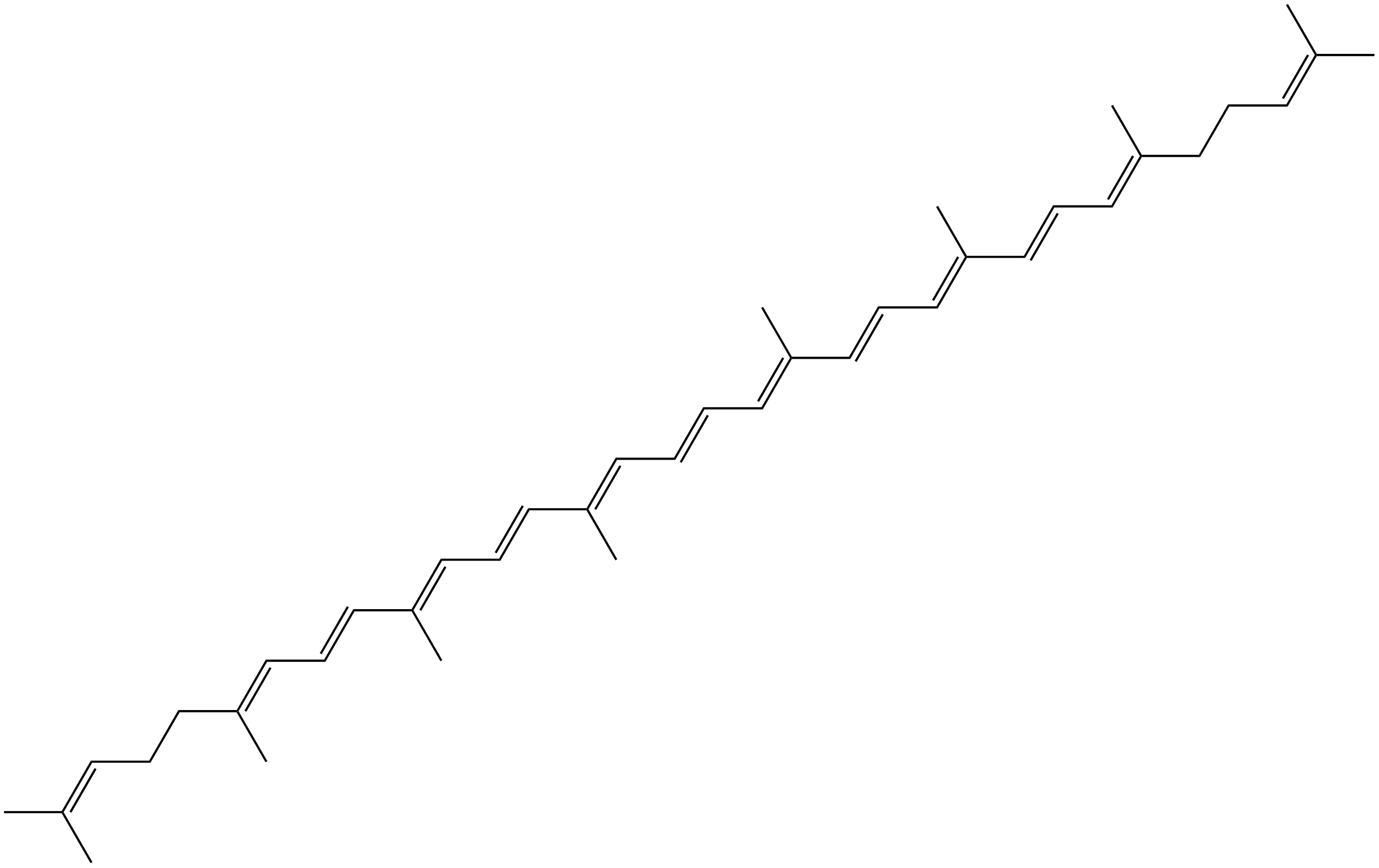
Cas No.: 502-65-8
Sample solution is provided at 25 µL, 10mM.
_1-3.$$$39978408@51.jpg');)
_1-9.$$$38538795@65.jpg');)
_1-9.$$$39112701@51.jpg');)
_1-7.$$$37316672@70.jpg');)
_366-372.$$$36198801@70.jpg');)
.$$$38565142@65.jpg');)
_1867-1883.$$$33248023@67.jpg');)
_eads6055.$$$39977546@45.jpg');)
_eadm9805.$$$40080571@45.jpg');)
_eadj3020.$$$39666821@45.jpg');)
_1-20.$$$39757301@28.jpg');)
_1-24.$$$38898113@28.jpg');)
_273-287.$$$36806353@46.jpg');)
_1-16.$$$37156877@44.jpg');)
_1-19.$$$37460805@44.jpg');)
_1291-1307.$$$34518654@46.jpg');)
リコペン(Lycopene)は脂肪に可溶なカロテノイド分子で、赤色のフルーツや野菜によく高濃度で発見され、強い抗酸化効果を持っている[1]。リコペンはHMG-CoAの還元酵素の活性を阻害できる[2]。リコペンは細胞周期においてG0/G1の停止とS期の停止を誘発することもできる[3]。
試験管内実験では、リコペン(1-5μM)をHT-29, T84, MCF-7細胞に48時間処理した結果、生細胞の数を著しく減らし、HT-29とT84細胞では30%減らし、MCF-7細胞では10%減らした。また、異なる段階で細胞周期の停止をも引き起こした[4]。リコペン(0.5-10μM)をSK-Hep-1細胞に処理した結果、PKC経路に生産されたNADPHオキシダーゼを阻害することで、細胞内ROSの生産を減らすこともできた[5]。
生体内実験では、SK-Hep-1腫瘍細胞を接種されたマウスにリコペン(20 mg/kg)を12週間経口投与した結果、腫瘍と腫瘍断面積の平均数を著しく減らし、肺組織における増殖細胞核抗体(PCNA)の陽性率を減らし、PCNA, MMP-9とVEGFタンパク質の発見をも減らした[6]。糖尿病のラットにリコペン(10 mg/kg) を経口投与した結果、血漿と心臓組織におけるアンジオテンシン変換酵素(ACE)の活性を著しく減らした[7]。
References:
[1] Wang Q, Wu X, Zhang J, et al. Role of ROS/JAK2/STAT3 signaling pathway in di-n-butyl phthalate-induced testosterone synthesis inhibition and antagonism of lycopene[J]. Food and Chemical Toxicology, 2023, 175: 113741.
[2] Palozza P, Catalano A, Simone R E, et al. Effect of lycopene and tomato products on cholesterol metabolism[J]. Annals of Nutrition and Metabolism, 2012, 61(2): 126-134.
[3] Hwang E S, Bowen P E. Cell cycle arrest and induction of apoptosis by lycopene in LNCaP human prostate cancer cells[J]. Journal of medicinal food, 2004, 7(3): 284-289.
[4] Teodoro A J, Oliveira F L, Martins N B, et al. Effect of lycopene on cell viability and cell cycle progression in human cancer cell lines[J]. Cancer cell international, 2012, 12: 1-9.
[5] Bandeira A C B, da Silva T P, de Araujo G R, et al. Lycopene inhibits reactive oxygen species production in SK-Hep-1 cells and attenuates acetaminophen-induced liver injury in C57BL/6 mice[J]. Chemico-Biological Interactions, 2017, 263: 7-17.
[6] Huang C S, Liao J W, Hu M L. Lycopene inhibits experimental metastasis of human hepatoma SK-Hep-1 cells in athymic nude mice[J]. The Journal of nutrition, 2008, 138(3): 538-543.
[7] Ozmutlu S, Dede S, Ceylan E. The effect of lycopene treatment on ACE activity in rats with experimental diabetes[J]. Journal of the Renin-Angiotensin-Aldosterone System, 2012, 13(3): 328-333.
| 細胞実験[1]: | |
細胞株 | HT-29、T84、MCF-7細胞 |
準備方法 | 三つの癌細胞株(HT-29, T84とMCF-7)をリコペン(1–5 μM)で48時間と96時間処理した。細胞の生存率はMTT法で監視した。 |
反応条件 | 1-5μM; 48、96時間 |
アプリケーション | 48時間処理した後、対照群に比べて、三つの細胞株で生細胞数の著しい減少が観察され、HT-29とT84細胞では30%減少し、MCF-7細胞では10%減少した。 |
| 動物実験 [2]: | |
動物モデル | 成体した雄の胸腺欠損ヌードマウス |
準備方法 | マウスにリコペン(1と20 mg/kg) またはトウモロコシ油のβ-カロチン(20 mg/kg)を12週間、1週間に二回経口投与した。注射されなかった対照群のマウスにはトウモロコシ油だけを投与した。投与から2週間後、マウスの外側尾静脈にSK-Hep-1細胞を1回注射し、MMPとVEGFを測定する為に、後眼窩神経叢から週に1回、血液サンプルを採った。 |
投与形態 | 1, 20mg/kg; p.o.(経口) |
アプリケーション | 高いリコペンの補給は腫瘍と腫瘍断面積の平均数を著しく減らし、肺組織における増殖細胞核抗体(PCNA)の陽性率を減らし、PCNA, MMP-9とVEGFタンパク質の発見をも減らした[6]。 |
References: | |
| Cas No. | 502-65-8 | SDF | |
| 同義語 | NSC 407322 | ||
| Chemical Name | (6E,8E,10E,12E,14E,16E,18E,20E,22E,24E,26E)-2,6,10,14,19,23,27,31-octamethyldotriaconta-2,6,8,10,12,14,16,18,20,22,24,26,30-tridecaene | ||
| Canonical SMILES | CC(=CCCC(=CC=CC(=CC=CC(=CC=CC=C(C)C=CC=C(C)C=CC=C(C)CCC=C(C)C)C)C)C)C | ||
| Formula | C40H56 | M.Wt | 536.89 |
| 溶解度 | <3.03 mg/mL in 0.5MNAOH; DMSO:12mg/ml | Storage | Store at -20°C, protect from light, stored under nitrogen |
| General tips | Please select the appropriate solvent to prepare the stock solution according to the
solubility of the product in different solvents; once the solution is prepared, please store it in
separate packages to avoid product failure caused by repeated freezing and thawing.Storage method
and period of the stock solution: When stored at -80°C, please use it within 6 months; when stored
at -20°C, please use it within 1 month. To increase solubility, heat the tube to 37°C and then oscillate in an ultrasonic bath for some time. |
||
| Shipping Condition | Evaluation sample solution: shipped with blue ice. All other sizes available: with RT, or with Blue Ice upon request. | ||
| Prepare stock solution | |||

|
1 mg | 5 mg | 10 mg |
| 1 mM | 1.8626 mL | 9.3129 mL | 18.6258 mL |
| 5 mM | 372.5 μL | 1.8626 mL | 3.7252 mL |
| 10 mM | 186.3 μL | 931.3 μL | 1.8626 mL |
Step 1: Enter information below (Recommended: An additional animal making an allowance for loss during the experiment)
 g
μL
g
μL
Step 2: Enter the in vivo formulation (This is only the calculator, not formulation. Please contact us first if there is no in vivo formulation at the solubility Section.)
Calculation results:
Working concentration: mg/ml;
Method for preparing DMSO master liquid: mg drug pre-dissolved in μL DMSO ( Master liquid concentration mg/mL, Please contact us first if the concentration exceeds the DMSO solubility of the batch of drug. )
Method for preparing in vivo formulation: Take μL DMSO master liquid, next addμL PEG300, mix and clarify, next addμL Tween 80, mix and clarify, next add μL saline, mix and clarify.
Method for preparing in vivo formulation: Take μL DMSO master liquid, next add μL Corn oil, mix and clarify.
Note: 1. Please make sure the liquid is clear before adding the next solvent.
2. Be sure to add the solvent(s) in order. You must ensure that the solution obtained, in the previous addition, is a clear solution before proceeding to add the next solvent. Physical methods such as vortex, ultrasound or hot water bath can be used to aid dissolving.
3. All of the above co-solvents are available for purchase on the GlpBio website.
Quality Control & SDS
- View current batch:
- Purity: >90.00% Appearance: A solid
- COA (Certificate of Analysis)
- SDS (Safety Data Sheet)
- Datasheet
Average Rating: 5 (Based on Reviews and 30 reference(s) in Google Scholar.)