

ML 348 (Synonyms: CID 3238952, SID 160654487) |
Catalog No.GC18039
 One-Click Copy Product Info
|

ML 348 est un inhibiteur sélectif et réversible de la lysophospholipase 1 (LYPLA1), sa valeur d'IC50 est approximativement 210nM, exhibant une sélectivité 14 fois supérieure pour LYPLA1 par rapport à LYPLA2.
Products are for research use only. Not for human use. We do not sell to patients.
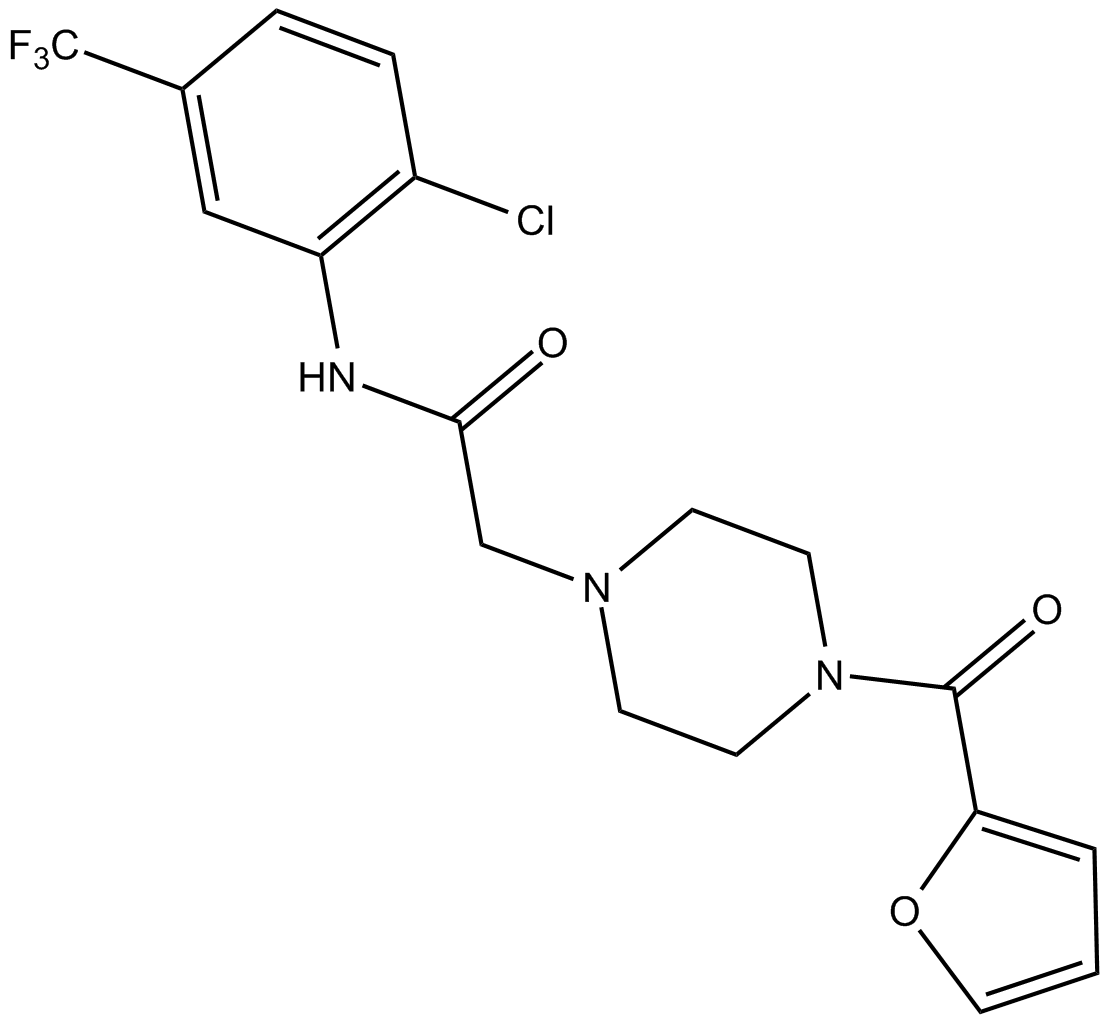
Cas No.: 899713-86-1
Sample solution is provided at 25 µL, 10mM.
_1-3.$$$39978408@51.jpg');)
_1-9.$$$38538795@65.jpg');)
_1-9.$$$39112701@51.jpg');)
_1-7.$$$37316672@70.jpg');)
_366-372.$$$36198801@70.jpg');)
.$$$38565142@65.jpg');)
_1867-1883.$$$33248023@67.jpg');)
_eads6055.$$$39977546@45.jpg');)
_eadm9805.$$$40080571@45.jpg');)
_eadj3020.$$$39666821@45.jpg');)
_1-20.$$$39757301@28.jpg');)
_1-24.$$$38898113@28.jpg');)
_273-287.$$$36806353@46.jpg');)
_1-16.$$$37156877@44.jpg');)
_1-19.$$$37460805@44.jpg');)
_1291-1307.$$$34518654@46.jpg');)
ML 348 est un inhibiteur sélectif et réversible de la lysophospholipase 1 (LYPLA1), sa valeur d'IC50 est approximativement 210nM, exhibant une sélectivité 14 fois supérieure pour LYPLA1 par rapport à LYPLA2[1-2]. ML 348 peut être utilisé pour étudier la palmitoylation des protéines et les fonctions biologiques de LYPLA1, et il inhibe significativement l'activité enzymatique dans les tissus cardiaques, pulmonaires et rénals[3-4].
Le pré-traitement in vitro avec ML 348 (1μM) aux macrophages alvéolaires porcins (PAMs) pendant 24-36 heures, suivi d'une infection par le virus du syndrome reproducteur et respiratoire porcin (PRRSV-2; MOI=0.1), a considérablement supprimé la transcription de mRNA viral ORF7 et l'expression de la protéine nucléocapside (protéine N), tout en réduisant les titres viraux[5]. Le pré-traitement avec ML 348 (≤12.5μM) aux cellules de mélanome mutées pour NRAS pendant 6 heures n'a pas affecté significativement la viabilité cellulaire, et n'a pas inhibé considérablement la phosphorylation des voies de signalisation en aval de NRAS (ERK et AKT)[6].
In vivo, l'infusion sous-cutanée chronique de ML 348 (0.3mg/kg) pendant 28 jours chez les rats Knock-in symptomatiques atteints de la maladie de Huntington CAG140 (âgés de 7 mois) a traversé efficacement la barrière hémato-encéphalique, amélioré significativement la coordination motrice, atténué les comportements anxio-dépressifs et inversé les modifications neuropathologiques[7]. L'administration orale de ML 348 (70mg/kg) pendant 90 jours chez les rats modèles de synucléinopathie 3KL α (symptomatiques, âgés de 12 mois) a renforcé significativement la coordination motrice, la mémoire spatiale et la mémoire à long terme, et restauré la plasticité synaptique hippocampique[8].
References:
[1] Adibekian A, Martin BR, Chang JW, et al. Characterization of a Selective, Reversible Inhibitor of Lysophospholipase 1 (LYPLA1). National Center for Biotechnology Information (US); 2010- 2013 Apr 08.
[2] Hulce JJ, Joslyn C, Speers AE, et al. An in Vivo Active Carbamate-based Dual Inhibitor of Lysophospholipase 1 (LYPLA1) and Lysophospholipase 2 (LYPLA2). National Center for Biotechnology Information (US); 2013 Dec 9.
[3] Won SJ, Davda D, Labby KJ, et al. Molecular Mechanism for Isoform-Selective Inhibition of Acyl Protein Thioesterases 1 and 2 (APT1 and APT2). ACS Chem Biol. 2016 Dec 16;11(12):3374-3382.
[4] Gu M, Jiang H, Tan M, et al. Palmitoyltransferase DHHC9 and acyl protein thioesterase APT1 modulate renal fibrosis through regulating β-catenin palmitoylation. Nat Commun. 2023 Oct 21;14(1):6682.
[5] Jing H, Liu Y, Song Y, et al. ZDHHC3-LYPLA1 regulates PRRSV-2 replication through reversible palmitoylation. Vet Microbiol. 2025 Feb;301:110368.
[6] Vujic I, Sanlorenzo M, Esteve-Puig R, et al. Acyl protein thioesterase 1 and 2 (APT-1, APT-2) inhibitors palmostatin B, ML348 and ML349 have different effects on NRAS mutant melanoma cells. Oncotarget. 2016 Feb 9;7(6):7297-306.
[7] Virlogeux A, Scaramuzzino C, Lenoir S, et al. Increasing brain palmitoylation rescues behavior and neuropathology in Huntington disease mice. Sci Adv. 2021 Mar 31;7(14):eabb0799.
[8] Moors TE, Li S, McCaffery TD, et al. Increased palmitoylation improves estrogen receptor alpha-dependent hippocampal synaptic deficits in a mouse model of synucleinopathy. Sci Adv. 2023 Nov 15;9(46):eadj1454.
| Expériences cellulaires [1]: | |
Lignées cellulaires | Cellules de mélanome mutées pour NRAS |
Méthode de préparation | Les cellules ont été traitées avec ML 348 (≤12.5µM) pendant 6 heures afin d'évaluer les modifications acutes de la signalisation. |
Conditions de réaction | ≤12.5μM; 6h |
Domaines d'application | ML 348 a provoqué une légère augmentation de la phosphorylation d'AKT, mais n'a pas modifié la phosphorylation d' ERK ou de S6, indiquant qu'il n'a aucun impact biologiquement significatif sur les voies de signalisation en aval de NRAS. |
| Expériences animales [2]: | |
Modèles animaux | Rats Knock-in CAG140 (modèle de maladie de Huntington) |
Méthode de préparation | Les rats ont reçu une infusion sous-cutanée de ML 348 (0.3mg/kg/jour) via des pompes osmotique Alzet pendant 28 jours. Des tests comportementaux et des analyses tissulaires ont été réalisés pendant et après le traitement. |
Forme de dosage | 0.3mg/kg; infusion sous-cutanée; administration chronique; quotidiennement pendant 28 jours |
Domaines d'application | Le traitement avec ML 348 a restauré la coordination motrice dans le test de l'échelle horizontale (réduction du taux d'erreurs et du temps de traversée), amélioré l'équilibre dans les tests rotarod, et atténué les comportements anxio-dépressifs dans les tests d'alimentation sous contrainte de nouveauté. ML 348 a également augmenté le niveau de palmitoylation cérébrale, réduit l'accumulation nucléaire de Huntingtin mutante (mHTT), et restauré la densité des synapses corticostriées. |
References: | |
| Cas No. | 899713-86-1 | SDF | |
| Synonymes | CID 3238952, SID 160654487 | ||
| Chemical Name | N-(2-chloro-5-(trifluoromethyl)phenyl)-2-(4-(furan-2-carbonyl)piperazin-1-yl)acetamide | ||
| Canonical SMILES | ClC1=C(NC(CN2CCN(C(C3=CC=CO3)=O)CC2)=O)C=C(C(F)(F)F)C=C1 | ||
| Formula | C18H17ClF3N3O3 | M.Wt | 415.79 |
| Solubility | ≥ 19.1mg/mL in DMSO | Storage | Store at -20°C |
| General tips | Please select the appropriate solvent to prepare the stock solution according to the
solubility of the product in different solvents; once the solution is prepared, please store it in
separate packages to avoid product failure caused by repeated freezing and thawing.Storage method
and period of the stock solution: When stored at -80°C, please use it within 6 months; when stored
at -20°C, please use it within 1 month. To increase solubility, heat the tube to 37°C and then oscillate in an ultrasonic bath for some time. |
||
| Shipping Condition | Evaluation sample solution: shipped with blue ice. All other sizes available: with RT, or with Blue Ice upon request. | ||
| Prepare stock solution | |||

|
1 mg | 5 mg | 10 mg |
| 1 mM | 2.4051 mL | 12.0253 mL | 24.0506 mL |
| 5 mM | 481 μL | 2.4051 mL | 4.8101 mL |
| 10 mM | 240.5 μL | 1.2025 mL | 2.4051 mL |
Step 1: Enter information below (Recommended: An additional animal making an allowance for loss during the experiment)
 g
μL
g
μL
Step 2: Enter the in vivo formulation (This is only the calculator, not formulation. Please contact us first if there is no in vivo formulation at the solubility Section.)
Calculation results:
Working concentration: mg/ml;
Method for preparing DMSO master liquid: mg drug pre-dissolved in μL DMSO ( Master liquid concentration mg/mL, Please contact us first if the concentration exceeds the DMSO solubility of the batch of drug. )
Method for preparing in vivo formulation: Take μL DMSO master liquid, next addμL PEG300, mix and clarify, next addμL Tween 80, mix and clarify, next add μL saline, mix and clarify.
Method for preparing in vivo formulation: Take μL DMSO master liquid, next add μL Corn oil, mix and clarify.
Note: 1. Please make sure the liquid is clear before adding the next solvent.
2. Be sure to add the solvent(s) in order. You must ensure that the solution obtained, in the previous addition, is a clear solution before proceeding to add the next solvent. Physical methods such as vortex, ultrasound or hot water bath can be used to aid dissolving.
3. All of the above co-solvents are available for purchase on the GlpBio website.
Quality Control & SDS
- View current batch:
- Purity: >99.50% Appearance: A solid
- COA (Certificate of Analysis)
- SDS (Safety Data Sheet)
- Datasheet
Average Rating: 5 (Based on Reviews and 31 reference(s) in Google Scholar.)