
UK-5099 (Synonyms: PF-1005023;UK5099;UK 5099;PF1005023;PF 1005023) |
| Catalog No.GC11865 |
UK-5099 est un inhibiteur du transporteur du pyruvate mitochondrial (MPC) que une valeur d'IC50 est 50nM pour inhiber la consommation d'O2 pyruvate - dépendante.
Products are for research use only. Not for human use. We do not sell to patients.
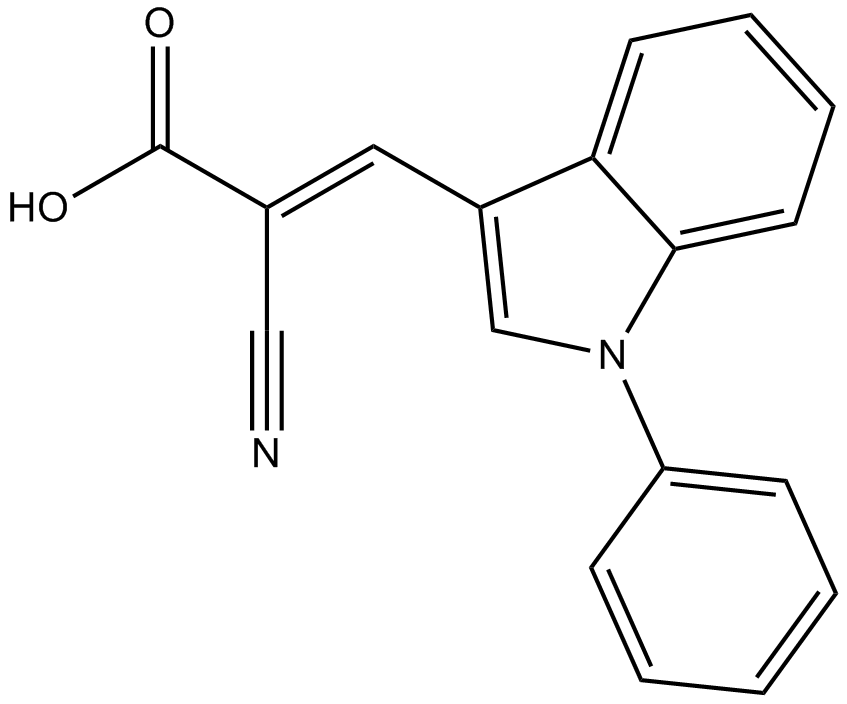
Cas No.: 56396-35-1
Sample solution is provided at 25 µL, 10mM.
UK-5099 est un inhibiteur du transporteur du pyruvate mitochondrial (MPC) que une valeur d'IC50 est 50nM pour inhiber la consommation d'O2 pyruvate - dépendante[1]. UK-5099 est un dérivé de l'α-cyanocinnamate qui bloque l'entrée du pyruvate dans les mitochondries, impairit la phosphorylation oxydative mitochondriale et déclenche la glycolyse aérobique[2]. UK-5099 peut augmenter l'oxydation du glutamate et prévenir la mort neuronale excitotoxique[3].
In vitro, le traitement par UK-5099 (25, 50µM) aux macrophages moelle osseuse - dérivés pendant 30 minutes a réduit de manière dose - dépendante la formation de la protéine adaptatrice de speck - type apoptose - associée qui contient CARD (ASC)[4]. Le traitement par UK-5099 (40, 80µM) aux microglies a significativement réduit l'intensité du signal nucléaire de NF-κB and NF-IL6 dans les cellules[5]. Le traitement par UK-5099 (10-150µM) aux cellules 832/13 a inhibé de façon dose - dépendante la sécrétion d'insuline glucose - stimulée dans les cellules[6].
In vivo, UK-5099 (3mg/kg) a été injecté par voie intra - péritonéale aux rats qui portent de xénogreffes de cancer du poumon de la cellule non - petites et a coopéré avec la syrosingopine pour inhiber la croissance tumorale[7].
References:
[1] Halestrap A P. The mitochondrial pyruvate carrier. Kinetics and specificity for substrates and inhibitors[J]. Biochemical Journal, 1975, 148(1): 85-96.
[2] Zeng Q, Si H, Lv K, et al. Determination and pharmacokinetics study of UK-5099 in mouse plasma by LC–MS/MS[J]. BMC Veterinary Research, 2022, 18(1): 145.
[3] Quansah E, Peelaerts W, Langston J W, et al. Targeting energy metabolism via the mitochondrial pyruvate carrier as a novel approach to attenuate neurodegeneration[J]. Molecular Neurodegeneration, 2018, 13: 1-12.
[4] Ran L, Chen M, Ye J, et al. UK5099 Inhibits the NLRP3 Inflammasome Independently of its Long‐Established Target Mitochondrial Pyruvate Carrier[J]. Advanced Science, 2024, 11(33): 2307224.
[5] Guimarães N C, Alves D S, Vilela W R, et al. Mitochondrial pyruvate carrier as a key regulator of fever and neuroinflammation[J]. Brain, Behavior, and Immunity, 2021, 92: 90-101.
[6] Patterson J N, Cousteils K, Lou J W, et al. Mitochondrial metabolism of pyruvate is essential for regulating glucose-stimulated insulin secretion[J]. Journal of Biological Chemistry, 2014, 289(19): 13335-13346.
[7] Li Y, Song Y, Shi Z, et al. Syrosingopine and UK5099 synergistically suppress non-small cell lung cancer by activating the integrated stress response[J]. Cell Death & Disease, 2024, 15(6): 431.
| Expériences cellulaires [1]: | |
Lignées cellulaires | Macrophages moelle osseuse - dérivés (BMDMs) |
Méthode de préparation | BMDMs qui sont isolés à partir de rats de rapporteur ASC (ASCcitrine BMDMs) ont été ensemencés sur les lameaux à chambre à une densité de 1×10⁶/mL. Les cellules ont été stimulées par la lipopolysaccharide (LPS) pendant 3 heures le lendemain. Ensuite, les cellules ont été traitées par 25µM ou 50µM UK-5099 pendant 30 minutes, suivies d'une stimulation de la nigericine pendant 1 heure. Puis, les cellules ont été lavées tois fois avec PBS à glace, et ont été fixées ensuite pendant 15 minutes dans une solution de fixation contenant 4% PFA dans PBS (formaléhyde polyéthylénique). Après avoir été lavées trois fois par PBST, les noyaux ont été colorés par DAPI. Les images ont été collectionnées par utiliser le microscope confocal à laser - balayage. |
Conditions de réaction | 25, 50µM; 30 minutes |
Domaines d'application | La fluorescence d'ASC était répartie de façon équitable dans les macrophages au repos, et la formation de taches denses était évidente après la stimulation de LPS et de la nigericine. UK-5099 a réduit de manière dose - dépendante la formation de taches d'ASC. |
| Expériences animales [2]: | |
Modèles animaux | Rats nus Balb/c |
Méthode de préparation | 5×10⁶ PC-9 cellules ont été inocubées de manière sous - cutanée dans les rats nus Balb/c. Une fois que le volume tumoral a atteint 50mm3, les rats ont été répartis en quatre groupes de six rats chacun : groupe de témoin (PBS), groupe syrosingopine (7,5mg/kg), groupe UK - 5099 ou PBS, ont été administrés aux rats par l'injection intra - péritonéale pendant 14 jours consécutifs. Dans cette période, les observations ont été effectuées avec soin, le volume et le poids tumorals ont été enregistrés pour l'analyse ultérieure. |
Forme de dosage | 3mg/kg pendant 14 jours; i.p. |
Domaines d'application | In vivo, l'inhibition de la croissance tumorale de la combinaison de syrosingopine et de UK - 5099. |
References: | |
| Cas No. | 56396-35-1 | SDF | |
| Synonymes | PF-1005023;UK5099;UK 5099;PF1005023;PF 1005023 | ||
| Chemical Name | (E)-2-cyano-3-(1-phenylindol-3-yl)prop-2-enoic acid | ||
| Canonical SMILES | C1=CC=C(C=C1)N2C=C(C3=CC=CC=C32)C=C(C#N)C(=O)O | ||
| Formula | C18H12N2O2 | M.Wt | 288.3 |
| Solubility | ≥ 28.8 mg/mL in DMSO | Storage | Store at -20°C |
| General tips | Please select the appropriate solvent to prepare the stock solution according to the
solubility of the product in different solvents; once the solution is prepared, please store it in
separate packages to avoid product failure caused by repeated freezing and thawing.Storage method
and period of the stock solution: When stored at -80°C, please use it within 6 months; when stored
at -20°C, please use it within 1 month. To increase solubility, heat the tube to 37°C and then oscillate in an ultrasonic bath for some time. |
||
| Shipping Condition | Evaluation sample solution: shipped with blue ice. All other sizes available: with RT, or with Blue Ice upon request. | ||
| Prepare stock solution | |||
|
1 mg | 5 mg | 10 mg |
| 1 mM | 3.4686 mL | 17.343 mL | 34.6861 mL |
| 5 mM | 693.7 μL | 3.4686 mL | 6.9372 mL |
| 10 mM | 346.9 μL | 1.7343 mL | 3.4686 mL |
Step 1: Enter information below (Recommended: An additional animal making an allowance for loss during the experiment)
Step 2: Enter the in vivo formulation (This is only the calculator, not formulation. Please contact us first if there is no in vivo formulation at the solubility Section.)
Calculation results:
Working concentration: mg/ml;
Method for preparing DMSO master liquid: mg drug pre-dissolved in μL DMSO ( Master liquid concentration mg/mL, Please contact us first if the concentration exceeds the DMSO solubility of the batch of drug. )
Method for preparing in vivo formulation: Take μL DMSO master liquid, next addμL PEG300, mix and clarify, next addμL Tween 80, mix and clarify, next add μL ddH2O, mix and clarify.
Method for preparing in vivo formulation: Take μL DMSO master liquid, next add μL Corn oil, mix and clarify.
Note: 1. Please make sure the liquid is clear before adding the next solvent.
2. Be sure to add the solvent(s) in order. You must ensure that the solution obtained, in the previous addition, is a clear solution before proceeding to add the next solvent. Physical methods such as vortex, ultrasound or hot water bath can be used to aid dissolving.
3. All of the above co-solvents are available for purchase on the GlpBio website.
Quality Control & SDS
- View current batch:
- Purity: >99.50%
- COA (Certificate Of Analysis)
- SDS (Safety Data Sheet)
- Datasheet
Average Rating: 5 (Based on Reviews and 30 reference(s) in Google Scholar.)
GLPBIO products are for RESEARCH USE ONLY. Please make sure your review or question is research based.
Required fields are marked with *
