

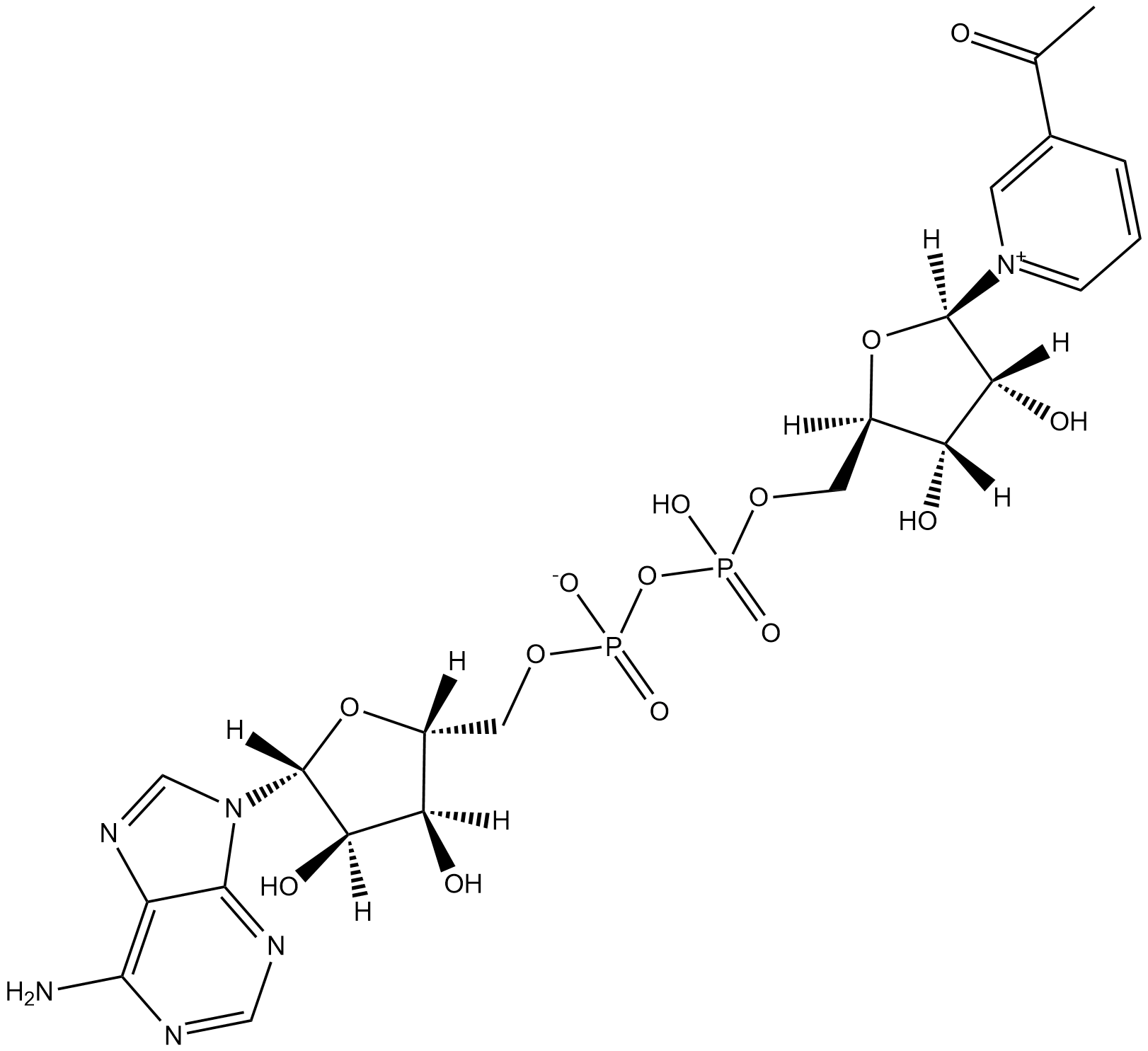
3-Acetylpyridine NAD (Synonyms: APAD, NSC 20275) |
カタログ番号GC18294
 One-Click Copy Product Info
|

3-アセチルピリジンNAD(APAD)は、多くの酵素のシグナル分子および補因子または基質であるNAD +(フリーアシッド)のアナログです。
Products are for research use only. Not for human use. We do not sell to patients.
Cas No.: 86-08-8
Sample solution is provided at 25 µL, 10mM.
_1-3.$$$39978408@51.jpg');)
_1-9.$$$38538795@65.jpg');)
_1-9.$$$39112701@51.jpg');)
_1-7.$$$37316672@70.jpg');)
_366-372.$$$36198801@70.jpg');)
.$$$38565142@65.jpg');)
_1867-1883.$$$33248023@67.jpg');)
_eads6055.$$$39977546@45.jpg');)
_eadm9805.$$$40080571@45.jpg');)
_eadj3020.$$$39666821@45.jpg');)
_1-20.$$$39757301@28.jpg');)
_1-24.$$$38898113@28.jpg');)
_273-287.$$$36806353@46.jpg');)
_1-16.$$$37156877@44.jpg');)
_1-19.$$$37460805@44.jpg');)
_1291-1307.$$$34518654@46.jpg');)
3-Acetylpyridine NAD (APAD) is an analog of NAD+ (free acid) , a signaling molecule and cofactor or substrate for many enzymes. APAD has been used to study the mechanisms of oxidative phosphorylation. It can be reduced by transdehydrogenase from NADH (sodium salt) . It can be reduced more efficiently and is more stable than NAD+; thus, it is useful as a substitute.
References:
[1]. Houtkooper, R.H., Cantó, C., Wanders, R.J., et al. The secret life of NAD+: An old metabolite controlling new metabolic signaling pathways Endocr. Rev. 31(2), 194-223 (2010).
[2]. Ciaccio, E.I. The inhibition of lactate dehydrogenase by 3-acetylpyridine adenine dinucleotide and bisulfite J. Biol. Chem. 241(7), 1581-1586 (1966).
[3]. Birrell, J.A., and Hirst, J. Investigation of NADH binding, hydride transfer, and NAD(+) dissociation during NADH oxidation by mitochondrial complex I using modified nicotinamide nucleotides Biochemistry 52(23), 4048-4055 (2013).
[4]. Stilwell, S.N., Bizouam, T., and Jackson, J.B. The reduction of acetylpyridine adenine dinucleotide by NADH: is it a significant reaction of proton-translocating transhydrogenase, or an artefact? Biochim Biophys. Acta. 1320(1), 83-94 (1997).
[5]. Lee, H.J., Lee, S.H., Park, C.B., et al. Coenzyme analogs: Excellent substitutes (not poor imitations) for electrochemical regeneration Chem. Commun. (Camb.) 47(46), 12538-12540 (2011).
| Cas No. | 86-08-8 | SDF | |
| 同義語 | APAD, NSC 20275 | ||
| Chemical Name | adenosine 5'-(trihydrogen diphosphate), P’→5’-ester with 3-acetyl-1-β-D-ribofuranosylpyridinium, inner salt | ||
| Canonical SMILES | O[C@H]1[C@H](N2C=NC3=C2N=CN=C3N)O[C@H](COP(OP(OC[C@@H]4[C@@H](O)[C@@H](O)[C@H]([N+]5=CC(C(C)=O)=CC=C5)O4)([O-])=O)(O)=O)[C@H]1O | ||
| Formula | C22H28N6O14P2 | M.Wt | 662.4 |
| 溶解度 | 10mg/ml in PBS (pH 7.2) | Storage | Store at -20°C |
| General tips | Please select the appropriate solvent to prepare the stock solution according to the
solubility of the product in different solvents; once the solution is prepared, please store it in
separate packages to avoid product failure caused by repeated freezing and thawing.Storage method
and period of the stock solution: When stored at -80°C, please use it within 6 months; when stored
at -20°C, please use it within 1 month. To increase solubility, heat the tube to 37°C and then oscillate in an ultrasonic bath for some time. |
||
| Shipping Condition | Evaluation sample solution: shipped with blue ice. All other sizes available: with RT, or with Blue Ice upon request. | ||
| Prepare stock solution | |||

|
1 mg | 5 mg | 10 mg |
| 1 mM | 1.5097 mL | 7.5483 mL | 15.0966 mL |
| 5 mM | 301.9 μL | 1.5097 mL | 3.0193 mL |
| 10 mM | 151 μL | 754.8 μL | 1.5097 mL |
Step 1: Enter information below (Recommended: An additional animal making an allowance for loss during the experiment)
 g
μL
g
μL
Step 2: Enter the in vivo formulation (This is only the calculator, not formulation. Please contact us first if there is no in vivo formulation at the solubility Section.)
Calculation results:
Working concentration: mg/ml;
Method for preparing DMSO master liquid: mg drug pre-dissolved in μL DMSO ( Master liquid concentration mg/mL, Please contact us first if the concentration exceeds the DMSO solubility of the batch of drug. )
Method for preparing in vivo formulation: Take μL DMSO master liquid, next addμL PEG300, mix and clarify, next addμL Tween 80, mix and clarify, next add μL saline, mix and clarify.
Method for preparing in vivo formulation: Take μL DMSO master liquid, next add μL Corn oil, mix and clarify.
Note: 1. Please make sure the liquid is clear before adding the next solvent.
2. Be sure to add the solvent(s) in order. You must ensure that the solution obtained, in the previous addition, is a clear solution before proceeding to add the next solvent. Physical methods such as vortex, ultrasound or hot water bath can be used to aid dissolving.
3. All of the above co-solvents are available for purchase on the GlpBio website.
Quality Control & SDS
- View current batch:
- Purity: >95.00% Appearance: A solid
- COA (Certificate of Analysis)
- SDS (Safety Data Sheet)
- Datasheet
Average Rating: 5 (Based on Reviews and 31 reference(s) in Google Scholar.)