

AC 253 |
カタログ番号GC50495
 One-Click Copy Product Info
|

AC 253はアミリン(AMY3)受容体拮抗剤である。
Products are for research use only. Not for human use. We do not sell to patients.
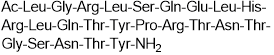
Cas No.: 151804-79-4
Sample solution is provided at 25 µL, 10mM.
_1-3.$$$39978408@51.jpg');)
_1-9.$$$38538795@65.jpg');)
_1-9.$$$39112701@51.jpg');)
_1-7.$$$37316672@70.jpg');)
_366-372.$$$36198801@70.jpg');)
.$$$38565142@65.jpg');)
_1867-1883.$$$33248023@67.jpg');)
_eads6055.$$$39977546@45.jpg');)
_eadm9805.$$$40080571@45.jpg');)
_eadj3020.$$$39666821@45.jpg');)
_1-20.$$$39757301@28.jpg');)
_1-24.$$$38898113@28.jpg');)
_273-287.$$$36806353@46.jpg');)
_1-16.$$$37156877@44.jpg');)
_1-19.$$$37460805@44.jpg');)
_1291-1307.$$$34518654@46.jpg');)
AC 253はアミリン(AMY3)受容体拮抗剤である。AC 253は125I-アドレノメデュリンの結合を阻害し(IC50=25nM)、アドレノメデュリンに刺激されたcAMPの産生を遮断する[1-2]。AC 253はアルツハイマー病と糖尿病に関連する研究に使われる[3-4]。
In vitro(体外)実験で、N2a細胞をAC 253(10μM)で8時間前処理し、その後はAMY3受容体リッチの細胞外小胞(EV)とAβ(10μM)で48時間共同培養した。AC 253は、Aβ誘発性の細胞毒性に対するAMY3 EVの保護効果を遮断した[5]。ヒト胎児小膠細胞をAC 253(10μM)で24時間前処理し、その後はAmylin(1μM)またはAβ1-42(1μM)に6時間暴露した。AC 253は、細胞内カルシウムでAβ-またはAmylinによる増加を遮断し、NLRP3とcaspase-1の活性化、TNFαとIL-1βの放出を軽減した[6]。
In vivo(体内)実験で、24時間飢餓させたSprague-Dawleyラットに、暗期の開始の1時間前に、AC 253(500μg/kg)を腹腔内注射した。AC 253は、cholecystokinin(CCK;0.5μg/kg)とbombesin(BBS;0.5μg/kg)に誘発された食欲減退作用を著しく軽減した[7]。TgCRND8アルツハイマー病モデルのマウスに、AC 253(2.4μg/日)を5か月間連続的に脳室内注入した。AC 253は、マウスの空間記憶と学習能力を著しく改善し、シナプスタンパク質(synapsin 1とsynaptophysin)の発現を増やし、小膠細胞マーカーIba-1の活性化を低下させた[8]。
| 細胞実験 [1]: | |
|
細胞株 |
N2aマウス神経芽腫細胞 |
|
調製方法 |
5% FBSを添加したDMEMでN2a細胞を培養した。AC 253(10μM)で細胞を8時間前インキュベートし、その後は無血清培地に、AMY3受容体リッチの細胞外小胞(EV)とAβを48時間添加培養した。 |
|
反応条件 |
10μM;8時間の前インキュベーション |
|
応用 |
AC 253の前処理により、Aβ誘発の毒性に対するAMY3 EVの細胞保護作用が遮断された。 |
| 動物実験 [2]: | |
|
動物モデル |
TgCRND8トランスジェニックマウスと野生型(Wt)同腹仔マウス |
|
調製方法 |
マウスに、ミニポンプを埋め込み、3か月齢から、AC 253(人工CSFに2.4μg/日)または人工CSF(対照)を5か月間連続的に脳室内注入した。行動試験(モリス水迷路とT迷路)を8か月齢に行った。 |
|
剤形 |
2.4μg/日;脳室内注入;5か月間 |
|
応用 |
AC 253を慢性的に脳室内注入したところ、高齢のTgCRND8マウスで、空間記憶と学習障害が改善された。AC 253は、シナプスタンパク質synapsin 1とsynaptophysinの発現を増やし、小膠細胞マーカーIba-1の発現を著しく低下させた。 |
| Cas No. | 151804-79-4 | SDF | |
| Formula | C122H196N40O39 | M.Wt | 2847.11 |
| 溶解度 | Soluble in DMSO | Storage | Store at -20°C |
| General tips | Please select the appropriate solvent to prepare the stock solution according to the
solubility of the product in different solvents; once the solution is prepared, please store it in
separate packages to avoid product failure caused by repeated freezing and thawing.Storage method
and period of the stock solution: When stored at -80°C, please use it within 6 months; when stored
at -20°C, please use it within 1 month. To increase solubility, heat the tube to 37°C and then oscillate in an ultrasonic bath for some time. |
||
| Shipping Condition | Evaluation sample solution: shipped with blue ice. All other sizes available: with RT, or with Blue Ice upon request. | ||
| Prepare stock solution | |||

|
1 mg | 5 mg | 10 mg |
| 1 mM | 351.2 μL | 1.7562 mL | 3.5123 mL |
| 5 mM | 70.2 μL | 351.2 μL | 702.5 μL |
| 10 mM | 35.1 μL | 175.6 μL | 351.2 μL |
Step 1: Enter information below (Recommended: An additional animal making an allowance for loss during the experiment)
 g
μL
g
μL
Step 2: Enter the in vivo formulation (This is only the calculator, not formulation. Please contact us first if there is no in vivo formulation at the solubility Section.)
Calculation results:
Working concentration: mg/ml;
Method for preparing DMSO master liquid: mg drug pre-dissolved in μL DMSO ( Master liquid concentration mg/mL, Please contact us first if the concentration exceeds the DMSO solubility of the batch of drug. )
Method for preparing in vivo formulation: Take μL DMSO master liquid, next addμL PEG300, mix and clarify, next addμL Tween 80, mix and clarify, next add μL saline, mix and clarify.
Method for preparing in vivo formulation: Take μL DMSO master liquid, next add μL Corn oil, mix and clarify.
Note: 1. Please make sure the liquid is clear before adding the next solvent.
2. Be sure to add the solvent(s) in order. You must ensure that the solution obtained, in the previous addition, is a clear solution before proceeding to add the next solvent. Physical methods such as vortex, ultrasound or hot water bath can be used to aid dissolving.
3. All of the above co-solvents are available for purchase on the GlpBio website.
Quality Control & SDS
- View current batch:
- Purity: >99.00% Appearance: A solid
- COA (Certificate of Analysis)
- SDS (Safety Data Sheet)
- Datasheet
Average Rating: 5 (Based on Reviews and 35 reference(s) in Google Scholar.)