

Cynaropicrin |
カタログ番号GC33330
 One-Click Copy Product Info
|

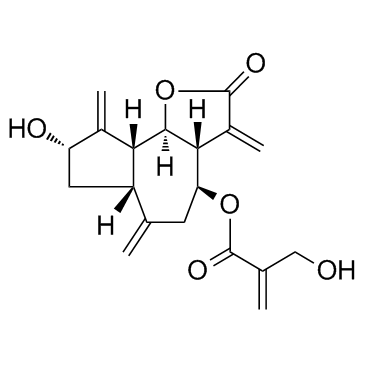
シナロピクリンは、腫瘍壊死因子 (TNF-α) の放出を阻害できるセスキテルペン ラクトンであり、マウスおよびヒトのマクロファージ細胞に対してそれぞれ 8.24 μM および 3.18 μM の IC50 を示します。シナロピクリンはまた、軟骨分解因子 (MMP13) の増加を阻害し、NF-κB シグナル伝達を抑制します。
Products are for research use only. Not for human use. We do not sell to patients.
Cas No.: 35730-78-0
Sample solution is provided at 25 µL, 10mM.
_1-3.$$$39978408@51.jpg');)
_1-9.$$$38538795@65.jpg');)
_1-9.$$$39112701@51.jpg');)
_1-7.$$$37316672@70.jpg');)
_366-372.$$$36198801@70.jpg');)
.$$$38565142@65.jpg');)
_1867-1883.$$$33248023@67.jpg');)
_eads6055.$$$39977546@45.jpg');)
_eadm9805.$$$40080571@45.jpg');)
_eadj3020.$$$39666821@45.jpg');)
_1-20.$$$39757301@28.jpg');)
_1-24.$$$38898113@28.jpg');)
_273-287.$$$36806353@46.jpg');)
_1-16.$$$37156877@44.jpg');)
_1-19.$$$37460805@44.jpg');)
_1291-1307.$$$34518654@46.jpg');)
Cynaropicrin is a sesquiterpene lactone containing an α-methylene-γ-butyrolactone active group, isolated from the Ranunculaceae plant Saussurea lappa. Cynaropicrin has an inhibitory effect on tumor necrosis factor (TNF-α) production and cytokine-induced neutrophil chemokine-1. Cynaropicrin also inhibits the upregulation of the cartilage degradation factor MMP13 and can suppress the NF-κB signaling pathway[1][2].
In vitro, Cynaropicrin (0-40µM; 6h) exhibited no cytotoxicity in RAW264.7 and U937 cells. Cynaropicrin (0-40µM; 24h) inhibited macrophage proliferation in a dose-dependent manner, with IC₅₀ values of 16.3µM in RAW264.7 cells and 17.2µM in U937 cells. Cynaropicrin (0-40µM) inhibited the proliferation of Sup-T1 cells after 24h and 48h of treatment, with IC₅₀ values of 27.5µM and 14.1µM, respectively. Cynaropicrin (0-40µM; 6h) strongly inhibited lipopolysaccharide-induced TNF-α release from both murine and human macrophage cells in a dose-dependent manner with the IC50 values of 8.24 and 3.18µM[1]. Cynaropicrin (1–4µM; 1h) dose-dependently inhibited TNF-α-induced upregulation of MMP13, HIF-2α, and ADAMTS4 mRNA expression and reversed the downregulation of Sox9 mRNA expression in OUMS-27 cells[2].
In vivo, Cynaropicrin (2.5 and 5mg/kg; i.p.; every 2 days for 14 days) decreased tumor volume and weight in mice bearing HCT116 xenografts with minimal toxicity[3].
References:
[1] Cho, J Y et al. “In vitro anti-inflammatory effects of cynaropicrin, a sesquiterpene lactone, from Saussurea lappa.” European journal of pharmacology vol. 398,3 (2000): 399-407.
[2] Masutani, Teruaki et al. “Cynaropicrin is dual regulator for both degradation factors and synthesis factors in the cartilage metabolism.” Life sciences vol. 158 (2016): 70-7.
[3] Zheng, Dandan et al. “Cynaropicrin Shows Antitumor Progression Potential in Colorectal Cancer Through Mediation of the LIFR/STATs Axis.” Frontiers in cell and developmental biology vol. 8 605184. 11 Jan. 2021.
| Cell experiment [1]: | |
Cell lines | RAW264.7 cells |
Preparation Method | Cynaropicrin was solubilized with vehicle (89.9% propylene glycol, 10% ethanol and 0.1% dimethyl sulfoxide) were diluted with RPMI1640. The final concentration of vehicle was never exceeded 0.05% in the culture medium. Before stimulation with lipopolysaccharide (1µg/ml), RAW264.7 cells were incubated for 18h in 24 well plates under the same conditions. Stimuli and the various concentrations of Cynaropicrin were then added to the wells for 6h. Supernatants were then collected and assayed for TNF-α content. |
Reaction Conditions | 0-40µM;6h |
Applications | Cynaropicrin (0-40µM; 6h) strongly inhibited lipopolysaccharide-induced TNF-α release in a dose-dependent manner. |
| Animal experiment [2]: | |
Animal models | Xenograft mice models bearing HCT116 cells |
Preparation Method | HCT116 cells mixed with an equal volume of PBS and matrigel were implanted in the hind flank of mice (nude mice, female, 5-6 weeks old). Upon attaining an appropriate tumor volume (approximately one-week post-implantation), mice were intraperitoneally injected with Napabucasin (NAPA) or Cynaropicrin (2.5 and 5mg/kg) for 14 days. The mice were given the drug every 2 days and their weight was weighed. |
Dosage form | 2.5 and 5mg/kg; i.p.; every 2 days for 14 days |
Applications | Intraperitoneal administration of Cynaropicrin at doses of 2.5 and 5mg/kg resulted in decreased tumor volume and weight compared to the vehicle group and Napabucasin (10mg/kg) group. LIFR and STAT3 phosphorylation was mechanistically inhibited in the treatment groups. |
References: | |
| Cas No. | 35730-78-0 | SDF | |
| Canonical SMILES | C=C([C@H]1O)[C@]([C@@]2([H])C1)([H])[C@](OC3=O)([H])[C@@](C3=C)([H])[C@@H](OC(C(CO)=C)=O)CC2=C | ||
| Formula | C19H22O6 | M.Wt | 346.37 |
| 溶解度 | DMSO: ≥ 50 mg/mL (144.35 mM) | Storage | -20°C, protect from light |
| General tips | Please select the appropriate solvent to prepare the stock solution according to the
solubility of the product in different solvents; once the solution is prepared, please store it in
separate packages to avoid product failure caused by repeated freezing and thawing.Storage method
and period of the stock solution: When stored at -80°C, please use it within 6 months; when stored
at -20°C, please use it within 1 month. To increase solubility, heat the tube to 37°C and then oscillate in an ultrasonic bath for some time. |
||
| Shipping Condition | Evaluation sample solution: shipped with blue ice. All other sizes available: with RT, or with Blue Ice upon request. | ||
| Prepare stock solution | |||

|
1 mg | 5 mg | 10 mg |
| 1 mM | 2.8871 mL | 14.4354 mL | 28.8709 mL |
| 5 mM | 577.4 μL | 2.8871 mL | 5.7742 mL |
| 10 mM | 288.7 μL | 1.4435 mL | 2.8871 mL |
Step 1: Enter information below (Recommended: An additional animal making an allowance for loss during the experiment)
 g
μL
g
μL
Step 2: Enter the in vivo formulation (This is only the calculator, not formulation. Please contact us first if there is no in vivo formulation at the solubility Section.)
Calculation results:
Working concentration: mg/ml;
Method for preparing DMSO master liquid: mg drug pre-dissolved in μL DMSO ( Master liquid concentration mg/mL, Please contact us first if the concentration exceeds the DMSO solubility of the batch of drug. )
Method for preparing in vivo formulation: Take μL DMSO master liquid, next addμL PEG300, mix and clarify, next addμL Tween 80, mix and clarify, next add μL saline, mix and clarify.
Method for preparing in vivo formulation: Take μL DMSO master liquid, next add μL Corn oil, mix and clarify.
Note: 1. Please make sure the liquid is clear before adding the next solvent.
2. Be sure to add the solvent(s) in order. You must ensure that the solution obtained, in the previous addition, is a clear solution before proceeding to add the next solvent. Physical methods such as vortex, ultrasound or hot water bath can be used to aid dissolving.
3. All of the above co-solvents are available for purchase on the GlpBio website.
Quality Control & SDS
- View current batch:
- Purity: >98.00% Appearance: An oil
- COA (Certificate of Analysis)
- SDS (Safety Data Sheet)
- Datasheet
Average Rating: 5 (Based on Reviews and 9 reference(s) in Google Scholar.)