

Estriol (Synonyms: E3, 16α-hydroxy-17β-Estradiol, 1,3,5(10)-Estratriene-3,16α,17β-triol) |
カタログ番号GC12182
 One-Click Copy Product Info
|

Estriolはエストロゲン受容体(ERαとERβ)の作動剤で、Gタンパク質共役受容体30(GPR30)の拮抗剤である。
Products are for research use only. Not for human use. We do not sell to patients.
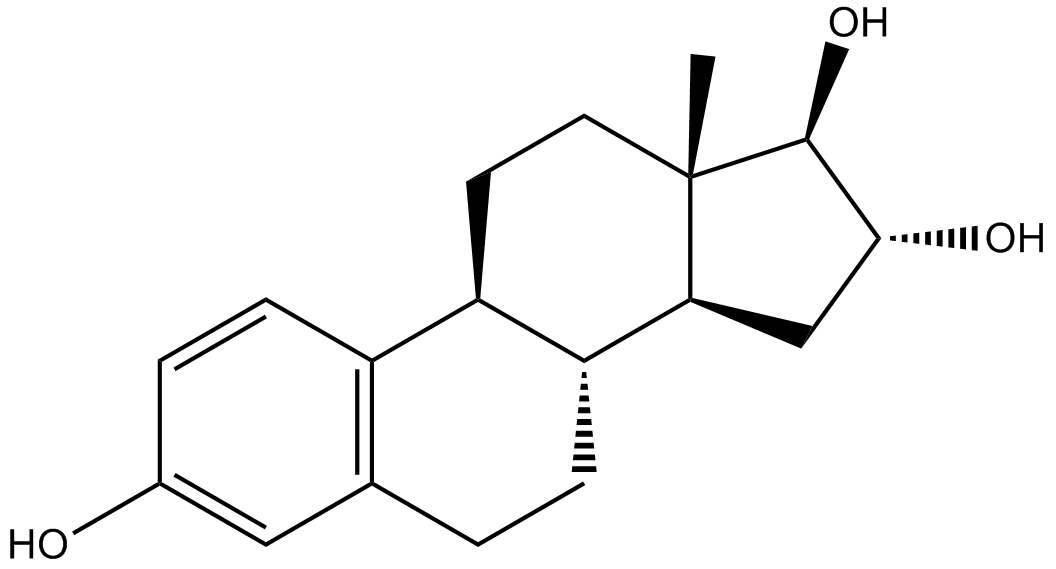
Cas No.: 50-27-1
Sample solution is provided at 25 µL, 10mM.
_1-3.$$$39978408@51.jpg');)
_1-9.$$$38538795@65.jpg');)
_1-9.$$$39112701@51.jpg');)
_1-7.$$$37316672@70.jpg');)
_366-372.$$$36198801@70.jpg');)
.$$$38565142@65.jpg');)
_1867-1883.$$$33248023@67.jpg');)
_eads6055.$$$39977546@45.jpg');)
_eadm9805.$$$40080571@45.jpg');)
_eadj3020.$$$39666821@45.jpg');)
_1-20.$$$39757301@28.jpg');)
_1-24.$$$38898113@28.jpg');)
_273-287.$$$36806353@46.jpg');)
_1-16.$$$37156877@44.jpg');)
_1-19.$$$37460805@44.jpg');)
_1291-1307.$$$34518654@46.jpg');)
Estriolはエストロゲン受容体(ERαとERβ)の作動剤で、Gタンパク質共役受容体30(GPR30)の拮抗剤である[1]。Estriolは細胞核でERα/ERβと結合し、遺伝子の転写を誘発し、細胞の増殖、分化とその他の機能を影響する[2]。Estriolは局部皮膚抗老衰と潜在的な免疫調節治療に使われる[3-4]。
SkBr3細胞で、Estriol (1μM; 6d)は、GPR30依存性のシグナル伝達経路を阻害することで、乳癌細胞の異常な増殖を遮断できる[1]。MDA-MB-231細胞で、Estriol (1-80μM; 7d)は、17β-エストラジオール刺激の細胞の増殖を阻害する[5]。ミエリン塩基性タンパク質反応性T細胞で、Estriol (0-50ng/mL; 16h)の処理は、細胞の移動で、用量依存的な阻害作用を示した[6]。
ペンチレンテトラゾール(PTZ)誘発の癲癇マウスモデルで、Estriol (0.005mg/kg, 0.01mg/kg;腹腔内注射;単回注射)の処理は、癲癇発作の発生率を増やす[7]。ストレプトゾトシン誘発のタイプ1の糖尿病マウスモデルで、Estriol (3.5µM;静脈内注射;単回注射)は、肝臓インスリン合成を通じて、高血糖をコントロールする[8]。
References:
[1]. Lappano R, Rosano C, De Marco P, et al. Estriol acts as a GPR30 antagonist in estrogen receptor-negative breast cancer cells[J]. Molecular and cellular endocrinology, 2010, 320(1-2): 162-170.
[2]. Kim S, Liva S M, Dalal M A, et al. Estriol ameliorates autoimmune demyelinating disease: implications for multiple sclerosis[J]. Neurology, 1999, 52(6): 1230-1230.
[3]. Ali E S, Mangold C, Peiris A N. Estriol: emerging clinical benefits[J]. Menopause, 2017, 24(9): 1081-1085.
[4]. Merrill R C. Estriol: a review[J]. Physiological reviews, 1958, 38(3): 463-480.
[5]. Girgert R, Emons G, Gründker C. Inhibition of GPR30 by estriol prevents growth stimulation of triple-negative breast cancer cells by 17β-estradiol[J]. BMC cancer, 2014, 14(1): 935.
[6]. Zang Y C Q, Halder J B, Hong J, et al. Regulatory effects of estriol on T cell migration and cytokine profile: inhibition of transcription factor NF-κB[J]. Journal of neuroimmunology, 2002, 124(1-2): 106-114.
[7]. Ahmad A, Vohora D. Proconvulsant effects of estriol, the third estrogen, in the mouse PTZ-kindling model[J]. Neurological Sciences, 2014, 35(10): 1561-1566.
[8]. Bhattacharya S, Bank S, Maiti S, et al. The control of hyperglycemia by estriol and progesterone in alloxan induced type I diabetes mellitus mice model through hepatic insulin synthesis[J]. International Journal of Biomedical Science: IJBS, 2014, 10(1): 8.
| 細胞実験[1]: | |
細胞株 | SkBr3細胞 |
準備方法 | SkBr3乳癌細胞を、10000細胞/ウェルの密度で、96ウェルのプレートに播種した。接着後、2.5%の脱脂FBSで培養し、GPR30作動剤G-1 (100nM)と/またはEstriol (E3, 1μM)で処理した。培養を6日間続け、2日ごとに新鮮な培地に交換し、処理を行った。処理については、細胞の増殖活性をMTT法で評価した。 |
反応条件 | 1μM;6日間 |
アプリケーション | Estriol はGPR30依存性のシグナル伝達経路を阻害することで、乳癌細胞の異常な増殖を遮断できる。 |
| 動物実験 [2]: | |
動物モデル | ペンチレンテトラゾール(PTZ)誘発の癲癇マウスモデル |
準備方法 | 体重25から35gのSwissアルビノマウスを使用した。ポリプロピレンケージで飼育し、自然な昼夜循環で、25–30℃、50–55 %の湿度で維持した。EstriolをDMSOに溶解し、0.005と0.01mg/kgの用量で腹腔内注射した。対照群には溶媒としてのDMSOを投与した。Clomipheneを蒸留水で溶解し、0.9mg/kgの用量で腹腔内投与した。Diazepamを標準とし、3mg/kgで投与した。Pentylenetetrazole (PTZ)を、それぞれのグループで、Estriolとclomiphene処理の1時間後、diazepam処理の1.5時間後に投与した。 |
投与形態 | 0.005mg/kg、0.01mg/kg;腹腔内注射;単回注射 |
アプリケーション | Estriolの処理は、マウスで癲癇発作の発生率を増やす。 |
References: | |
| Cas No. | 50-27-1 | SDF | |
| 同義語 | E3, 16α-hydroxy-17β-Estradiol, 1,3,5(10)-Estratriene-3,16α,17β-triol | ||
| Chemical Name | (8R,9S,13S,14S,16R,17R)-13-methyl-6,7,8,9,11,12,14,15,16,17-decahydrocyclopenta[a]phenanthrene-3,16,17-triol | ||
| Canonical SMILES | CC12CCC3C(C1CC(C2O)O)CCC4=C3C=CC(=C4)O | ||
| Formula | C18H24O3 | M.Wt | 288.39 |
| 溶解度 | ≥ 9.25mg/mL in DMSO | Storage | Store at RT |
| General tips | Please select the appropriate solvent to prepare the stock solution according to the
solubility of the product in different solvents; once the solution is prepared, please store it in
separate packages to avoid product failure caused by repeated freezing and thawing.Storage method
and period of the stock solution: When stored at -80°C, please use it within 6 months; when stored
at -20°C, please use it within 1 month. To increase solubility, heat the tube to 37°C and then oscillate in an ultrasonic bath for some time. |
||
| Shipping Condition | Evaluation sample solution: shipped with blue ice. All other sizes available: with RT, or with Blue Ice upon request. | ||
| Prepare stock solution | |||

|
1 mg | 5 mg | 10 mg |
| 1 mM | 3.4675 mL | 17.3376 mL | 34.6753 mL |
| 5 mM | 693.5 μL | 3.4675 mL | 6.9351 mL |
| 10 mM | 346.8 μL | 1.7338 mL | 3.4675 mL |
Step 1: Enter information below (Recommended: An additional animal making an allowance for loss during the experiment)
 g
μL
g
μL
Step 2: Enter the in vivo formulation (This is only the calculator, not formulation. Please contact us first if there is no in vivo formulation at the solubility Section.)
Calculation results:
Working concentration: mg/ml;
Method for preparing DMSO master liquid: mg drug pre-dissolved in μL DMSO ( Master liquid concentration mg/mL, Please contact us first if the concentration exceeds the DMSO solubility of the batch of drug. )
Method for preparing in vivo formulation: Take μL DMSO master liquid, next addμL PEG300, mix and clarify, next addμL Tween 80, mix and clarify, next add μL saline, mix and clarify.
Method for preparing in vivo formulation: Take μL DMSO master liquid, next add μL Corn oil, mix and clarify.
Note: 1. Please make sure the liquid is clear before adding the next solvent.
2. Be sure to add the solvent(s) in order. You must ensure that the solution obtained, in the previous addition, is a clear solution before proceeding to add the next solvent. Physical methods such as vortex, ultrasound or hot water bath can be used to aid dissolving.
3. All of the above co-solvents are available for purchase on the GlpBio website.
Quality Control & SDS
- View current batch:
- Purity: >99.00% Appearance: A solid
- COA (Certificate of Analysis)
- SDS (Safety Data Sheet)
- Datasheet
Average Rating: 5 (Based on Reviews and 4 reference(s) in Google Scholar.)