

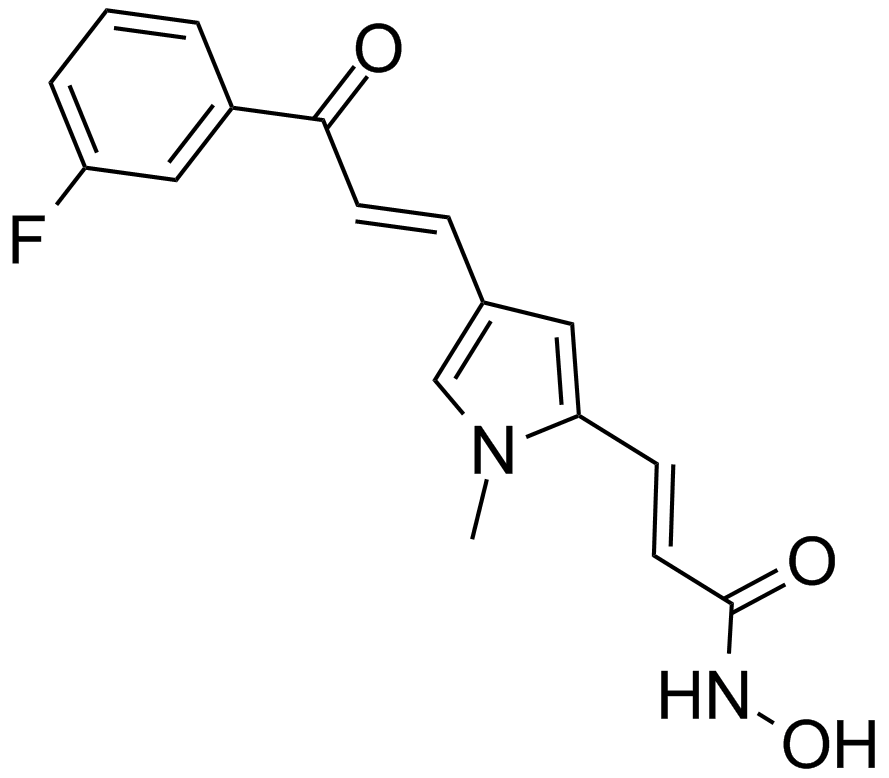
MC1568 (Synonyms: MC 1568, MC-1568) |
カタログ番号GC15965
 One-Click Copy Product Info
|

選択的なクラスIIa HDAC阻害剤
Products are for research use only. Not for human use. We do not sell to patients.
Cas No.: 852475-26-4
Sample solution is provided at 25 µL, 10mM.
_1-3.$$$39978408@51.jpg');)
_1-9.$$$38538795@65.jpg');)
_1-9.$$$39112701@51.jpg');)
_1-7.$$$37316672@70.jpg');)
_366-372.$$$36198801@70.jpg');)
.$$$38565142@65.jpg');)
_1867-1883.$$$33248023@67.jpg');)
_eads6055.$$$39977546@45.jpg');)
_eadm9805.$$$40080571@45.jpg');)
_eadj3020.$$$39666821@45.jpg');)
_1-20.$$$39757301@28.jpg');)
_1-24.$$$38898113@28.jpg');)
_273-287.$$$36806353@46.jpg');)
_1-16.$$$37156877@44.jpg');)
_1-19.$$$37460805@44.jpg');)
_1291-1307.$$$34518654@46.jpg');)
MC1568, a derivative of (Aryloxopropenyl)pyrrolyl hydroxyamide, is a novel, potent and specific inhibitor of class II histone deacetylase (HDAC), including two subclasses IIa (HDAC4, HDAC5, HDAC6, HDAC7 and HDAC9) and IIb (HDAC6 and HDAC 10), that exhibits strong inhibition against maize class II HDAC with 50% inhibition concentration IC50 value of 22 μM. MC1568 has been found to tissue-selectively inhibits HDAC and arrest myogenesis in cultured muscle cells through three possible mechanisms, including decreasing the expression of myocyte enhancer factor 2D, stabilizing the HDAC-HDAC3-MEF2D complex and inhibiting the acetylation of differentiation-induced MEF2D. Moreover, MC1568 is able to interfere with RAR- and PPARγ-mediated differentiation-inducing signaling pathways.
Reference
Mai A, Massa S, Pezzi R, Simeoni S, Rotili D, Nebbioso A, Scognamiglio A, Altucci L, Loidl P, Brosch G. Class II (IIa)-selective histone deacetylase inhibitors. 1. Synthesis and biological evaluation of novel (aryloxopropenyl)pyrrolyl hydroxyamides. J Med Chem. 2005 May 5;48(9):3344-53.
Nebbioso A, Dell'Aversana C, Bugge A, Sarno R, Valente S, Rotili D, Manzo F, Teti D, Mandrup S, Ciana P, Maggi A, Mai A, Gronemeyer H, Altucci L. HDACs class II-selective inhibition alters nuclear receptor-dependent differentiation. J Mol Endocrinol. 2010 Oct;45(4):219-28. doi: 10.1677/JME-10-0043. Epub 2010 Jul 16.
Nebbioso A, Manzo F, Miceli M, Conte M, Manente L, Baldi A, De Luca A, Rotili D, Valente S, Mai A, Usiello A, Gronemeyer H, Altucci L. Selective class II HDAC inhibitors impair myogenesis by modulating the stability and activity of HDAC-MEF2 complexes. EMBO Rep. 2009 Jul;10(7):776-82. doi: 10.1038/embor.2009.88. Epub 2009 Jun 5.
| Kinase experiment [1]: | |
|
Maize HD2, HD1-B, and HD1-A enzyme inhibition |
The enzyme liberated tritiated acetic acid from the substrate, which was quantified by scintillation counting. IC50 values are results of triple determinations. A 50 μL sample of maize enzyme (at 30 °C) was incubated (30 mins) with 10 μL of total [3H]acetate-prelabeled chicken reticulocyte histones (2 mg/mL). Reaction was stopped by addition of 50 μL of 1 M HCl/0.4 M acetate and 800 μL of ethyl acetate. After centrifugation (10000 g, 5 mins), an aliquot of 600 μL of the upper phase was counted for radioactivity in 3 mL of liquid scintillation cocktail. MC1568 was tested at a starting concentration of 40 μM, and active substances were diluted further. NaB, VPA, TSA, SAHA, 85TPX, HC-toxin, and tubacin were used as the reference compounds, and blank solvents were used as negative controls. |
| Cell experiment [2]: | |
|
Cell lines |
3T3-L1 cells |
|
Preparation method |
The solubility of this compound in DMSO is >10 mM. General tips for obtaining a higher concentration: Please warm the tube at 37 °C for 10 minutes and/or shake it in the ultrasonic bath for a while. Stock solution can be stored below -20 °C for several months. |
|
Reaction Conditions |
~ 10 μM; 8 days |
|
Applications |
In 3T3-L1 cells, MC1568 attenuated PPARγ-induced adipogenesis. |
| Animal experiment [2]: | |
|
Animal models |
PPRE-Luc transgenic C57BL/6 mice |
|
Dosage form |
50 mg/kg; p.o.; q.d., for 7 days |
|
Applications |
In PPRE-Luc transgenic C57BL/6 mice, MC1568 (50 mg/kg) impaired PPARγ signaling mostly in the heart and adipose tissues. |
|
Other notes |
Please test the solubility of all compounds indoor, and the actual solubility may slightly differ with the theoretical value. This is caused by an experimental system error and it is normal. |
|
References: [1]. Mai A, Massa S, Pezzi R, Simeoni S, Rotili D, Nebbioso A, Scognamiglio A, Altucci L, Loidl P, Brosch G. Class II (IIa)-selective histone deacetylase inhibitors. 1. Synthesis and biological evaluation of novel (aryloxopropenyl)pyrrolyl hydroxyamides. J Med Chem. 2005 May 5;48(9):3344-53. [2]. Nebbioso A, Dell'Aversana C, Bugge A, Sarno R, Valente S, Rotili D, Manzo F, Teti D, Mandrup S, Ciana P, Maggi A, Mai A, Gronemeyer H, Altucci L. HDACs class II-selective inhibition alters nuclear receptor-dependent differentiation. J Mol Endocrinol. 2010 Oct;45(4):219-28. | |
| Cas No. | 852475-26-4 | SDF | |
| 同義語 | MC 1568, MC-1568 | ||
| Chemical Name | (E)-3-[4-[(E)-3-(3-fluorophenyl)-3-oxoprop-1-enyl]-1-methylpyrrol-2-yl]-N-hydroxyprop-2-enamide | ||
| Canonical SMILES | CN1C=C(C=C1C=CC(=O)NO)C=CC(=O)C2=CC(=CC=C2)F | ||
| Formula | C17H15FN2O3 | M.Wt | 314.31 |
| 溶解度 | ≥ 15.7 mg/mL in DMSO | Storage | Store at -20°C |
| General tips | Please select the appropriate solvent to prepare the stock solution according to the
solubility of the product in different solvents; once the solution is prepared, please store it in
separate packages to avoid product failure caused by repeated freezing and thawing.Storage method
and period of the stock solution: When stored at -80°C, please use it within 6 months; when stored
at -20°C, please use it within 1 month. To increase solubility, heat the tube to 37°C and then oscillate in an ultrasonic bath for some time. |
||
| Shipping Condition | Evaluation sample solution: shipped with blue ice. All other sizes available: with RT, or with Blue Ice upon request. | ||
| Prepare stock solution | |||

|
1 mg | 5 mg | 10 mg |
| 1 mM | 3.1816 mL | 15.9079 mL | 31.8157 mL |
| 5 mM | 636.3 μL | 3.1816 mL | 6.3631 mL |
| 10 mM | 318.2 μL | 1.5908 mL | 3.1816 mL |
Step 1: Enter information below (Recommended: An additional animal making an allowance for loss during the experiment)
 g
μL
g
μL
Step 2: Enter the in vivo formulation (This is only the calculator, not formulation. Please contact us first if there is no in vivo formulation at the solubility Section.)
Calculation results:
Working concentration: mg/ml;
Method for preparing DMSO master liquid: mg drug pre-dissolved in μL DMSO ( Master liquid concentration mg/mL, Please contact us first if the concentration exceeds the DMSO solubility of the batch of drug. )
Method for preparing in vivo formulation: Take μL DMSO master liquid, next addμL PEG300, mix and clarify, next addμL Tween 80, mix and clarify, next add μL saline, mix and clarify.
Method for preparing in vivo formulation: Take μL DMSO master liquid, next add μL Corn oil, mix and clarify.
Note: 1. Please make sure the liquid is clear before adding the next solvent.
2. Be sure to add the solvent(s) in order. You must ensure that the solution obtained, in the previous addition, is a clear solution before proceeding to add the next solvent. Physical methods such as vortex, ultrasound or hot water bath can be used to aid dissolving.
3. All of the above co-solvents are available for purchase on the GlpBio website.
Quality Control & SDS
- View current batch:
- Purity: >98.00% Appearance: A solid
- COA (Certificate of Analysis)
- SDS (Safety Data Sheet)
- Datasheet
Average Rating: 5 (Based on Reviews and 30 reference(s) in Google Scholar.)