

Nonactin |
カタログ番号GC12090
 One-Click Copy Product Info
|

Nonactinはマクロテトロリド系抗生物質とミトコンドリア酸化リン酸化脱共役剤である。
Products are for research use only. Not for human use. We do not sell to patients.
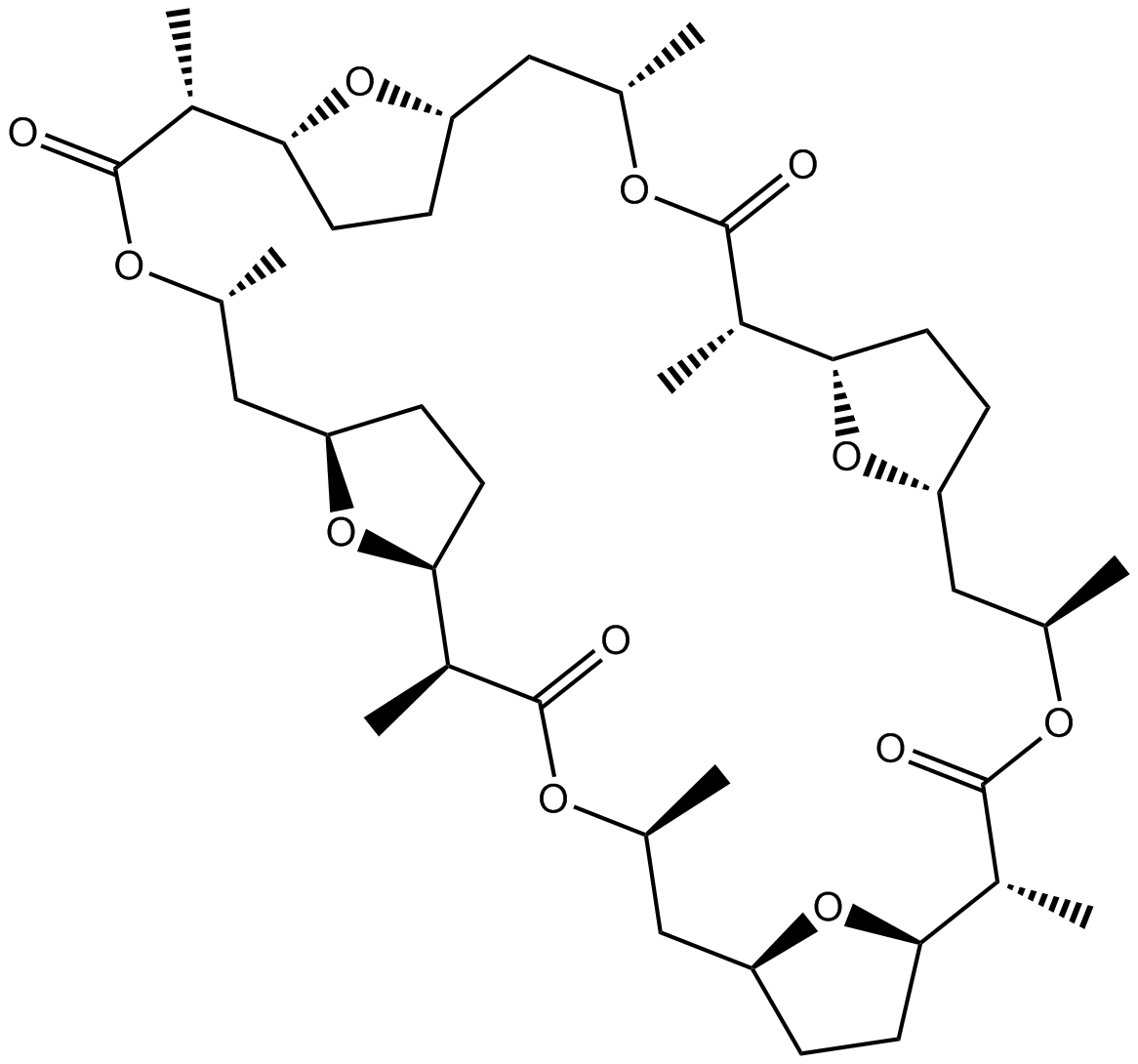
Cas No.: 6833-84-7
Sample solution is provided at 25 µL, 10mM.
_1-3.$$$39978408@51.jpg');)
_1-9.$$$38538795@65.jpg');)
_1-9.$$$39112701@51.jpg');)
_1-7.$$$37316672@70.jpg');)
_366-372.$$$36198801@70.jpg');)
.$$$38565142@65.jpg');)
_1867-1883.$$$33248023@67.jpg');)
_eads6055.$$$39977546@45.jpg');)
_eadm9805.$$$40080571@45.jpg');)
_eadj3020.$$$39666821@45.jpg');)
_1-20.$$$39757301@28.jpg');)
_1-24.$$$38898113@28.jpg');)
_273-287.$$$36806353@46.jpg');)
_1-16.$$$37156877@44.jpg');)
_1-19.$$$37460805@44.jpg');)
_1291-1307.$$$34518654@46.jpg');)
Nonactinはマクロテトロリド系抗生物質とミトコンドリア酸化リン酸化脱共役剤である[1][2]。Nonactinは、組み換えヒトアデニンヌクレオチドトランスロカーゼ(ANT)アイソフォームANT1–4を阻害し、IC50値はそれぞれ4.4、3.3、4.7と3.3μMである[3]。Nonactinは、酸化リン酸化脱共役、イオンフォアのメカニズム、β-catenin変異腫瘍におけるアポトーシスに関する研究に広く使われる[4]。
体外で、Nonactin (5μg/ml;12-14時間)でBHK細胞を処理し、総合成を減らさずに、NDV-HNとVSV-Gの糖タンパク質の細胞表面発見を遮断し、VSV-Gの細胞内蓄積を起こし、シンシチウム形成を阻害し、感染性ウイルス量を低くする[5]。Nonactin (0.12-0.5µM;72時間)で甲状腺髄様癌TT細胞を処理した結果、RETタンパク質とmRNAのレベルを減らし、pAKT/pmTORシグナル伝達を抑制し、G1停止を誘発し、cyclin D1/E、E2F1とBCL-2を低くし、γH2AXと切断型のPARPを増やし、 caspase-3/7の活性を上昇させる[6]。
体内で、β-catenin変異HCT 116異種移植マウスで、Nonactin (100mg/kg/日;腹腔内注射;4日間)は著しい体重減少を起こさずに、著しい腫瘍退縮と強力なTUNEL陽性アポトーシスを誘発した[7]。
References:
[1] Pampaloni F, Mayer B, Kabat Vel-Job K, et al. A Novel Cellular Spheroid-Based Autophagy Screen Applying Live Fluorescence Microscopy Identifies Nonactin as a Strong Inducer of Autophagosomal Turnover. SLAS Discov. 2017;22(5):558-570.
[2] Martínez-Haya B, Avilés-Moreno JR, Hamad S, Elguero J. On the ionophoric selectivity of nonactin and related macrotetrolide derivatives. Phys Chem Chem Phys. 2017;19(2):1288-1297.
[3] Zhang Y, Tian D, Matsuyama H, et al. Human Adenine Nucleotide Translocase (ANT) Modulators Identified by High-Throughput Screening of Transgenic Yeast. J Biomol Screen. 2016;21(4):381-390.
[4] Hu J, Zhang J, He J. Structures, Synthesis and Biological Activities of Nonactic Acid and Its Derivatives. Curr Med Chem. 2021;28(42):8673-8691.
[5] Lee JM, Kim JG, Kim TH, et al. Nonactin hinders intracellular glycosylation in virus-infected baby hamster kidney cells. Mol Med Rep. 2010;3(1):115-119.
[6] Alqahtani T, Alsubait A, Aloumi M, et al. A novel role for nonactin: interfering with G-quadruplex in RET-driven medullary thyroid cancer. BMC Cancer. 2024;24(1):1569.
[7] Shikata Y, Kiga M, Futamura Y, et al. Mitochondrial uncoupler exerts a synthetic lethal effect against β-catenin mutant tumor cells. Cancer Sci. 2017;108(4):772-784.
| 細胞実験[1]: | |
細胞株 | MTC由来のTT細胞 |
準備方法 | 15%の熱不活性化のウシ胎児血清(FBS)を添加したDMEM/F12培地でMTC由来のTT細胞を培養し、5%のCO2、37°Cの湿潤環境で維持した。細胞を7,500個の細胞/ウェルの密度で、96ウェルのプレートに播種し、一晩中接着させた。続いて、様々な濃度のNonactin (0.12-0.5µM)に最大72時間暴露した。細胞の生存率を評価するため、200µg/mLのフェナジンメトサルフェート(PMS)と混合した0.33mg/mLのMTS染料の溶液を使用した。490nmで吸光度を読み取った。TT細胞におけるCaspase-3の活性を、ApoAlert Caspase Fluorescent Assay kitで評価した。細胞をPCRとウエスタンブロット分析のために採取した。 |
反応条件 | 0.12-0.5µM;72時間 |
アプリケーション | Nonactin (0.12-0.5µM;72時間)で甲状腺髄様癌TT細胞を処理した結果、RETタンパク質とmRNAのレベルを減らし、pAKT/pmTORシグナル伝達を抑制し、cyclin D1/E、E2F1とBCL-2を低くし、γH2AXと切断のPARPを増やし、 caspase-3/7の活性を上昇させる。 |
| 動物実験 [2]: | |
動物モデル | BALB/cA Jcl-nuマウス |
準備方法 | 特異性の病原体を持たない雌のヌードマウス(BALB/cA Jcl-nu)をこの実験に使った。0日目に、β-catenin変異のHCT 116細胞(2×10⁶個の細胞/mL)を、ヌードマウスの腋窩部に皮下接種した。Nonactinを、10%のジメチルアセトアミド、10%のNIKKOL HCO60と生理食塩水に溶解し、動物に毎日腹腔内投与(100mg/kg)した。腫瘍を持つヌードマウスをランダムにグループに分け(6匹/群)、nonactinの投与は9から12日目まで行われた。下記の式に従い、腫瘍の体積をマイクロゲージで算出した:腫瘍の体積(mm3)=1/2×(腫瘍の長さ)×(腫瘍の幅)2。メーカーのプロトコールに従い、FragEL DNA Fragmentation Detection Kitで異種移植腫瘍組織にTUNEL染色を行った。組織の切片を、100倍の倍率で観察し、画像をデジタルカメラで撮った。 |
投与形態 | 100mg/kg/日;腹腔内注射;4日間 |
アプリケーション | β-catenin変異HCT 116異種移植マウスで、Nonactin (100mg/kg/日;腹腔内注射;4日間)は著しい体重減少を起こさずに、著しい腫瘍退縮と大量のTUNEL陽性アポトーシスを誘発した[7]。 |
References: | |
| Cas No. | 6833-84-7 | SDF | |
| Chemical Name | (1R,2R,5R,7R,10S,11S,14S,16S,19R,20R,23R,25R,28S,29S,32S,34S)-2,5,11,14,20,23,29,32-octamethyl-4,13,22,31,37,38,39,40-octaoxapentacyclo[32.2.1.17,10.116,19.125,28]tetracontane-3,12,21,30-tetrone | ||
| Canonical SMILES | O=C([C@H](C)[C@@H]1O[C@H]2CC1)O[C@H](C)C[C@@H]3O[C@H]([C@H](C)C(O[C@@H](C)C[C@H]4O[C@@H]([C@@H](C)C(O[C@H](C)C[C@@H]5O[C@H]([C@H](C)C(O[C@@H](C)C2)=O)CC5)=O)CC4)=O)CC3 | ||
| Formula | C40H64O12 | M.Wt | 736.94 |
| 溶解度 | 1mg/mL in ethanol, 0.25mg/mL in DMSO, 10mg/mL in DMF | Storage | Desiccate at -20°C |
| General tips | Please select the appropriate solvent to prepare the stock solution according to the
solubility of the product in different solvents; once the solution is prepared, please store it in
separate packages to avoid product failure caused by repeated freezing and thawing.Storage method
and period of the stock solution: When stored at -80°C, please use it within 6 months; when stored
at -20°C, please use it within 1 month. To increase solubility, heat the tube to 37°C and then oscillate in an ultrasonic bath for some time. |
||
| Shipping Condition | Evaluation sample solution: shipped with blue ice. All other sizes available: with RT, or with Blue Ice upon request. | ||
| Prepare stock solution | |||

|
1 mg | 5 mg | 10 mg |
| 1 mM | 1.357 mL | 6.7848 mL | 13.5696 mL |
| 5 mM | 271.4 μL | 1.357 mL | 2.7139 mL |
| 10 mM | 135.7 μL | 678.5 μL | 1.357 mL |
Step 1: Enter information below (Recommended: An additional animal making an allowance for loss during the experiment)
 g
μL
g
μL
Step 2: Enter the in vivo formulation (This is only the calculator, not formulation. Please contact us first if there is no in vivo formulation at the solubility Section.)
Calculation results:
Working concentration: mg/ml;
Method for preparing DMSO master liquid: mg drug pre-dissolved in μL DMSO ( Master liquid concentration mg/mL, Please contact us first if the concentration exceeds the DMSO solubility of the batch of drug. )
Method for preparing in vivo formulation: Take μL DMSO master liquid, next addμL PEG300, mix and clarify, next addμL Tween 80, mix and clarify, next add μL saline, mix and clarify.
Method for preparing in vivo formulation: Take μL DMSO master liquid, next add μL Corn oil, mix and clarify.
Note: 1. Please make sure the liquid is clear before adding the next solvent.
2. Be sure to add the solvent(s) in order. You must ensure that the solution obtained, in the previous addition, is a clear solution before proceeding to add the next solvent. Physical methods such as vortex, ultrasound or hot water bath can be used to aid dissolving.
3. All of the above co-solvents are available for purchase on the GlpBio website.
Quality Control & SDS
- View current batch:
- Purity: >95.00% Appearance: A solid
- COA (Certificate of Analysis)
- SDS (Safety Data Sheet)
- Datasheet
Average Rating: 5 (Based on Reviews and 40 reference(s) in Google Scholar.)