

Phenamil |
カタログ番号GC13994
 One-Click Copy Product Info
|

Phenamilは、一過性受容体電位(TRP)および酸感受性イオンチャネル(ASIC)の選択的阻害剤である。
Products are for research use only. Not for human use. We do not sell to patients.
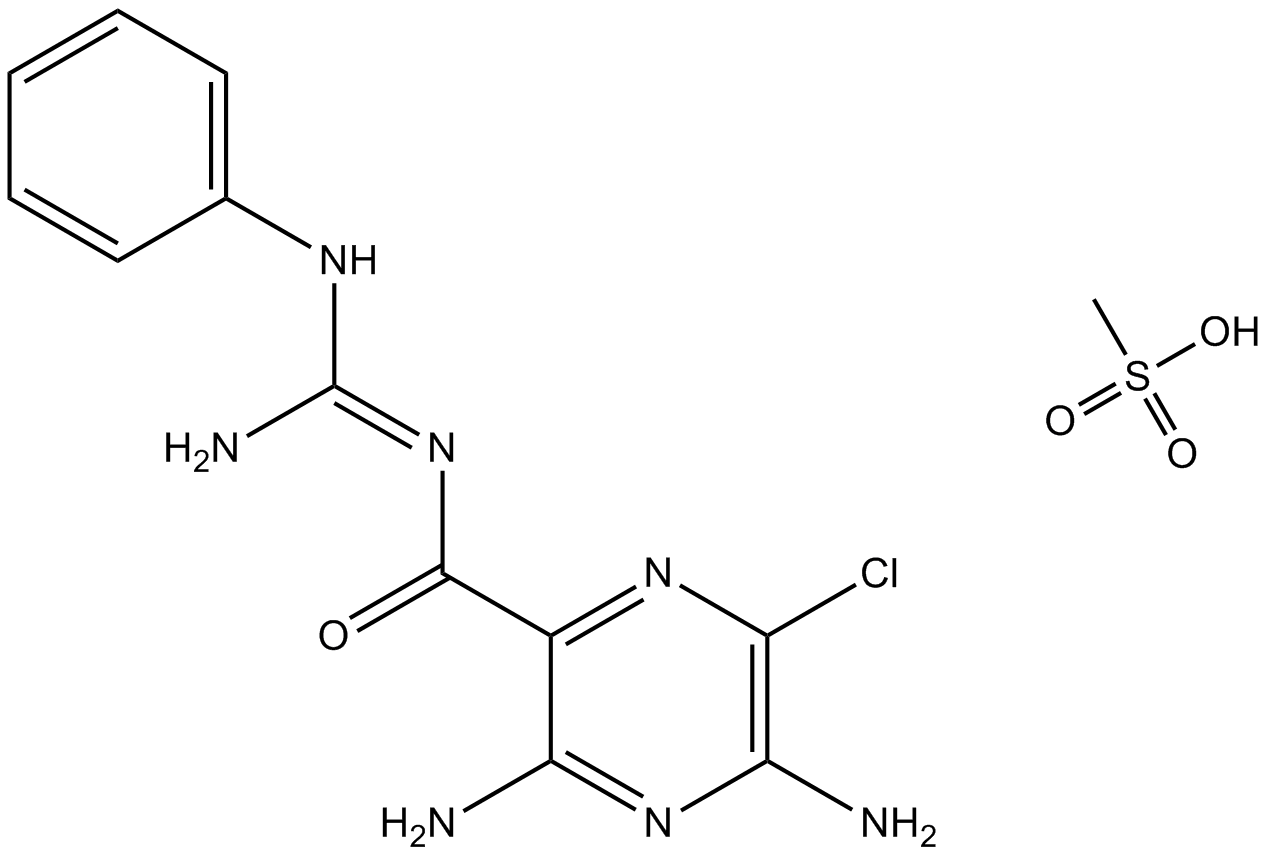
Cas No.: 1161-94-0
Sample solution is provided at 25 µL, 10mM.
Phenamilは、一過性受容体電位(TRP)および酸感受性イオンチャネル(ASIC)の選択的阻害剤である。Phenamilはアミロライド類似体であり、より強力で逆行しにくい上皮性ナトリウムチャネル(ENaC)ブロッカーであり、IC50は400 nMである。Phenamilは、Ca2+取り込みアッセイでTRPP3を介したCa2+輸送をIC50 140 nMで阻害した。
Phenamil(10 µM)は、M2-10B4(M2)マウス間葉系幹細胞(MSC)を6日間処理し、ALP、Runx2、OCN、およびosterixをコードする遺伝子の発現を著しく刺激した。Phenamilは、MSCおよび一次頭蓋骨器官培養において骨形成遺伝子の発現と石灰化を誘導する。Phenamil(10 µM)は、3T3-F442A前脂肪細胞株において24時間以内にPPARγの発現を誘導した。Phenamilは新しい脂肪形成促進化合物として作用する。
Phenamil(15または30 mg/kg; 21日間)は、慢性低酸素によって誘発される肺動脈高血圧症(PAH)を減少させた。低酸素治療中のPhenamilの注入は、肺血管リモデリングを抑制した。
References:
[1]. Chan M C, Weisman A S, Kang H, et al. The amiloride derivative phenamil attenuates pulmonary vascular remodeling by activating NFAT and the bone morphogenetic protein signaling pathway[J]. Molecular and cellular biology, 2011, 31(3): 517-530.
[2]. Hirsh A J, Molino B F, Zhang J, et al. Design, synthesis, and structure− activity relationships of novel 2-substituted pyrazinoylguanidine epithelial sodium channel blockers: drugs for cystic fibrosis and chronic bronchitis[J]. Journal of medicinal chemistry, 2006, 49(14): 4098-4115.
[3]. Dai X Q, Ramji A, Liu Y, et al. Inhibition of TRPP3 channel by amiloride and analogs[J]. Molecular pharmacology, 2007, 72(6): 1576-1585.
[4]. Park K W, Waki H, Kim W K, et al. The small molecule phenamil induces osteoblast differentiation and mineralization[J]. Molecular and cellular biology, 2009, 29(14): 3905-3914.
[5]. Park K W, Waki H, Choi S P, et al. The small molecule phenamil is a modulator of adipocyte differentiation and PPARγ expression [S][J]. Journal of lipid research, 2010, 51(9): 2775-2784.
[6]. Chan M C, Weisman A S, Kang H, et al. The amiloride derivative phenamil attenuates pulmonary vascular remodeling by activating NFAT and the bone morphogenetic protein signaling pathway[J]. Molecular and cellular biology, 2011, 31(3): 517-530.
| 細胞実験[1]: | |
細胞株 | 骨芽細胞様MC3T3-E1細胞 |
準備方法 | 細胞は通常の増殖培地、すなわち10%ウシ胎児血清 (FBS)、100 U/ml ペニシリン G、および 100 mg/ml ストレプトマイシンを添加した α 最小必須培地で維持した。培養培地は、10 µMフェナミルの有無にかかわらず、3~4日ごとに交換した。 |
反応条件 | 10µM、14日間 |
アプリケーション | フェナミル処理および未処理の対照細胞は、7日目から14 日目にかけて統計的に有意な細胞増殖の増加を示した。 |
| 動物実験 [2]: | |
動物モデル | 雄のSprague-Dawleyラット |
準備方法 | 生理食塩水-DMSO (50% 生理食塩水-50% DMSO) 溶液または生理食塩水-DMSO 中のフェナミルを送達する小型浸透圧注入ポンプを、雄のSprague-Dawleyラット(生後6~7週、体重250~300g)の肩甲骨の間に皮下埋め込み、左頸動脈に挿入したカテーテルを介して接続した。各条件で 4 匹のラットを使用した。フェナミル(15または30mg・kg・日)を1 ml/hの注入速度で21 日間連続投与した。ラットは、21日間、低圧低酸素状態(酸素濃度10.5%)または常酸素状態(室内空気)に置かれた。 |
投与形態 | 15または30 mg/kg、小型浸透圧注入ポンプ |
アプリケーション | フェナミルは、慢性低酸素症誘発性肺動脈性高血圧(PAH)を軽減する。 |
参考文献: [1] : Lo K W H, Ulery B D, Kan H M, et al. Evaluating the feasibility of utilizing the small molecule phenamil as a novel biofactor for bone regenerative engineering[J]. Journal of tissue engineering and regenerative medicine, 2014, 8(9): 728-736. [2] :Chan M C, Weisman A S, Kang H, et al. The amiloride derivative phenamil attenuates pulmonary vascular remodeling by activating NFAT and the bone morphogenetic protein signaling pathway[J]. Molecular and cellular biology, 2011, 31(3): 517-530. | |
| Cas No. | 1161-94-0 | SDF | |
| Chemical Name | (E)-3,5-diamino-N-(amino(phenylamino)methylene)-6-chloropyrazine-2-carboxamide methanesulfonate | ||
| Canonical SMILES | ClC(N=C1C(/N=C(N)/NC2=CC=CC=C2)=O)=C(N)N=C1N.OS(=O)(C)=O | ||
| Formula | C12H12ClN7O.CH3SO3H | M.Wt | 401.83 |
| 溶解度 | DMF: 0.1 mg/ml,DMSO: 1 mg/ml,DMSO:PBS (pH 7.2) (1:1): 0.5 mg/ml | Storage | Store at -20°C |
| General tips | Please select the appropriate solvent to prepare the stock solution according to the
solubility of the product in different solvents; once the solution is prepared, please store it in
separate packages to avoid product failure caused by repeated freezing and thawing.Storage method
and period of the stock solution: When stored at -80°C, please use it within 6 months; when stored
at -20°C, please use it within 1 month. To increase solubility, heat the tube to 37°C and then oscillate in an ultrasonic bath for some time. |
||
| Shipping Condition | Evaluation sample solution: shipped with blue ice. All other sizes available: with RT, or with Blue Ice upon request. | ||
| Prepare stock solution | |||

|
1 mg | 5 mg | 10 mg |
| 1 mM | 2.4886 mL | 12.4431 mL | 24.8861 mL |
| 5 mM | 497.7 μL | 2.4886 mL | 4.9772 mL |
| 10 mM | 248.9 μL | 1.2443 mL | 2.4886 mL |
Step 1: Enter information below (Recommended: An additional animal making an allowance for loss during the experiment)
 g
μL
g
μL
Step 2: Enter the in vivo formulation (This is only the calculator, not formulation. Please contact us first if there is no in vivo formulation at the solubility Section.)
Calculation results:
Working concentration: mg/ml;
Method for preparing DMSO master liquid: mg drug pre-dissolved in μL DMSO ( Master liquid concentration mg/mL, Please contact us first if the concentration exceeds the DMSO solubility of the batch of drug. )
Method for preparing in vivo formulation: Take μL DMSO master liquid, next addμL PEG300, mix and clarify, next addμL Tween 80, mix and clarify, next add μL saline, mix and clarify.
Method for preparing in vivo formulation: Take μL DMSO master liquid, next add μL Corn oil, mix and clarify.
Note: 1. Please make sure the liquid is clear before adding the next solvent.
2. Be sure to add the solvent(s) in order. You must ensure that the solution obtained, in the previous addition, is a clear solution before proceeding to add the next solvent. Physical methods such as vortex, ultrasound or hot water bath can be used to aid dissolving.
3. All of the above co-solvents are available for purchase on the GlpBio website.
Quality Control & SDS
- View current batch:
- Purity: >98.00% Appearance: A solid
- COA (Certificate of Analysis)
- SDS (Safety Data Sheet)
- Datasheet
Average Rating: 5 (Based on Reviews and 30 reference(s) in Google Scholar.)