

Polyoxyethylene stearate (POES) |
カタログ番号GC33151
 One-Click Copy Product Info
|

ポリオキシエチレン ステアレート (POES) (POES) は、非イオン性乳化剤です。
Products are for research use only. Not for human use. We do not sell to patients.
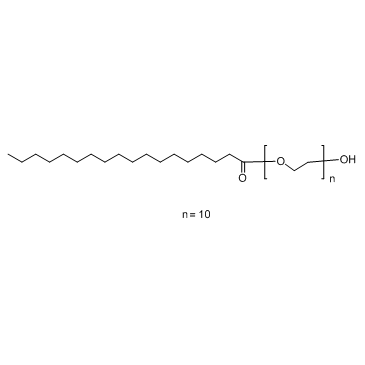
Cas No.: 9004-99-3
Sample solution is provided at 25 µL, 10mM.
_1-3.$$$39978408@51.jpg');)
_1-9.$$$38538795@65.jpg');)
_1-9.$$$39112701@51.jpg');)
_1-7.$$$37316672@70.jpg');)
_366-372.$$$36198801@70.jpg');)
.$$$38565142@65.jpg');)
_1867-1883.$$$33248023@67.jpg');)
_eads6055.$$$39977546@45.jpg');)
_eadm9805.$$$40080571@45.jpg');)
_eadj3020.$$$39666821@45.jpg');)
_1-20.$$$39757301@28.jpg');)
_1-24.$$$38898113@28.jpg');)
_273-287.$$$36806353@46.jpg');)
_1-16.$$$37156877@44.jpg');)
_1-19.$$$37460805@44.jpg');)
_1291-1307.$$$34518654@46.jpg');)
Polyoxyethylene stearate (POES) is a non-ionic emulsifying agent.
Polyoxyethylene stearate has been recommended as an additive to the radiolabelled 7H12 Middlebrook TB media and as such has been shown to enhance growth of mycobacteria in the radiometric BACTEC rapid culture system. Polyoxyethylene (50) stearate produces the greatest enhancement in growth and reduction in the time taken to detect growth for M. tuberculosis and polyoxyethylene (30) stearate and polyoxyethylene (JL) stearate for species of mycobacteria other than M. tuberculosis[1]. Polyoxyethylene stearate inhibits P-gp mediated efflux in a concentration dependent manner mainly by modulating substrate-stimulated P-gp ATPase activity[2]. Polyoxyethylene 40 stearate reduces vinblastine sulfate efllux. The cytotoxicity of vinblastine to K562/ADR cells is significantly enhanced when the cells are cotreated with 100 or 150 μg/mL polyoxyethylene 40 stearate[3].
Polyoxyethylene stearate is potentially useful as a pharmaceutical ingredient to improve the oral bioavailability of coadministered P-gp substrates and substrates for certain CYP isoforms[2]. The average tumor volume and average tumor weight are significantly less in the polyoxyethylene 40 stearate+vinblastine group. The inhibition rate for tumor growth is increased from 0.06 (vinblastine group) to 0.84 (vinblastine+polyoxyethylene 40 stearate group)[3].
[1]. Cutler RR, et al. The effect of polyoxyethylene stearate (POES) on the growth of mycobacteria in radiometric 7H12 Middlebrook TB medium. Tubercle. 1987 Sep;68(3):209-20. [2]. Zhu S, et al. Effects of polyoxyethylene (40) stearate on the activity of P-glycoprotein and cytochrome P450. Eur J Pharm Sci. 2009 Jul 12;37(5):573-80. [3]. Luo L, et al. Polyoxyethylene 40 stearate modulates multidrug resistance and enhances antitumor activity of vinblastine sulfate. AAPS J. 2007 Oct 5;9(3):E329-35.
Cell experiment: | Polyoxyethylene 40 stearate is added to the test vinblastine solution. The cytotoxicity of vinblastine to K562/ADR cells is then assessed. The final concentrations of polyoxyethylene 40 stearate are 0, 50, 100, and 150 μg/mL. After 8 hours of treatment, cells are incubated for 4 hours in the presence of MTT reagent and then lysed with DMSO. Absorbance is measured at 490 nM[3]. |
Animal experiment: | Mice: Polyoxyethylene 40 stearate and vinblastine are dissolved in 0.9% sodium chloride solution, yielding a solution of 200 μg/mL VBL and 150 μg/mL PS40. The drug is injected subcutaneously in a volume of 0.1 mL per 10 g of body weight at a dosage of 2 mg/kg vinblastine and 1.5 mg/kg polyoxyethylene 40 stearate around the tumor every other day for 8 days. The volume of tumors and the weight of mice are measured every day from the day the tumors are formed[3]. |
References: [1]. Cutler RR, et al. The effect of polyoxyethylene stearate (POES) on the growth of mycobacteria in radiometric 7H12 Middlebrook TB medium. Tubercle. 1987 Sep;68(3):209-20. | |
| Cas No. | 9004-99-3 | SDF | |
| Canonical SMILES | O=C(OCCO)CCCCCCCCCCCCCCCCC.[n].[n].[=].[10] | ||
| Formula | C20H40O3 | M.Wt | 328.53 |
| 溶解度 | DMSO : ≥ 49 mg/mL (149.15 mM) | Storage | Store at -20°C |
| General tips | Please select the appropriate solvent to prepare the stock solution according to the
solubility of the product in different solvents; once the solution is prepared, please store it in
separate packages to avoid product failure caused by repeated freezing and thawing.Storage method
and period of the stock solution: When stored at -80°C, please use it within 6 months; when stored
at -20°C, please use it within 1 month. To increase solubility, heat the tube to 37°C and then oscillate in an ultrasonic bath for some time. |
||
| Shipping Condition | Evaluation sample solution: shipped with blue ice. All other sizes available: with RT, or with Blue Ice upon request. | ||
| Prepare stock solution | |||

|
1 mg | 5 mg | 10 mg |
| 1 mM | 3.0439 mL | 15.2193 mL | 30.4386 mL |
| 5 mM | 608.8 μL | 3.0439 mL | 6.0877 mL |
| 10 mM | 304.4 μL | 1.5219 mL | 3.0439 mL |
Step 1: Enter information below (Recommended: An additional animal making an allowance for loss during the experiment)
 g
μL
g
μL
Step 2: Enter the in vivo formulation (This is only the calculator, not formulation. Please contact us first if there is no in vivo formulation at the solubility Section.)
Calculation results:
Working concentration: mg/ml;
Method for preparing DMSO master liquid: mg drug pre-dissolved in μL DMSO ( Master liquid concentration mg/mL, Please contact us first if the concentration exceeds the DMSO solubility of the batch of drug. )
Method for preparing in vivo formulation: Take μL DMSO master liquid, next addμL PEG300, mix and clarify, next addμL Tween 80, mix and clarify, next add μL saline, mix and clarify.
Method for preparing in vivo formulation: Take μL DMSO master liquid, next add μL Corn oil, mix and clarify.
Note: 1. Please make sure the liquid is clear before adding the next solvent.
2. Be sure to add the solvent(s) in order. You must ensure that the solution obtained, in the previous addition, is a clear solution before proceeding to add the next solvent. Physical methods such as vortex, ultrasound or hot water bath can be used to aid dissolving.
3. All of the above co-solvents are available for purchase on the GlpBio website.
Quality Control & SDS
- View current batch:
- Purity: >98.00% Appearance: A solid
- COA (Certificate of Analysis)
- SDS (Safety Data Sheet)
- Datasheet
Average Rating: 5 (Based on Reviews and 38 reference(s) in Google Scholar.)