

Sophoflavescenol |
カタログ番号GC33067
 One-Click Copy Product Info
|

Sophoflavescenol はプレニル化フラボノールであり、ホスホジエステラーゼ 5 (PDE5) に対して 0.013 μM の IC50 で優れた阻害活性を示し、0.30 μM、0.17 μM、17.89 μg/mL の IC50 で RLAR、HRAR、AGE、BACE1、AChE、および BChE も阻害します。 、それぞれ 10.98 μM、8.37 μM、8.21 μM。
Products are for research use only. Not for human use. We do not sell to patients.
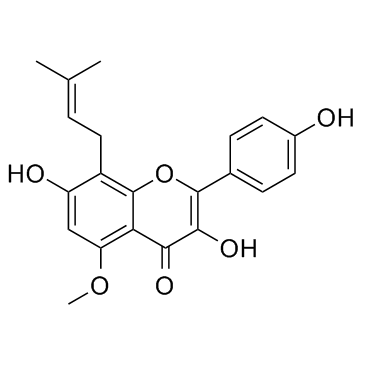
Cas No.: 216450-65-6
Sample solution is provided at 25 µL, 10mM.
_1-3.$$$39978408@51.jpg');)
_1-9.$$$38538795@65.jpg');)
_1-9.$$$39112701@51.jpg');)
_1-7.$$$37316672@70.jpg');)
_366-372.$$$36198801@70.jpg');)
.$$$38565142@65.jpg');)
_1867-1883.$$$33248023@67.jpg');)
_eads6055.$$$39977546@45.jpg');)
_eadm9805.$$$40080571@45.jpg');)
_eadj3020.$$$39666821@45.jpg');)
_1-20.$$$39757301@28.jpg');)
_1-24.$$$38898113@28.jpg');)
_273-287.$$$36806353@46.jpg');)
_1-16.$$$37156877@44.jpg');)
_1-19.$$$37460805@44.jpg');)
_1291-1307.$$$34518654@46.jpg');)
Sophoflavescenol is a prenylated flavonol, which shows great inhibitory activity with IC50 of 0.013 μM against Phosphodiesterase 5 (PDE5), and also inhibits RLAR, HRAR, AGE, BACE1, AChE and BChE with IC50s of 0.30 µM, 0.17 µM, 17.89 µg/mL, 10.98 µM, 8.37 µM and 8.21 µM, respectively.
Sophoflavescenol shows cytotoxicity against human leukaemia (HL-60), Lewis lung carcinoma (LLC), and human lung adenocarcinoma epithelial (A549) cells. Sophoflavescenol exerts notable anti-inflammatory activity by inhibiting nitric oxide generation and tert-butylhydroperoxide-induced ROS generation rather than inhibiting nuclear factor kappa B activation in RAW 264.7 cells[1]. Sophoflavescenol exhibits remarkable inhibition of RLAR activity with an IC50 value of 0.30 µM, compared with 0.07 µM for epalrestat, a well known ARI. Sophoflavescenol also shows potent inhibitory activity with an IC50 value of 0.17 µM, comparable to epalrestat (0.15 µM) in the HRAR assay. In the AGE assay, sophoflavescenol (IC50 17.89 µg/mL) is a more potent inhibitor of AGE formation than aminoguanidine (IC50 81.05 µg/mL). Sophoflavescenol exerts both potent AChE and BChE inhibitory effects with respective IC50 values of 8.37 and 8.21 µM. Sophoflavescenol also exhibits good BACE1 inhibition in a dose-dependent manner with an IC50 value of 10.98 µM[2]. Sophoflavescenol is a mixed inhibitor (Ki=0.005 μM) against cGMP PDE5. Sophoflavescenol shows greatest selectivity toward PDE5, 31.5- and 196.2-fold over PDE3 and PDE4, respectively[3].
Sophoflavescenol exerts potent in vivo antitumor activity by tumor growth inhibition in the LLC tumor model as well as apoptotic activity by caspase-3 activation in HL-60 cells[1].
[1]. Jung HA, et al. Anti-tumorigenic activity of sophoflavescenol against Lewis lung carcinoma in vitro and in vivo. Arch Pharm Res. 2011 Dec;34(12):2087-99. [2]. Jung HA, et al. Antidiabetic complications and anti-Alzheimer activities of sophoflavescenol, a prenylated flavonol from Sophora flavescens, and its structure-activity relationship. Phytother Res. 2011 May;25(5):709-15. [3]. Shin HJ, et al. A prenylated flavonol, sophoflavescenol: a potent and selective inhibitor of cGMP phosphodiesterase 5. Bioorg Med Chem Lett. 2002 Sep 2;12(17):2313-6.
Kinase experiment: | Briefly, a mixture of 10 µL of assay buffer (50 mm sodium acetate, pH 4.5), 10 µL of BACE1 (1.0 U/mL), 10 µL of the substrate (750 nm Rh-EVNLDAEFK-Quencher in 50 mm, ammonium bicarbonate) and 10 µL of the tested samples [final concentration (f.c.) 100 µM for compounds] dissolved in 10% DMSO is incubated for 60 min at 25°C in the dark. The proteolysis of two fluorophores (Rh-EVNLDAEFK-Quencher) by BACE1 is monitored by formation of the fluorescent donor (Rh-EVNL) that increased in fluorescence wavelengths at 530-545 nm (excitation) and 570-590 nm (emission), respectively. Fluorescence is measured with a microplate spectrofluorometer. The mixture is irradiated at 545 nm and the emission intensity recorded at 585 nm. The percent inhibition (%) is obtained by the following equation: % Inhibition=[1 − (S60 − S0)/(C60 − C0)] × 100, where C60 is the fluorescence of the control (enzyme, buffer, substrate) after 60 min of incubation, C0 the initial fluorescence of the control, S60 the fluorescence of the tested samples (enzyme, sample solution, substrate) after 60 min of incubation, and S0 the initial fluorescence of the tested samples. To allow for the quenching effect of the samples, the sample solution is added to reaction mixture C, and any reduction in fluorescence by the sample is then investigated. The BACE1 inhibitory activity of each sample is expressed in terms of the IC50 value (µM required to inhibit proteolysis of the BACE1 substrate, by 50%), as calculated from the log-dose inhibition curve. |
References: [1]. Jung HA, et al. Anti-tumorigenic activity of sophoflavescenol against Lewis lung carcinoma in vitro and in vivo. Arch Pharm Res. 2011 Dec;34(12):2087-99 | |
| Cas No. | 216450-65-6 | SDF | |
| Canonical SMILES | O=C1C(O)=C(C2=CC=C(O)C=C2)OC3=C(C/C=C(C)\C)C(O)=CC(OC)=C13 | ||
| Formula | C21H20O6 | M.Wt | 368.38 |
| 溶解度 | Soluble in DMSO | Storage | 4°C, away from moisture and light |
| General tips | Please select the appropriate solvent to prepare the stock solution according to the
solubility of the product in different solvents; once the solution is prepared, please store it in
separate packages to avoid product failure caused by repeated freezing and thawing.Storage method
and period of the stock solution: When stored at -80°C, please use it within 6 months; when stored
at -20°C, please use it within 1 month. To increase solubility, heat the tube to 37°C and then oscillate in an ultrasonic bath for some time. |
||
| Shipping Condition | Evaluation sample solution: shipped with blue ice. All other sizes available: with RT, or with Blue Ice upon request. | ||
| Prepare stock solution | |||

|
1 mg | 5 mg | 10 mg |
| 1 mM | 2.7146 mL | 13.5729 mL | 27.1459 mL |
| 5 mM | 542.9 μL | 2.7146 mL | 5.4292 mL |
| 10 mM | 271.5 μL | 1.3573 mL | 2.7146 mL |
Step 1: Enter information below (Recommended: An additional animal making an allowance for loss during the experiment)
 g
μL
g
μL
Step 2: Enter the in vivo formulation (This is only the calculator, not formulation. Please contact us first if there is no in vivo formulation at the solubility Section.)
Calculation results:
Working concentration: mg/ml;
Method for preparing DMSO master liquid: mg drug pre-dissolved in μL DMSO ( Master liquid concentration mg/mL, Please contact us first if the concentration exceeds the DMSO solubility of the batch of drug. )
Method for preparing in vivo formulation: Take μL DMSO master liquid, next addμL PEG300, mix and clarify, next addμL Tween 80, mix and clarify, next add μL saline, mix and clarify.
Method for preparing in vivo formulation: Take μL DMSO master liquid, next add μL Corn oil, mix and clarify.
Note: 1. Please make sure the liquid is clear before adding the next solvent.
2. Be sure to add the solvent(s) in order. You must ensure that the solution obtained, in the previous addition, is a clear solution before proceeding to add the next solvent. Physical methods such as vortex, ultrasound or hot water bath can be used to aid dissolving.
3. All of the above co-solvents are available for purchase on the GlpBio website.
Quality Control & SDS
- View current batch:
- Purity: >98.00% Appearance: A solid
- COA (Certificate of Analysis)
- SDS (Safety Data Sheet)
- Datasheet
Average Rating: 5 (Based on Reviews and 23 reference(s) in Google Scholar.)