
>>Signaling Pathways>> Others>> Synthases/Synthetases>>AT 56

AT 56

Catalog No.GC11950

AT 56은 95μM의 IC50 및 75μM의 Ki를 갖는 리포칼린형 프로스타글란딘 D 합성효소(L-PGDS)의 강력하고 선택적인 경구 활성 억제제입니다.

Products are for research use only. Not for human use. We do not sell to patients.
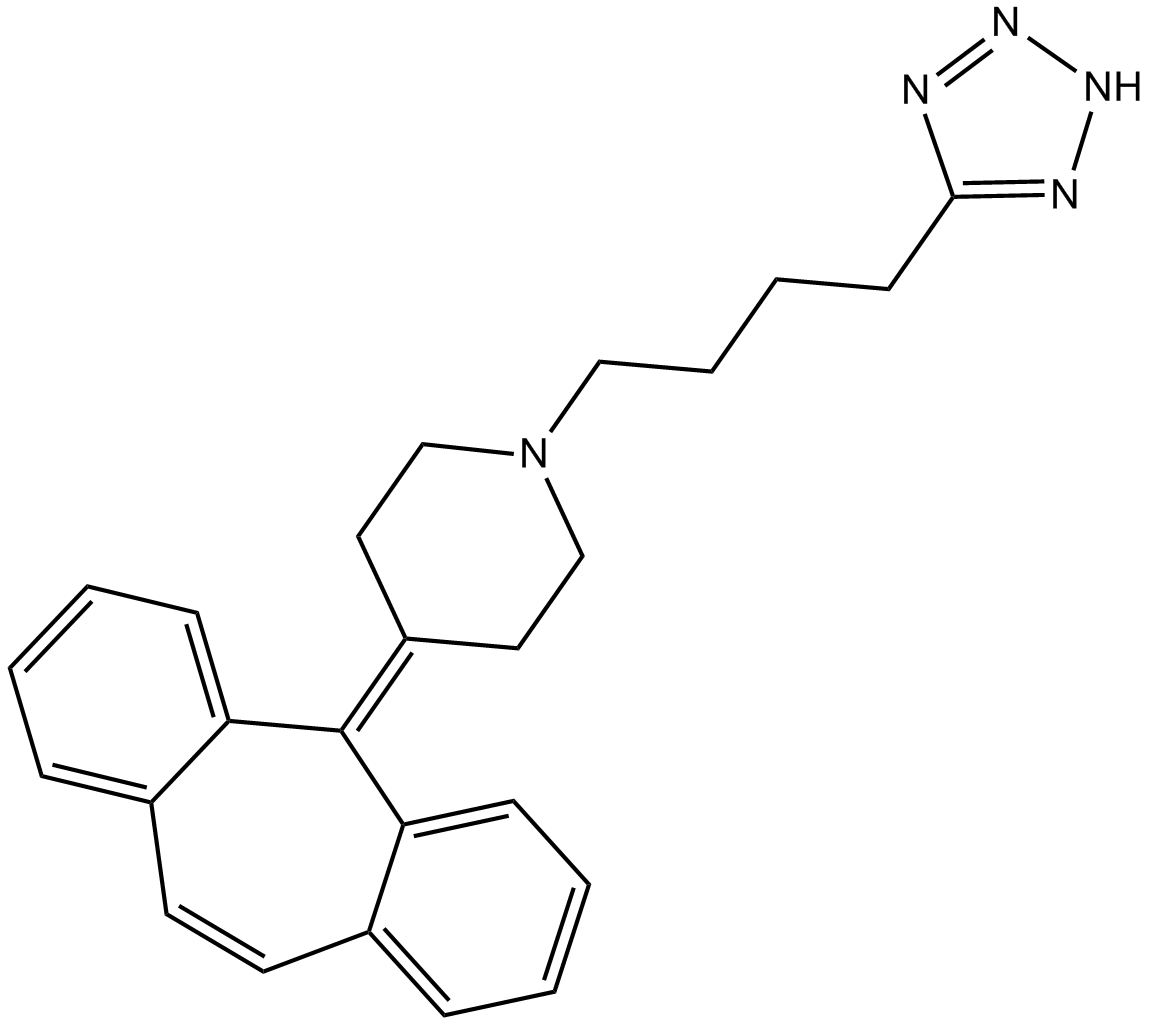
AT 56 Chemical Structure

Cas No.: 162640-98-4

Size 가격 재고 수량
10mM (in 1mL DMSO)
US$73.00
재고 있음
1mg
US$27.00
재고 있음
5mg
US$67.00
재고 있음
10mg
US$112.00
재고 있음
25mg
US$223.00
재고 있음
50mg
US$326.00
재고 있음

Tel:(909) 407-4943 Email: sales@glpbio.com


고객 리뷰

Based on customer reviews.

Sample solution is provided at 25 µL, 10mM.

Description of AT 56

AT 56 is an orally active and selective inhibitor of lipocalin-type prostaglandin D synthase (L-PGDS), with an IC50 value of 95µM[1]. AT 56 can inhibit leptin production and PGD2 production and affect cell proliferation[2]. AT 56 has been widely used to regulate the endothelial-to-mesenchymal transition (EndMT) process in cancer cell models[3].

In vitro, AT 56 treatment (100µM) for 48h inhibited cell proliferation and c-myc expression in diffuse large B-cell lymphoma (DLBCL) cells[4]. Treatment with 5µM AT 56 for 7 days significantly inhibited the development of wild-type oligodendrocytes without affecting cell survival[5]. Treatment with 5µM AT 56 for 10min inhibited PGD2 production in TE671 cells cultured under serum starvation conditions[6].

In vivo, AT 56 treatment via oral administration at a dose of 30mg/kg/day for 4 weeks reduced the ethanol-induced increase in vascular branching in the cerebral cortex of C57BL/6J mice and decreased L-PGDS expression[7]. Intraperitoneal injection of AT 56 (10mg/kg/day) for 7 days partially rescued the reproductive dysfunction of Clpxfl/fl; Zp3-Cre mice by inhibiting PGD2 synthesis[8].

References:
[1] Irikura D, Aritake K, Nagata N, et al. Biochemical, functional, and pharmacological characterization of AT-56, an orally active and selective inhibitor of lipocalin-type prostaglandin D synthase[J]. Journal of Biological Chemistry, 2009, 284(12): 7623-7630.
[2] Urade Y. Biochemical and structural characteristics, gene regulation, physiological, pathological and clinical features of lipocalin-type prostaglandin D2 synthase as a multifunctional lipocalin[J]. Frontiers in Physiology, 2021, 12: 718002.
[3] Omori K, Morikawa T, Kunita A, et al. Lipocalin-type prostaglandin D synthase‐derived PGD2 attenuates malignant properties of tumor endothelial cells[J]. The Journal of pathology, 2018, 244(1): 84-96.
[4] Hu S, Ren S, Cai Y, et al. Glycoprotein PTGDS promotes tumorigenesis of diffuse large B-cell lymphoma by MYH9-mediated regulation of Wnt–β-catenin–STAT3 signaling[J]. Cell Death & Differentiation, 2022, 29(3): 642-656.
[5] Pan L, Trimarco A, Zhang A J, et al. Oligodendrocyte-lineage cell exocytosis and L-type prostaglandin D synthase promote oligodendrocyte development and myelination[J]. Elife, 2023, 12: e77441.
[6] Fujimori K, Aritake K, Urade Y. Enhancement of prostaglandin D2 production through cyclooxygenase-2 and lipocalin-type prostaglandin D synthase by upstream stimulatory factor 1 in human brain-derived TE671 cells under serum starvation[J]. Gene, 2008, 426(1-2): 72-80.
[7] Li J, Li C, Subedi U, et al. The Role of Endothelial L-PGDS in the Pro-Angiogenic and Anti-Inflammatory Effects of Low-Dose Alcohol Consumption[J]. Cells, 2024, 13(23): 2007.
[8] Hua R, Hai Z, Gu J, et al. AT-56 RESCUES OOCYTE DYSFUNCTION IN OOCYTE-SPECIFIC KNOCKOUT CLPX MICE BY INHIBITING PGD2 SYNTHESIS[J]. Fertility and Sterility, 2024, 122(4): e171.

Protocol of AT 56

Cell experiment [1]:

Cell lines

TE-671 cells

Preparation Method

TE-671 cells (1×10⁶ cells/well) were seeded in multi-well plates. Cultures were grown in Dulbecco's modified Eagle medium (DMEM) containing 10% heat-inactivated fetal bovine serum, 4mM glutamine, 4.5g/l glucose, 100U/ml penicillin, and 100μg/ml streptomycin sulfate at 37°C at 5% CO2. After 1 day of cell culture, AT 56 was added at various doses (0, 3, 10, 30, and 100μM), and the cells were then incubated at 37°C for 10min. The amount of PGD2 released from TE-671 cells was measured by enzyme-linked immunosorbent assay.

Reaction Conditions

0, 3, 10, 30, and 100μM; 10min

Applications

AT 56 treatment reduced the the production of PGD2 in a dose-dependent manner within TE-671 cells.
Animal experiment [2]:

Animal models

C57BL/6J mice

Preparation Method

Sixty-two male C57BL/6J mice (3 months old) (25-30g) were randomly divided into 2 groups and fed with 0.7g/kg ethanol (experimental group) or an equal volume of water (control group) daily for 8 weeks. Mice in the control and experimental groups were orally administered AT 56 (30mg/kg/day) for 4 weeks starting from week 5. At the end of the 8-week feeding period, mice were euthanized to measure cerebral vessel density and L-PGDS expression under physiological conditions.

Dosage form

30mg/kg/day for 4 weeks; p.o.

Applications

AT 56 treatment significantly reduced the alcohol-induced increase in vascular branching within the cerebral cortex and subcortical regions of mice, and decreased L-PGDS expression.

References:
[1] Irikura D, Aritake K, Nagata N, et al. Biochemical, functional, and pharmacological characterization of AT-56, an orally active and selective inhibitor of lipocalin-type prostaglandin D synthase[J]. Journal of Biological Chemistry, 2009, 284(12): 7623-7630.
[2] Li J, Li C, Subedi U, et al. The Role of Endothelial L-PGDS in the Pro-Angiogenic and Anti-Inflammatory Effects of Low-Dose Alcohol Consumption[J]. Cells, 2024, 13(23): 2007.

Chemical Properties of AT 56

Cas No. 162640-98-4 SDF
Chemical Name 1-(4-(2H-tetrazol-5-yl)butyl)-4-(5H-dibenzo[a,d][7]annulen-5-ylidene)piperidine
Canonical SMILES N(CC/1)(CCCCC2=NNN=N2)CCC1=C3C4=CC=CC=C4C=CC5=CC=CC=C\35
Formula C25H27N5 M.Wt 397.52
Solubility DMF: 30 mg/ml,DMSO: 30 mg/ml,Ethanol: 30 mg/ml,Ethanol:PBS(pH 7.2) (1:1): 0.5 mg/ml Storage Store at -20°C
General tips Please select the appropriate solvent to prepare the stock solution according to the solubility of the product in different solvents; once the solution is prepared, please store it in separate packages to avoid product failure caused by repeated freezing and thawing.Storage method and period of the stock solution: When stored at -80°C, please use it within 6 months; when stored at -20°C, please use it within 1 month.
To increase solubility, heat the tube to 37°C and then oscillate in an ultrasonic bath for some time.
Shipping Condition Evaluation sample solution: shipped with blue ice. All other sizes available: with RT, or with Blue Ice upon request.

Complete Stock Solution Preparation Table of AT 56

Prepare stock solution
1 mg 5 mg 10 mg
1 mM 2.5156 mL 12.578 mL 25.156 mL
5 mM 503.1 μL 2.5156 mL 5.0312 mL
10 mM 251.6 μL 1.2578 mL 2.5156 mL
  • Molarity Calculator

  • Dilution Calculator

  • Molecular Weight Calculator

Mass
=
Concentration
x
Volume
x
MW*


**When preparing stock solutions always use the batch-specific molecular weight of the product found on the vial label and MSDS / CoA (available online).

Calculate

In vivo Formulation Calculator (Clear solution) of AT 56

Step 1: Enter information below (Recommended: An additional animal making an allowance for loss during the experiment)

mg/kg g μL

Step 2: Enter the in vivo formulation (This is only the calculator, not formulation. Please contact us first if there is no in vivo formulation at the solubility Section.)

% DMSO % % Tween 80 % ddH2O
%DMSO %

Calculation results:

Working concentration: mg/ml;

Method for preparing DMSO master liquid: mg drug pre-dissolved in μL DMSO ( Master liquid concentration mg/mL, Please contact us first if the concentration exceeds the DMSO solubility of the batch of drug. )

Method for preparing in vivo formulation: Take μL DMSO master liquid, next addμL PEG300, mix and clarify, next addμL Tween 80, mix and clarify, next add μL ddH2O, mix and clarify.

Method for preparing in vivo formulation: Take μL DMSO master liquid, next add μL Corn oil, mix and clarify.

Note: 1. Please make sure the liquid is clear before adding the next solvent.
2. Be sure to add the solvent(s) in order. You must ensure that the solution obtained, in the previous addition, is a clear solution before proceeding to add the next solvent. Physical methods such as vortex, ultrasound or hot water bath can be used to aid dissolving.
3. All of the above co-solvents are available for purchase on the GlpBio website.

Product Documents

Quality Control & SDS

View current batch:

리뷰

Review for AT 56

Average Rating: 5 ★★★★★ (Based on Reviews and 19 reference(s) in Google Scholar.)

5 Star
100%
4 Star
0%
3 Star
0%
2 Star
0%
1 Star
0%
Review for AT 56

GLPBIO products are for RESEARCH USE ONLY. Please make sure your review or question is research based.

Required fields are marked with *

You may receive emails regarding this submission. Any emails will include the ability to opt-out of future communications.
