

Boceprevir (Synonyms: Victrelis) |
Catalog No.GC10959
 One-Click Copy Product Info
|

An NS3/4A protease inhibitor
Products are for research use only. Not for human use. We do not sell to patients.
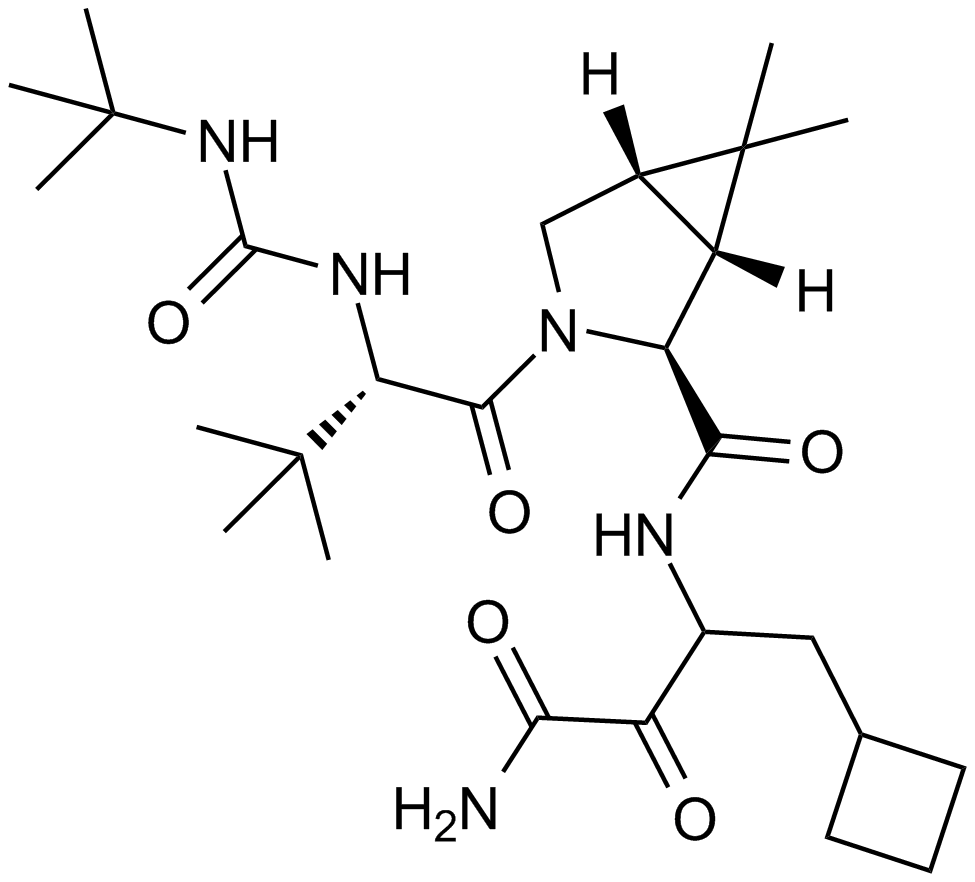
Cas No.: 394730-60-0
Sample solution is provided at 25 µL, 10mM.
_1-3.$$$39978408@51.jpg');)
_1-9.$$$38538795@65.jpg');)
_1-9.$$$39112701@51.jpg');)
_1-7.$$$37316672@70.jpg');)
_366-372.$$$36198801@70.jpg');)
.$$$38565142@65.jpg');)
_1867-1883.$$$33248023@67.jpg');)
_eads6055.$$$39977546@45.jpg');)
_eadm9805.$$$40080571@45.jpg');)
_eadj3020.$$$39666821@45.jpg');)
_1-20.$$$39757301@28.jpg');)
_1-24.$$$38898113@28.jpg');)
_273-287.$$$36806353@46.jpg');)
_1-16.$$$37156877@44.jpg');)
_1-19.$$$37460805@44.jpg');)
_1291-1307.$$$34518654@46.jpg');)
Boceprevir is a potent and selective inhibitor of hepatitis C virus (HCV) protease NS3 with Ki value of 14 nM [1].
HCV is a type of RNA virus and infects about 300 million people worldwide. As a serine protease of HCV, NS3 plays an important role in the replication process of HCV when the virus enters the host cell. NS3 processes the polyprotein translated from the virus RNA genome and promotes the maturation of the virus. NS3 is also found to restore the interferon-sensitive signaling pathway. Due to these features, NS3 is thought to be the appropriate target for the therapy of antivirus. The SAR studies led to the discovery of boceprevir (also named as SCH 503034). Boceprevir has a ketoamide group, it binds NS3 and forms a covalent and reversible adduct with the active site serine [1, 2 and 3].
In the cell-based replicon assay using hepatocytes, boceprevir showed improved potency than other derivatives with IC90 value of 350 nM. The selectivity of boceprevir was tested by binding to human neutrophil elastase which had similar structure with NS3. Boceprevir exerted a great selectivity with a HNE/HCV ratio of 2200. It is approximately 15-fold more selective than the corresponding carbamate derivative. In MTS assay, the compound showed no significant cytotoxicity even when its concentration was up to 50 μM [1].
Boceprevir is an orally bioavailable inhibitor of HCV NS3 protease. In rats, oral administration of boceprevir showed AUC value of 1.5 μM•H and bioavailability of 26%. In dogs, boceprevir demonstrated a 30% bioavailability with AUC value of 3.1μM•H at a dose of 3 mg/kg. Boceprevir was also used as a combination therapy with the pegylated interferon (PEG-IFN-α-2B). It was found that the combination showed at least addictive potency compared with each one alone [1, 2].
References:
1.Venkatraman S, Bogen S L, Arasappan A, et al. Discovery of (1 R, 5 S)-N-[3-Amino-1-(cyclobutylmethyl)-2, 3-dioxopropyl]-3-[2 (S)-[[[(1, 1-dimethylethyl) amino] carbonyl] amino]-3, 3-dimethyl-1-oxobutyl]-6, 6-dimethyl-3-azabicyclo [3.1. 0] hexan-2 (S)-carboxamide (SCH 503034), a Selective, Potent, Orally Bioavailable Hepatitis C Virus NS3 Protease Inhibitor: A Potential Therapeutic Agent for the Treatment of Hepatitis C Infection. Journal of medicinal chemistry, 2006, 49(20): 6074-6086.
2.Sarrazin C, Rouzier R, Wagner F, et al. SCH 503034, a novel hepatitis C virus protease inhibitor, plus pegylated interferon α-2b for genotype 1 nonresponders. Gastroenterology, 2007, 132(4): 1270-1278.
3.Flores M V, Strawbridge J, Ciaramella G, et al. HCV-NS3 inhibitors: determination of their kinetic parameters and mechanism. Biochimica et Biophysica Acta (BBA)-Proteins and Proteomics, 2009, 1794(10): 1441-1448.
|
Animal experiment: |
Mice[2] Boceprevir is purchased from MedChem Express. To evaluate the effect of Boceprevir, triple-transgenic mice are induced with Doxycycline (Dox) for 10 days (n=5 per group). On the third day after Dox induction, when plasma Gluc activity reaches its peak, the mice are administered either Boceprevir (100 mg/kg) or DMSO via oral gavage twice daily for 7 days. During this period, blood is collected from the caudal vein daily to detect plasma Gluc activity. |
|
References: [1]. Njoroge FG, et al. Challenges in modern drug discovery: a case study of boceprevir, an HCV protease inhibitor for the treatment of hepatitis C virus infection. Acc Chem Res. 2008 Jan;41(1):50-9. |
|
| Cas No. | 394730-60-0 | SDF | |
| Synonyms | Victrelis | ||
| Chemical Name | (1R,2S,5S)-N-(4-amino-1-cyclobutyl-3,4-dioxobutan-2-yl)-3-[(2S)-2-(tert-butylcarbamoylamino)-3,3-dimethylbutanoyl]-6,6-dimethyl-3-azabicyclo[3.1.0]hexane-2-carboxamide | ||
| Canonical SMILES | CC1(C2C1C(N(C2)C(=O)C(C(C)(C)C)NC(=O)NC(C)(C)C)C(=O)NC(CC3CCC3)C(=O)C(=O)N)C | ||
| Formula | C27H45N5O5 | M.Wt | 519.68 |
| Solubility | ≥ 25.98 mg/mL in DMSO, ≥ 89.8 mg/mL in EtOH | Storage | Store at -20°C, protect from light, stored under nitrogen |
| General tips | Please select the appropriate solvent to prepare the stock solution according to the
solubility of the product in different solvents; once the solution is prepared, please store it in
separate packages to avoid product failure caused by repeated freezing and thawing.Storage method
and period of the stock solution: When stored at -80°C, please use it within 6 months; when stored
at -20°C, please use it within 1 month. To increase solubility, heat the tube to 37°C and then oscillate in an ultrasonic bath for some time. |
||
| Shipping Condition | Evaluation sample solution: shipped with blue ice. All other sizes available: with RT, or with Blue Ice upon request. | ||
| Prepare stock solution | |||

|
1 mg | 5 mg | 10 mg |
| 1 mM | 1.9243 mL | 9.6213 mL | 19.2426 mL |
| 5 mM | 384.9 μL | 1.9243 mL | 3.8485 mL |
| 10 mM | 192.4 μL | 962.1 μL | 1.9243 mL |
Step 1: Enter information below (Recommended: An additional animal making an allowance for loss during the experiment)
 g
μL
g
μL
Step 2: Enter the in vivo formulation (This is only the calculator, not formulation. Please contact us first if there is no in vivo formulation at the solubility Section.)
Calculation results:
Working concentration: mg/ml;
Method for preparing DMSO master liquid: mg drug pre-dissolved in μL DMSO ( Master liquid concentration mg/mL, Please contact us first if the concentration exceeds the DMSO solubility of the batch of drug. )
Method for preparing in vivo formulation: Take μL DMSO master liquid, next addμL PEG300, mix and clarify, next addμL Tween 80, mix and clarify, next add μL saline, mix and clarify.
Method for preparing in vivo formulation: Take μL DMSO master liquid, next add μL Corn oil, mix and clarify.
Note: 1. Please make sure the liquid is clear before adding the next solvent.
2. Be sure to add the solvent(s) in order. You must ensure that the solution obtained, in the previous addition, is a clear solution before proceeding to add the next solvent. Physical methods such as vortex, ultrasound or hot water bath can be used to aid dissolving.
3. All of the above co-solvents are available for purchase on the GlpBio website.
Quality Control & SDS
- View current batch:
- Purity: >98.00% Appearance: A solid
- COA (Certificate of Analysis)
- SDS (Safety Data Sheet)
- Datasheet
Average Rating: 5 (Based on Reviews and 30 reference(s) in Google Scholar.)